
MCAT Biochemistry · Lesson 2
Enzymes
6 min read5 sectionsUpdated
5 sections
2.1 Enzyme as Biological Catalysts
Enzymes speed reactions by lowering activation energy without changing overall thermodynamics, and they’re grouped into major functional classes.
- Enzymes are biological catalysts → help reactions proceed faster
- Lower activation energy → increase rate
- Make reactions more KINETICALLY favorable
- Not changed/consumed
- Don’t alter equilibrium constant
- Don’t change
- pH and temperature sensitive
- Usually specific (specific reactions/substrates)
- Urease only breaks down urea
- Chymotrypsin catalyzes peptide bonds between AAs with aromatic rings
- Enzymes bind substrates at the transition state
Oxidoreductases
- Catalyze redox reactions (transfer of e⁻)
- Often use cofactors like NAD⁺ or NADP⁺
- Electron donor = reductant
- Electron acceptor = oxidant
- Oxidase: oxygen is final electron acceptor
- Dehydrogenases and reductases are oxidoreductases
Transferases
- Transfer functional groups
- Aminotransferases convert aspartate + α-ketoglutarate → glutamate + OAA
- Kinases are transferases
Hydrolases
- Break compounds using addition of water
- Phosphatase cleaves phosphate group
- Peptidase, nuclease, lipase all break down stuff
Lyases
- Cleave one molecule into 2 products
- Can catalyze reverse reaction (synthesis of 2)
- Then called synthases
- Often form cyclic compounds or double bonds
- Example: ATP → cAMP
Isomerases
- Rearrangement of bonds within a molecule
- Convert between stereoisomers and constitutional isomers
Ligases
- Addition/synthesis reactions
- Often require ATP
- Nucleic acid synthesis and repair
Impact on activation energy
- Endergonic reaction requires energy:
- Exergonic reaction releases energy:
- Enzymes increase rate at which equilibrium is reached
- Lower activation energy
- Reverse is energetically very unfavorable
2.2 Mechanisms of Enzyme Activity
Describes how enzymes bind substrates (lock-and-key vs induced fit) and the role of cofactors/coenzymes in catalysis.
- Enzyme binds substrate → forms ES complex
- Active site is where substrate is held
- Bonding stabilizes active site
Lock-and-key theory
- Active site is already shaped for substrate
- No structural change needed
Induced fit model
- Active site changes conformation to fit substrate
- Conformational change is endergonic; return to normal is exergonic
- When substrate is present, active site becomes ready
- Wrong substrate won’t induce fit
Cofactors and coenzymes
- Small enough to bind at active site
- Participate directly in catalysis
- Carry charge via ionization/protonation/deprotonation
- Apoenzyme: enzyme without cofactors
- Holoenzyme: enzyme with cofactors
- Prosthetic groups: tightly bound cofactors
- Cofactors: inorganic molecules/ions (ingested as minerals)
- Coenzymes: small organic groups (vitamins/derivatives)
- NAD⁺, FAD, CoA
- Water-soluble vitamins: B vitamins and ascorbic acid (vitamin C)
- Important coenzymes are excreted → must be replenished
- Reactions can require multiple cofactors/enzymes
2.3 Enzyme Kinetics
Reaction rate rises with substrate until saturation, described by Michaelis–Menten kinetics and modified by cooperativity; Lineweaver–Burk plots help analyze inhibition.
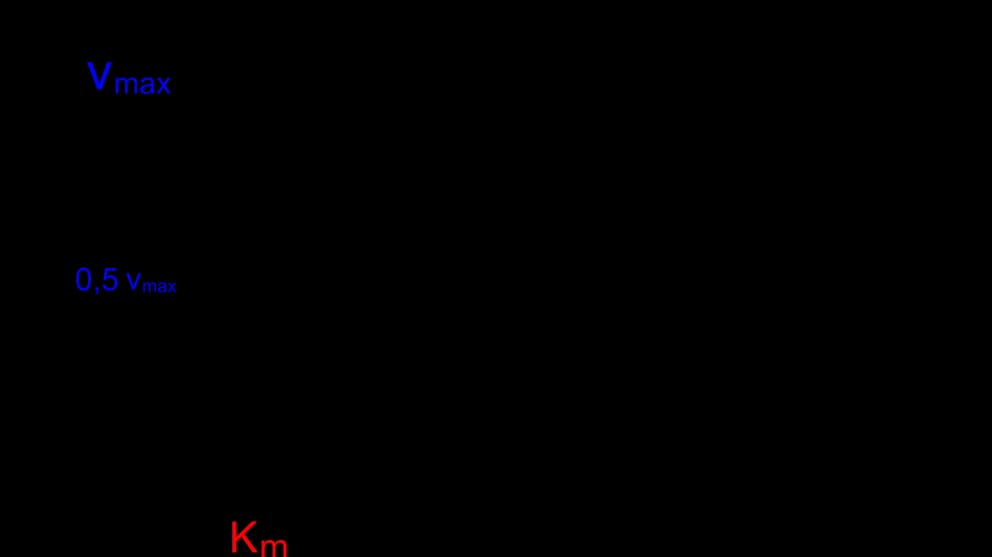
- As substrate increases, rate increases then levels off as active sites fill
- At saturation, rate =
- To increase , increase enzyme concentration
Michaelis–Menten equation
- Describes rate dependence on and
- ES forms at
- ES dissociates at or forms at
- When , then
- If , rate is half of
- = substrate concentration at “half saturation” (Michaelis constant)
- Used to compare enzymes
- can reflect affinity:
- Higher = lower affinity (need more substrate to half-saturate)
- If , rate ≈
- Relationship is usually a parabola
- Low : small greatly changes rate
- High : doesn’t change rate much
Linking to
- = substrate molecules turned over per enzyme per second
- Most enzymes: to
ratio
- Catalytic efficiency
- Larger and smaller → higher efficiency
Lineweaver–Burk plots
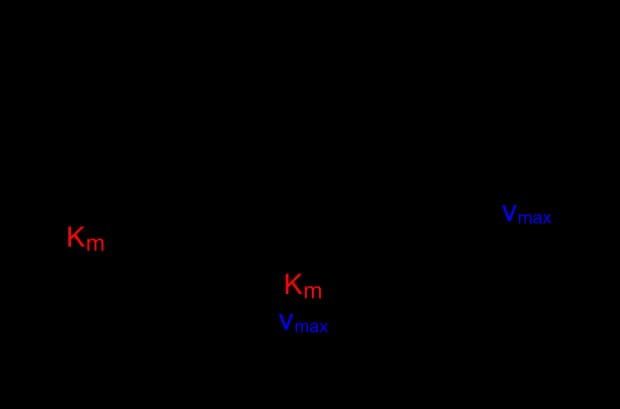
- Double reciprocal form of Michaelis–Menten
- x-intercept:
- y-intercept:
- Used to determine inhibition type
Cooperativity
- Some enzymes show sigmoidal kinetics due to cooperativity
- Often multiple subunits/active sites
- Enzyme exists in:
- T state (tense, low affinity)
- R state (relaxed, high affinity)
- Substrate binding shifts T → R
- Increases odds of binding at other subunits
- Party analogy: as more people arrive the party seems better; as more leave, more want to leave
- Affinity with 2 subunits bound > with 1 bound, but < with 3 bound
Hill coefficient
- Indicates cooperativity:
- 1 = positive cooperativity (binding increases future affinity)
- <1 = negative cooperativity
- =1 = no cooperativity
2.4 Effects of Local Conditions on Enzyme Activity
Temperature, pH, and salinity can change enzyme conformation and activity, with optimal conditions varying by enzyme.
Temperature
- Reaction rate doubles for every 10°C increase until optimal temp
- Past optimal temp → enzymes denature
- Siamese cats: tyrosinase for pigmentation
- Cooler areas (tail/feet/ears/face) → enzyme active → darker fur
- Without enzyme, peak temp is higher
pH
- Optimal body pH ~7.4
- Enzymes have different optimal pH:
- Pepsin ~2
- Pancreatic enzymes ~8.5
Salinity
- Salt concentration can affect enzyme activity in vitro
- Can disrupt H-bonds and ionic bonds
- Causes conformational change
- Can cause denaturation
2.5 Regulation of Enzyme Activity
Enzymes are regulated by feedback and inhibition (reversible/irreversible), plus allosteric regulation, covalent modification, and zymogen activation.
Feedback regulation
- Negative feedback: enough product → stop making more
Reversible inhibition
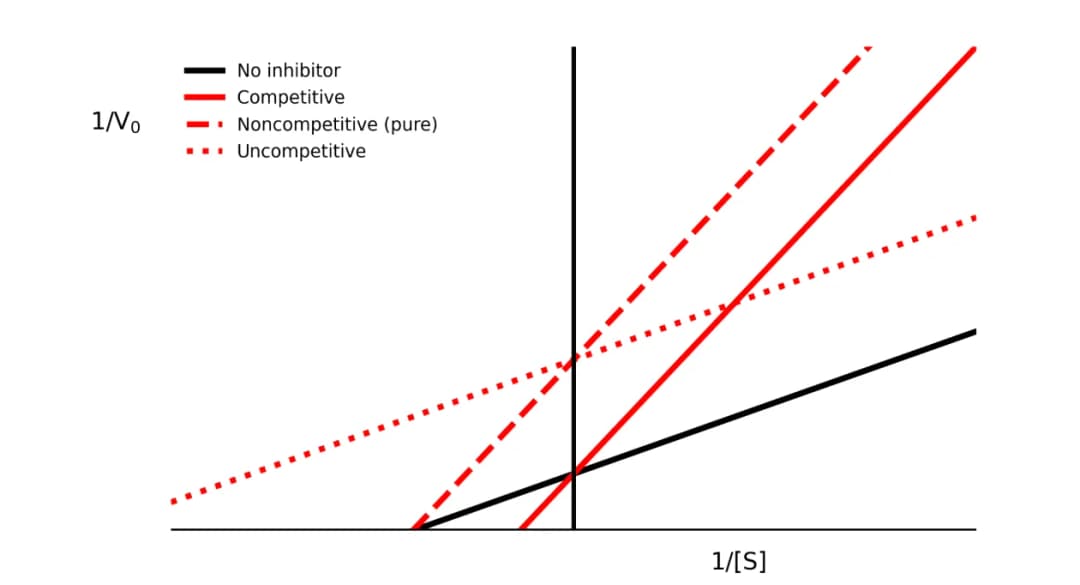
- Competitive inhibition
- Inhibitor blocks active site → substrate can’t access
- Add more substrate to overcome
- unchanged
- increases
- Noncompetitive inhibition
- Inhibitor binds allosteric site → conformational change
- Can’t be overcome by adding substrate
- decreases
- unchanged
- Mixed inhibition
- Inhibitor binds E or ES with different affinities
- Binds allosteric site
- changes depending on preference:
- If binds E → increases (affinity ↓)
- If binds ES → decreases (affinity ↑)
- always decreases
- Lines intersect not on an axis
- Uncompetitive inhibition
- Binds only ES complex
- Locks substrate in enzyme → prevents release
- Increases affinity between enzyme and substrate
- Must bind allosteric site
- Lowers both and
Irreversible inhibition
- Active site unavailable for a long time
- Can’t reverse
- Example: aspirin irreversibly modifies COX-1 → can’t make prostaglandins
- Must synthesize new COX-1 to restore function
- Prime drug mechanism
Regulated enzymes
- Allosteric enzymes
- Multiple binding sites
- Switch between active/inactive forms
- Activators or inhibitors bind → conformational shift
- Plots often sigmoidal
- Covalently modified enzymes
- Phosphorylation or dephosphorylation
- Can’t predict effect without experiments
- Glycosylation is another modification
- Tags for transport or modifies protein activity
- Zymogens
- Inactive enzymes that require modification/removal of regulatory domain to expose active site
- Often end in -ogen (e.g., trypsinogen)
Spotted something wrong or unclear? Tell us — these notes are revised continuously.