
MCAT General Chemistry · Lesson 7
Thermochemistry
4 min read6 sectionsUpdated
6 sections
7.1 Systems and Processes
Introduces thermodynamic systems, surroundings, boundaries, types of systems, and processes, including first law of thermodynamics and common process types.
- System, Surroundings, Boundary
- System: matter being observed.
- Surroundings: everything outside system.
- Boundary: not fixed, may include container or portion of system.
- Types of Systems
- Isolated: no exchange of energy or matter (e.g., insulated bomb calorimeter)
- Closed: exchanges energy, not matter (e.g., steam radiator)
- Open: exchanges energy and matter (e.g., pot of water)
- Processes
- Change in system properties.
- Most processes involve change of state.
- First Law of Thermodynamics
- = internal energy Q = heat added, W = work done, .
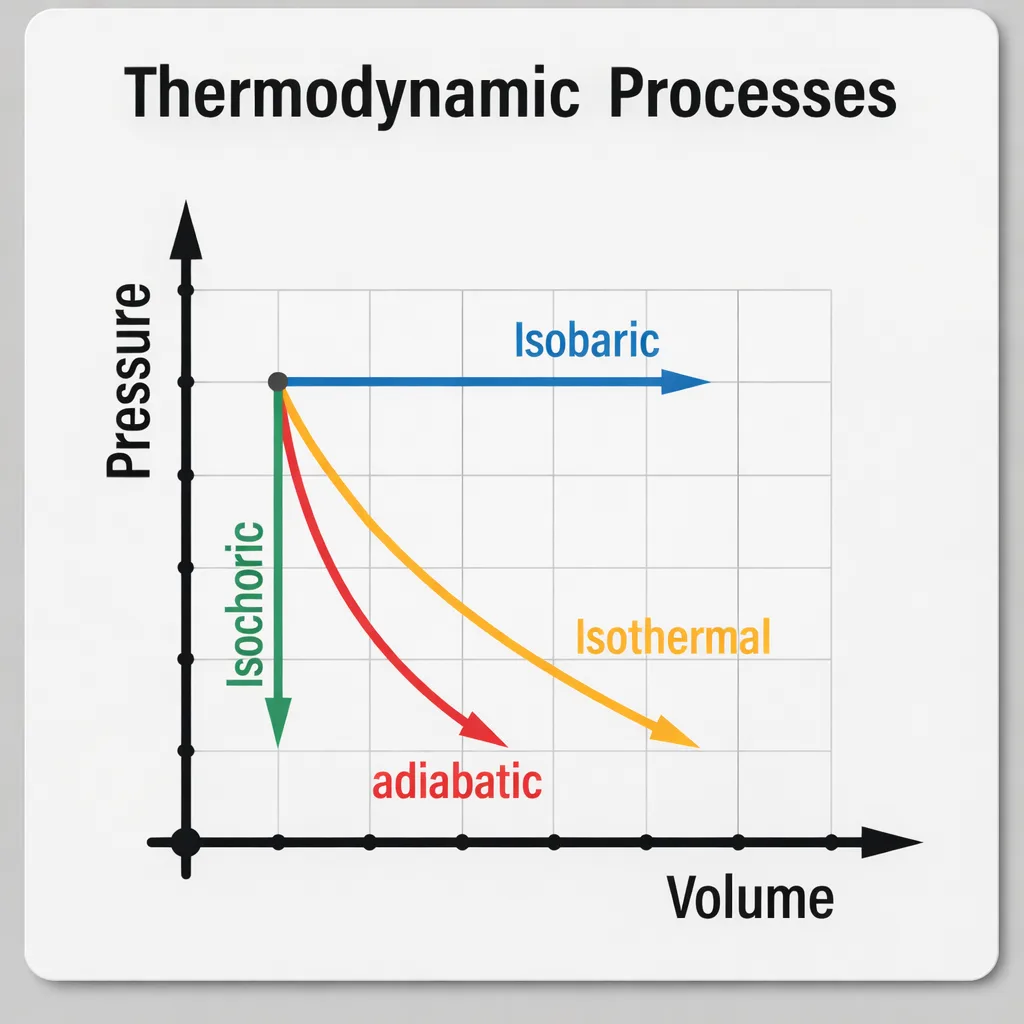
- Process Types
- Isothermal (temperature constant): , PV graph hyperbolic.
- Adiabatic (total heat constant): , PV graph hyperbolic.
- Isobaric (pressure constant): , flat line on PV graph.
- Isochoric (Isovolumetric - volume constant): , W = 0, vertical line on PV graph.
- Spontaneity
- Spontaneous: occurs without energy input; may require activation energy.
- Reactions can be coupled to favorable ones.
7.2 States and State Functions
Describes state functions vs. process functions, standard conditions, phase changes, and phase equilibria.
- State Functions
- Describe system at equilibrium (PVThugs).
- Pressure (P), Volume (V), Temperature (T), Internal Energy (U), Gibbs free energy (G), and Entropy (S)
- Process Functions
- Describe pathway, includes W and Q.
- Standard Conditions
- 25ºC, 1 atm, 1 M concentration.
- Phase Changes
- Gas ↔ Liquid: evaporation, boiling, condensation.
- Liquid ↔ Solid: fusion/melting, solidification/freezing.
- Gas ↔ Solid: sublimation, deposition.
- Example: Dry ice sublimes to gas at room temp.
- Phase Diagrams
- Lines = equilibrium between phases.
- Triple point: all three phases coexist.
- Critical point: liquid and gas densities equal → supercritical fluid.
7.3 Heat
Covers concepts of temperature, thermal energy, heat transfer, calorimetry, and heating curves.
- Heat (Q)
- Transfer of energy due to temperature difference.
- Endothermic: (absorbs heat)
- Exothermic: (releases heat)
- Units: J or cal; 1 cal = 4.184 J
- Cal = 1000 cal
- Enthalpy (H)
- Heat under constant pressure.
- Calorimetry
- Constant pressure: coffee cup calorimeter.
- Constant volume: bomb calorimeter, no work done.
- Equation:
- Heating Curves
- Temperature remains constant during phase changes.
- Phase change enthalpy: , L = latent heat.
Khan Academy Video: Specific Heat
7.4 Enthalpy
Explains enthalpy changes, standard heats of formation and reaction, Hess’s law, bond dissociation energy, and combustion enthalpy.
- Enthalpy Change
- Standard Heat of Formation
- : heat to form 1 mol compound from elements in standard state.
- Standard Heat of Reaction
- Hess’s Law
- Enthalpy changes additive; reverse reaction = same magnitude, opposite sign.
- Bond Dissociation Energy
- Average energy to break bond: kJ/mol.
- Standard Heat of Combustion
- Energy released when 1 mol fuel combusts in oxygen.
Khan Academy Video: Enthalpy
7.5 Entropy
Introduces entropy, second law of thermodynamics, and the unidirectional flow of energy.
- Entropy (S)
- Measure of energy dispersal: (J/mol·K)
- Energy naturally spreads; spontaneous processes increase entropy.
- Example: broken egg → higher entropy.
- Time’s Arrow
- Energy moves in one direction (unidirectional and irreversible)
- ∆S(system + surroundings) > 0.
- State function:
- entropy always increases
Khan Academy Video: Entropy
7.6 Gibbs Free Energy
Relates Gibbs free energy to spontaneity, equilibrium, and reaction direction.
Khan Academy Video: Gibbs Free Energy
- Spontaneity
- → spontaneous (exergonic)
- → non-spontaneous (endergonic)
- → system at equilibrium
- Gibbs Equation
- Rate does not determine spontaneity.
- Standard Gibbs Free Energy
- Standard state: 1 M solutions, pure substances in standard state.
- Non-standard Conditions
- → reaction proceeds forward
- → reaction proceeds in reverse
- Catalysts
- Can alter reaction profiles but do not change ∆G.
Spotted something wrong or unclear? Tell us — these notes are revised continuously.