
MCAT Physics · Lesson 5
Electrostatics and Magnetism
4 min read6 sectionsUpdated
6 sections
5.1 Charges
This section introduces electrostatics, the behavior of stationary charges, and the forces they create. It covers charge units, conservation, and how charges interact with materials.
- Electrostatics: Study of stationary charges.
- Basic properties:
- Proton (+), electron (-), opposites attract.
- Stable matter occurs when charges balanced; imbalance → unstable.
- Charge generation:
- Friction can transfer electrons (e.g., shuffle feet on carpet → body gains negative charge).
- Grounding: returning charge to Earth.
- Static electricity:
- More significant in dry air; humidity aids separation and maintenance of charge.
- Unit: Coulomb (C)
- Electron charge:
- Conservation: Charge cannot be created or destroyed.
- Mass effect: Electrons accelerate more than protons due to smaller mass.
Insulators and Conductors
- Insulators:
- Do not distribute charge; electrons bound to nuclei.
- Most nonmetals.
- Used in dielectrics for capacitors to prevent grounding.
- Conductors:
- Distribute charge across surface.
- Free electrons allow transfer.
- Metals, ionic solutions; used in circuits and electrochemical cells.
5.2 Coulomb's Law
Defines the electrostatic force between charges and introduces the electric field concept.
- Coulomb's law:
- Like charges repel, opposite attract.
- Example: + and - separated distance d → 2d → force = 1/4 original.
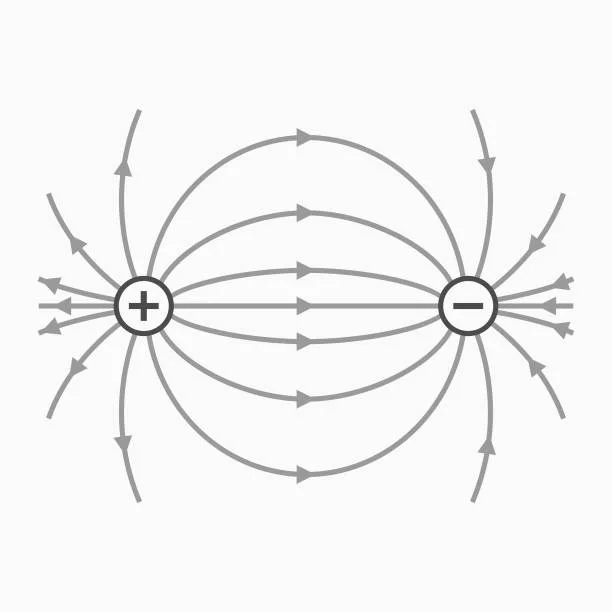
Electric Field
- Created by charge Q, exerts force on other charges.
- Magnitude:
- Vector points in direction a positive test charge would move:
- Positive source → repulsive, outward
- Negative source → attractive, inward
- Field lines:
- Imaginary lines showing charge motion.
- Closer lines → stronger field.
- test charge → force same direction; - test charge → opposite.
5.3 Electric Potential Energy
Electric potential energy depends on relative positions of charges and their interactions.
-
- Positive for like charges, negative for opposites.
- Relation to work:
- Attractive forces → closer = more stable.
- Increasingly negative values = decreasing potential energy.
5.4 Electric Potential
Electric potential quantifies potential energy per charge and explains voltage and potential difference.
- Electric potential:
- Units: volts (V) = J/C
- Scalar; sign follows Q.
- Voltage / Potential difference:
- Charge movement:
- Negative → lower to higher potential
- Positive → higher to lower potential
- Mnemonic: Battery + = high potential, - = low; + moves +→-, - moves -→+
5.5 Special Cases in Electrostatics
Covers equipotential lines and electric dipoles, including their fields and torques.
- Equipotential lines:
- Line where potential same → ΔV = 0
- No work along line
- Concentric circles (3D: spheres)
- Electric dipoles:
- Two equal opposite charges separated by distance d.
- V =
- Dipole moment: (vector along charge axis)
- Perpendicular bisector → potential = 0
- Electric field magnitude on bisector:
- Torque:
- Dipole aligns with external E field.
5.6 Magnetism
Describes magnetic fields generated by moving charges, types of magnetic materials, and forces on charges and currents.
- Magnetic field:
- Moving charge produces B field.
- Unit: Tesla (T), 1 T = 1 N·s/m·C; 1 T = 10⁴ gauss
- Magnetic materials:
- Diamagnetic: no unpaired e-, weakly repelled (wood, water)
- Paramagnetic: unpaired e-, weakly attracted (Al, Cu, Au)
- Ferromagnetic: unpaired e-, strongly attracted (Fe, Ni, Co)
- Field lines:
- Bar magnets: N→S, circular; monopoles impossible.
- Magnetic fields from current:
- Long straight wire:
- µ₀ = 4π × 10⁻⁷ T·m/A
- Right-hand rule: thumb = current, fingers = B direction
- Circular loop: at center
- Magnetic force:
- On moving charge:
- Right-hand rule for direction: thumb = velocity, fingers = B, palm = + charge force
- Uniform circular motion:
- Current-carrying wire:
- L = wire length, I = current
- Direction via right-hand rule
- Example: 2 m wire, I = 5 A, B = 30 gauss →
Spotted something wrong or unclear? Tell us — these notes are revised continuously.