
MCAT Biochemistry · Lesson 11
Lipid and Amino Acid Metabolism
4 min read7 sectionsUpdated
7 sections
11.1 Lipid Digestion and Absorption
Dietary fats are mainly triacylglycerols. Digestion begins minimally in the mouth and stomach, with most occurring in the small intestine via emulsification, micelle formation, and absorption into enterocytes.
- Digestion
- Dietary fats: triacylglycerols, cholesterol, cholesterol esters, phospholipids, free fatty acids
- Minimal digestion in mouth/stomach; transported to small intestine intact
- Emulsification in duodenum: mixing of immiscible liquids, increases surface area for digestion
- Aided by bile (bile salts, pigments, cholesterol)
- Bile secreted by liver, stored in gallbladder
- Pancreas produces pancreatic lipase, colipase, cholesterol esterase
- Micelle Formation
- Components: free fatty acids, cholesterol, 2-monoacylglycerol, bile salts
- Water-soluble sphere with lipid-soluble interior
- Actively reabsorbed and recycled; remaining fat excreted in stool
- Absorption
- Micelles diffuse to brush border of mucosal cells, absorbed
- Lipids reesterified in mucosa → chylomicrons
- Chylomicrons enter lacteals (lymphatic vessels) → thoracic duct → left subclavian vein
- Short-chain fatty acids absorbed via diffusion
11.2 Lipid Mobilization
In the postabsorptive state, fatty acids are released from adipose tissue for energy. Hormone-sensitive lipase and lipoprotein lipase regulate mobilization and metabolism of fats.
- Postabsorptive State
- Fatty acids released from adipose tissue
- ↓ insulin → activates hormone-sensitive lipase (HSL)
- HSL hydrolyzes triacylglycerols → fatty acids + glycerol
- Activated by epinephrine and cortisol
- Lipoprotein Lipase (LPL)
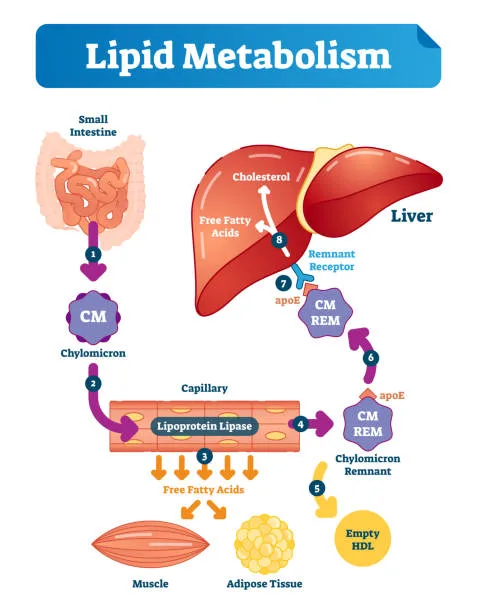
- Metabolizes chylomicrons and VLDL
- Releases free fatty acids from triacylglycerols
11.3 Lipid Transport
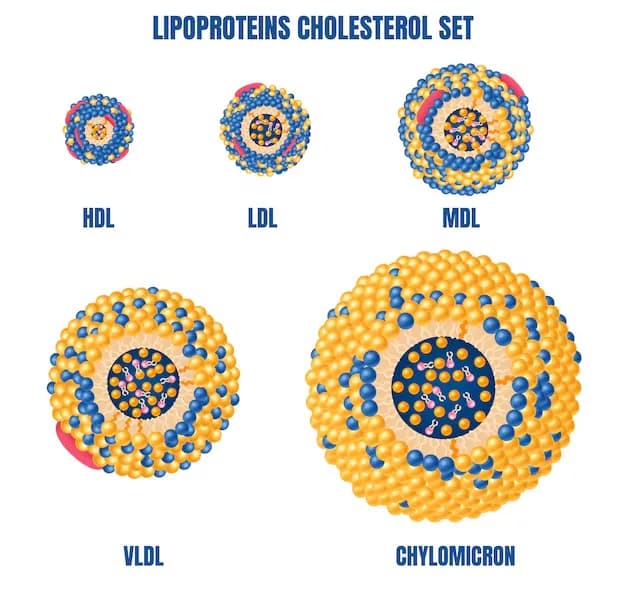
Lipids are transported in blood as lipoproteins, which vary in density and function. Key lipoproteins include chylomicrons, VLDL, IDL, LDL, and HDL.
- Lipoproteins
- Composition: apolipoproteins + lipids
- Density-based naming
- Chylomicrons
- Transport dietary triacylglycerols, cholesterol, cholesterol esters
- Assembled in small intestine
- VLDL
- Made in liver; transports newly synthesized triacylglycerols
- IDL
- VLDL remnant after triacylglycerol removal
- Can pick up cholesterol esters from HDL → LDL
- LDL
- Majority of blood cholesterol
- Delivers cholesterol for biosynthesis, membranes, bile acids
- HDL
- Produced by liver/intestine
- Removes excess cholesterol, delivers to steroidogenic tissues
- Apolipoproteins
- apoA-I: activates LCAT for cholesterol esterification
- apoB-48: mediates chylomicron secretion
- apoB-100: mediates LDL uptake by liver
- apoC-II: activates lipoprotein lipase
- apoE: uptake of chylomicron remnants and VLDL
11.4 Cholesterol Metabolism
Cholesterol is vital for membranes, hormones, bile acids, and vitamin D. It can be obtained from diet, LDL/HDL, or synthesized de novo in the liver.
- Sources
- LDL/HDL uptake
- De novo synthesis in liver from acetyl CoA + ATP
- Citrate shuttle moves acetyl CoA from mitochondria → cytoplasm
- NADPH reduces intermediates
- Rate-limiting Step
- HMG-CoA reductase converts HMG-CoA → mevalonate in smooth ER
- Regulated by feedback inhibition
- Insulin ↑ cholesterol synthesis
- Specific Enzymes
- LCAT: activated by HDL; forms soluble cholesteryl esters
- CETP: transfers cholesteryl esters between lipoproteins (IDL → LDL)
11.5 Fatty Acids and Triacylglycerols
Fatty acids are long-chain carboxylic acids, essential for energy storage and membrane fluidity. Biosynthesis occurs in the cytosol; oxidation occurs in mitochondria.
- Structure & Nomenclature
- C1 = carboxyl, C2 = α-carbon
- Notation: C: = # (total carbons : double bonds)
- Humans synthesize few unsaturated FAs; α-linolenic & linoleic acids are essential
- ω-numbering system: double bond location from terminal methyl
- Synthesis (Cytosol)
- Excess carbs/protein → fatty acids → energy reserves
- Liver: main site; adipose tissue: minor synthesis
- Stimulated by insulin
- Key Enzymes
- Acetyl CoA Carboxylase: adds CO₂ to acetyl CoA → malonyl CoA (rate-limiting)
- Fatty Acid Synthase (FAS): builds palmitate (16C) using NADPH
- Steps: attachment → bond formation → reduction → dehydration → reduction (ABRDR)
- Triacylglycerol Synthesis
- 3 fatty acids + glycerol
- Liver packages → VLDL → adipose
- Oxidation
- Beta-oxidation (mitochondria/peroxisomes)
- Activation: fatty acid + CoA → acyl CoA (via fatty acyl CoA synthetase)
- Entry into mitochondria:
- Short/medium chain: diffuse
- Long chain: carnitine shuttle; rate-limiting: Carnitine acyltransferase I
- Steps:
- Oxidation → double bond
- Hydration → OH
- Oxidation → carbonyl
- Thiolysis → acetyl CoA + shortened acyl CoA
- Odd-chain FAs → propionyl CoA → methylmalonyl CoA → succinyl CoA → malate → gluconeogenesis
- Unsaturated FAs: enoyl CoA isomerase & 2,4-dienoyl CoA reductase required
11.6 Ketone Bodies
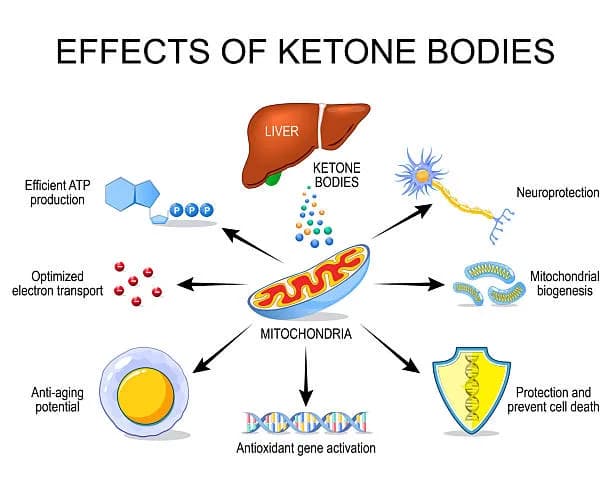
Ketone bodies are produced in the liver during prolonged fasting from excess acetyl CoA. They provide alternative energy for muscles and the brain.
- Ketogenesis (Liver Mitochondria)
- HMG-CoA synthase → HMG-CoA
- HMG-CoA lyase → acetoacetate
- Reduction → 3-hydroxybutyrate
- Acetone: byproduct, not used for energy
- Ketolysis
- Acetoacetate → mitochondria of peripheral tissues
- Activated by succinyl-CoA: acetoacetyl CoA transferase (thiophorase)
- Liver lacks enzyme → cannot use its own ketones
- Brain uses ketones during prolonged fasting (2/3 energy)
- Ketone metabolism inhibits pyruvate dehydrogenase → ↓ glycolysis & glucose uptake → protein sparing
11.7 Protein Catabolism
Proteins are rarely used for energy except in extreme starvation. Amino acids are catabolized to feed into gluconeogenesis or ketogenesis, with nitrogen excreted via the urea cycle.
- Proteolysis
- Begins: stomach (pepsin)
- Continues: pancreas (trypsin, chymotrypsin, carboxypeptidases A/B)
- Brush border: dipeptidase, aminopeptidase
- Products: amino acids, dipeptides, tripeptides
- Amino Acid Catabolism
- Transamination/deamination → carbon skeletons used for energy
- Glucogenic AA: converted to glucose (except leucine, lysine)
- Ketogenic AA: leucine, lysine, phenylalanine, threonine, tyrosine, tryptophan → acetyl CoA + ketone bodies
- Amino groups → ammonia → urea cycle
- Side chains: basic → urea; others → carbon skeleton intermediates
Spotted something wrong or unclear? Tell us — these notes are revised continuously.