
MCAT Biochemistry · Lesson 10
Carbohydrate Metabolism II: Aerobic Respiration
5 min read4 sectionsUpdated
4 sections
10.1 Acetyl CoA
Acetyl-CoA is mainly formed from pyruvate via PDH, but also comes from fatty acids, amino acids, and alcohol metabolism, feeding into aerobic energy pathways and storage.
Formation through glycolysis
- Pyruvate enters PDC → makes acetyl-CoA
Pyruvate dehydrogenase
- Pyruvate oxidized → makes CO₂
- 2C molecule binds to TPP (coenzyme held by noncovalent interactions to PDH)
- Mg²⁺ required
Dihydrolipoyl transacetylase
- 2C group bonded to TPP is oxidized + transferred to lipoic acid (bonded coenzyme)
- Disulfide group acts as oxidizing agent → makes acetyl group
- Acetyl group bonded via thioester linkage
- Catalyzes CoA-SH interaction → transfers acetyl group
Dihydrolipoyl dehydrogenase
- FAD used as coenzyme to deoxidize lipoic acid
- Reduces FAD → FADH₂
Other pathways that make acetyl-CoA
- Fatty acid oxidation (cytosol)
- Activation forms thioester bond between fatty acid carboxyl group and CoA-SH
- Acyl group transferred to carnitine → crosses inner membrane
- Crosses membrane, then fatty acyl group transferred back to CoA-SH
- β-oxidation removes 2C fragments from carboxyl end of acyl-CoA
- Amino acid catabolism
- AAs lose amino group via transamination
- Carbon skeletons make ketone bodies
- When PDC inhibited, ketones can make acetyl-CoA (usually reverse)
- Alcohol
- Moderate alcohol: alcohol dehydrogenase + acetaldehyde dehydrogenase convert OH to CoA
- NADH buildup inhibits Krebs cycle
- Acetyl-CoA made is used to make fatty acids
10.2 Reactions of Citric Acid Cycle (Matrix)
The citric acid cycle oxidizes acetyl-CoA to CO₂ while generating NADH, FADH₂, and GTP, with regulation at citrate synthase, isocitrate dehydrogenase, and α-KGDH complex.
Key reactions
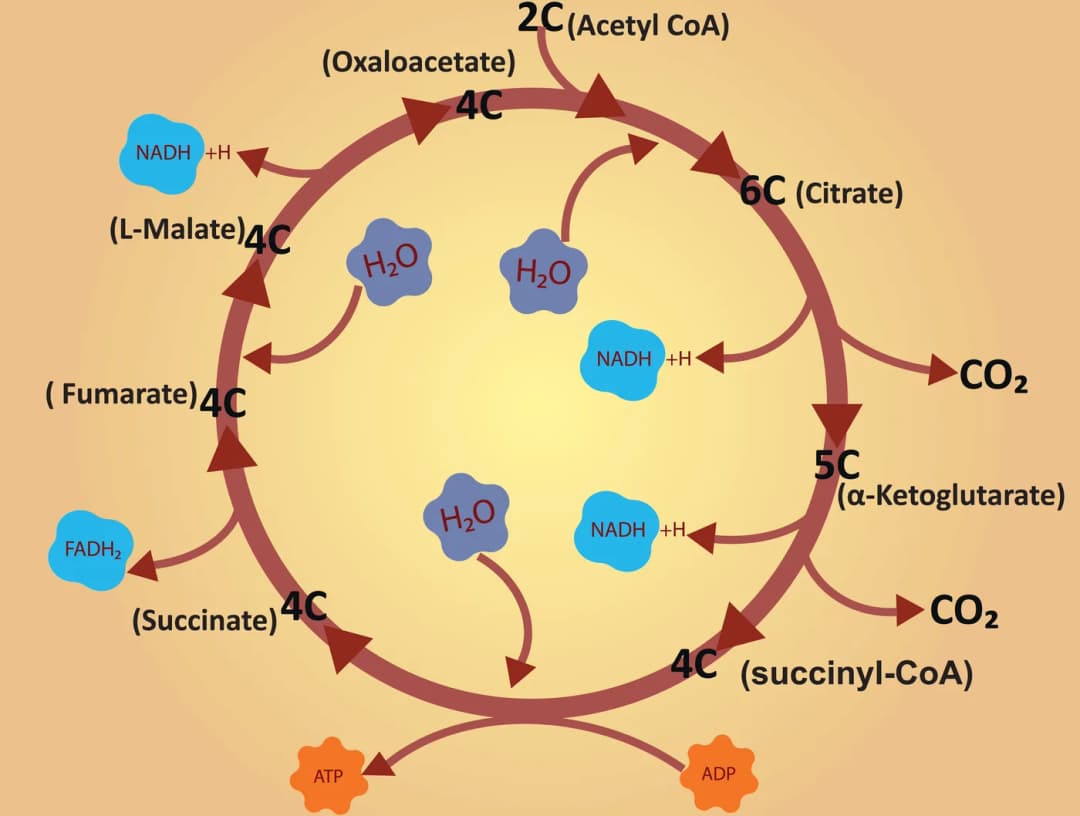
Citrate formation
- Acetyl-CoA + OAA condense → citryl-CoA
- Hydrolysis → citrate + CoA-SH
Citrate → isocitrate
- Achiral citrate isomerized
- Forms cis-aconitate, then H₂O added → isocitrate
α-KG and CO₂
- Isocitrate oxidized → oxalosuccinate (by isocitrate dehydrogenase)
- Oxalosuccinate decarboxylated → α-KG
- Rate-limiting enzyme: isocitrate dehydrogenase
- Makes first NADH
Succinyl-CoA and CO₂
- Done by α-KGDC (similar to PDC)
- α-KG + CoA → CO₂
- Makes another NADH
Succinate formation
- Hydrolysis of thioester bond on succinyl-CoA → succinate + CoA-SH
- Catalyzed by succinyl-CoA synthetase
- Makes new covalent bonds with energy input
- Thioester bonds in acetyl-CoA release energy when broken
- GDP → GTP phosphorylation driven by thioester hydrolysis energy
Fumarate
- Takes place in matrix (not membrane)
- Succinate dehydrogenase oxidizes succinate → fumarate
- SDH is a flavoprotein (bonded to FAD)
- FAD → FADH₂ because reducing power can’t reduce NAD⁺
Malate
- Fumarase hydrolyzes alkene in fumarate → malate
- Only L-malate forms
OAA made again
- Malate dehydrogenase oxidizes malate → OAA
- Makes another NADH
Net results and ATP yield
PDC
Citric acid cycle
ATP production
- Glycolysis makes another → total 30–32 ATP
PDC regulation
- Pyruvate dehydrogenase kinase
- When ATP rises → phosphorylates PDH → inhibits acetyl-CoA formation
- Pyruvate dehydrogenase phosphatase
- Reactivates PDC when ADP high
- High fat fuel:
- Acetyl-CoA from fats makes carb → acetyl-CoA redundant
- Why high fat meal fills you up
Control points
- Citrate synthase
- ATP and NADH allosterically inhibit
- Citrate directly inhibits citrate synthase
- Isocitrate dehydrogenase
- Inhibited by ATP and NADH
- ADP and NAD⁺ activate
- α-KGDC
- Succinyl-CoA and NADH inhibit
- ATP inhibits
- ADP and Ca²⁺ stimulate
10.3 ETC
Electrons flow through ETC complexes I–IV to generate a proton gradient (proton motive force) used for ATP synthesis, with shuttles moving cytosolic NADH equivalents into mitochondria.
E⁻ flow and complexes
- ATP synthesis is endergonic, e⁻ transport is exergonic → coupled
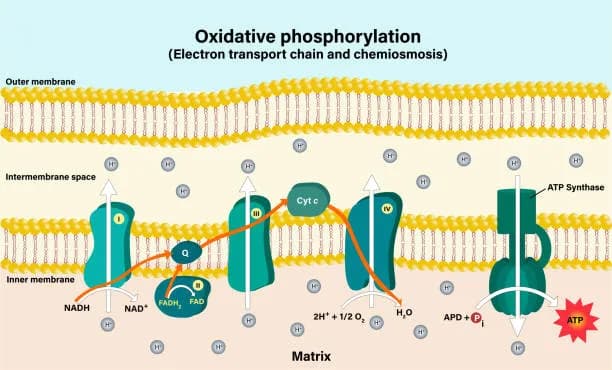
Complex I (NADH–CoQ oxidoreductase)
- Transfers e⁻ from NADH → coenzyme Q (CoQ)
- Contains iron–sulfur clusters + flavoprotein
- NADH transfers e⁻ to FMN:
- NADH → NAD⁺ and FMNH₂
- Reduced iron–sulfur donates e⁻ from FMNH₂ → CoQ
- Proton pumping: 4 H⁺ moved
Complex II (succinate–CoQ oxidoreductase)
- Transfers e⁻ to CoQ
- Receives e⁻ from succinate:
- succinate oxidized, FAD → FADH₂
- Reduces iron–sulfur protein and makes FAD
- No proton pumping
Complex III
- Cytochrome reductase
- Transfers e⁻ from CoQ → cytochrome c (steps)
- Cytochromes have heme groups:
- Fe³⁺ reduced → Fe²⁺
- Proton motive force via Q cycle
- Ubiquinol → ubiquinone
- Moves 4 H⁺
Complex IV
- Transfers e⁻ from cytochrome c → oxygen
- Final proton pumping site
- Cyanide inhibits this
Proton motive force
- ↑ → pH drops
- Voltage difference between intermembrane space and matrix increases
- Creates electrochemical gradient
- Called proton motive force because it’s based on protons
- ATP synthase uses this
NADH shuttles
- ATP totals vary because efficiency varies by cell type
- Cytosolic NADH (from glycolysis) can’t cross into matrix → needs shuttles
Glycerol-3-phosphate shuttle
- Cytosolic G3P dehydrogenase oxidizes NADH → NAD⁺ while DHAP → G3P
- On other side, mitochondrial isoform is FAD-dependent:
- FAD reduced → FADH₂
- Transfers e⁻ to ETC via Complex II
Malate–aspartate shuttle
- Cytosolic OAA can’t cross membrane → reduced to malate
- Malate dehydrogenase oxidizes NADH → NAD⁺
- Malate enters matrix, then NADH generated in matrix feeds ETC via Complex I
- OAA transaminated → aspartate
- Aspartate enters cytosol → reconverted to OAA
10.4 Oxidative Phosphorylation
OxPhos uses chemiosmotic coupling where proton flow through ATP synthase drives ATP production; oxygen availability regulates this via respiratory control.
Chemiosmotic coupling
- ATP synthase spans membrane:
- F₀ portion = ion channel
- Protons move down gradient into matrix
- Coupling = using proton gradient energy to make ATP
- F₁ portion uses released energy to phosphorylate ADP
Conformational coupling
- Proton gradient and ATP synthesis are indirect
- F₁ portion acts like a turbine (spins)
Regulation
- O₂ is limited → oxidative phosphorylation decreases
- and increase
- NADH accumulation inhibits cycle
- Respiratory control can affect pathways
Spotted something wrong or unclear? Tell us — these notes are revised continuously.