
MCAT Biochemistry · Lesson 9
Carbohydrate Metabolism I
7 min read7 sectionsUpdated
7 sections
9.1 Glucose Transport
Glucose transport uses GLUT transporters and concentration gradients (not Na⁺), with key tissue-specific roles for GLUT2 and GLUT4.
- Glucose entry driven by concentration gradient, independent of Na⁺
- GLUT1–4 transporters
GLUT2
- Low-affinity transporter in hepatocytes and pancreatic cells
- Captures excess glucose for storage
- (high)
- When drops below , glucose bypasses liver → goes into peripheral circulation
- Liver preferentially picks up excess glucose after a meal and stores it
- In pancreatic β-islet cells: GLUT2 + glucokinase = glucose sensor for insulin
GLUT4
- In adipose tissue and muscle
- Responds to in peripheral blood
- Transport rate increased by insulin (only one that responds)
- Insulin stimulates movement of GLUT4 to membrane
- similar to normal levels (~5 mM)
- Transporter saturated when blood glucose > normal
- Can increase intake by increasing number of transporters on surface
- High insulin → increased glucose transport in adipose + muscle
- Muscle stores excess as glycogen
- Adipose stores excess as DHAP → glycerol phosphate
- Stores incoming fatty acids as triacylglycerols
9.2 Glycolysis (Cytosol)
Glycolysis occurs in the cytosol to generate ATP (especially anaerobically) and NADH, with key regulatory enzymes and important intermediates.
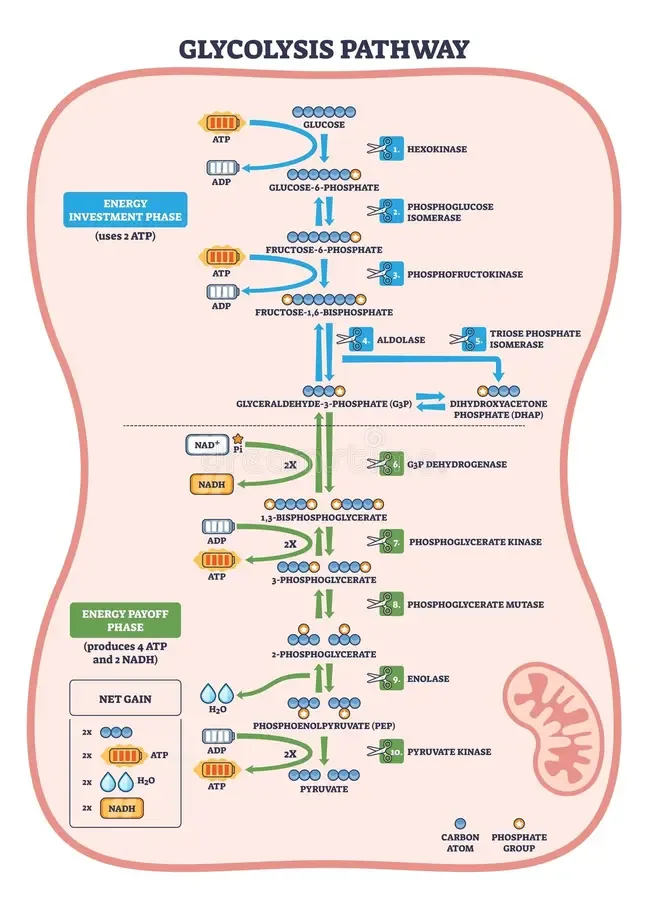
- Energy-yielding pathway in cytoplasm
- Produces NADH for ETC
Hexokinase and glucokinase
- Phosphorylate glucose → traps it (prevents leaving via transporter)
- Produces glucose-6-phosphate (G6P)
- Hexokinase:
- Widely distributed
- Inhibited by G6P
- Low
- Glucokinase:
- Liver + pancreatic β-islet cells only
- Induced by insulin
- High
Phosphofructokinases (PFK1/2)
- PFK1 = rate-limiting enzyme (main control point)
- Reaction: F6P → F1,6BP (uses ATP)
- PFK1 regulation:
- Inhibited by ATP and citrate
- Activated by AMP
- Insulin stimulates, glucagon inhibits
- Insulin activates PFK2 → converts F6P → F2,6BP
- Glucagon inhibits PFK2 → lowers F2,6BP
- F2,6BP activates PFK1 → overrides ATP inhibition → glycolysis continues
Glyceraldehyde-3-phosphate dehydrogenase
- Oxidation + adds Pi to G3P
- Produces 1,3-bisphosphoglycerate (1,3BPG)
- Reduces NAD⁺ → NADH
- Oxidation = ↑ bonds to O
- Reduction = ↑ bonds to H
- Aerobic glycolysis: NADH oxidized by ETC
3-Phosphoglycerate kinase
- Transfers high-energy phosphate from 1,3BPG to ADP → ATP + 3-phosphoglycerate
- Substrate-level phosphorylation
- Only ATP source in anaerobic tissue
Pyruvate kinase
- Substrate-level phosphorylation using PEP to make ATP
- Activated by F1,6BP (feed-forward activation)
- Product of earlier step stimulates later step
Fermentation
- Lactate dehydrogenase oxidizes NADH → NAD⁺
- Replenishes coenzyme for G3P dehydrogenase
- Produces lactate (no carbon loss)
- Low O₂ (exercise) → lactate production starts
- Fermentation (general): pyruvate → ethanol + CO₂
Important intermediates
- DHAP:
- Used in hepatic + adipose tissue for triacylglycerol synthesis
- Formed from F1,6BP
- Isomerized to G3P → converted to glycerol
- 1,3BPG and PEP:
- High-energy intermediates used for substrate-level phosphorylation
- Only ATP gained in anaerobic respiration
Irreversible enzymes
- Keep pathway one-direction:
- Glucokinase
- PFK1
- Pyruvate kinase
Glycolysis in erythrocytes
- Anaerobic glucose metabolism → net 2 ATP per glucose
- Bisphosphoglycerate mutase makes 2,3BPG from 1,3BPG
- Mutases move functional group (here phosphate)
- 2,3BPG binds allosterically to β chains of HbA → decreases affinity
- Right shift → unloading in tissues while still allowing 100% saturation
- Doesn’t bind well to fetal Hb → HbF higher affinity
- High 2,3BPG, low pH, high pCO₂ → right shift
- Exercise is the RIGHT thing to do
9.3 Other Monosaccharides
Galactose and fructose enter metabolism through liver pathways, with fructose bypassing major glycolysis control points.
Galactose metabolism
- Lactose hydrolyzed to glucose + galactose by lactase
- Galactose goes to liver via hepatic portal vein
- Phosphorylated by galactokinase
- Galactose-1P → glucose-1P via:
- Galactose-1P uridyl transferase
- Epimerase
- Epimerase converts sugar epimers into another
Fructose metabolism
- Found in honey + fruit
- Part of sucrose (with glucose)
- Liver uses fructokinase → fructose-1P
- Aldolase B cleaves fructose-1P → glyceraldehyde + DHAP
- Then enters glycolysis
- Skips rate-limiting enzymes fructokinase and PFK1
9.4 Pyruvate Dehydrogenase
PDH irreversibly converts pyruvate to acetyl-CoA and is regulated by insulin and product inhibition.
- Pyruvate dehydrogenase complex (PDH) is irreversible
- Converts pyruvate → acetyl-CoA
- Activated by insulin (signals well-fed state)
- Shifts toward storage rather than oxidation
- Multi-enzyme complex (reactions in succession)
- 1 of 3 fates of pyruvate:
- Lactate
- OAA
- Acetyl-CoA (PDH)
- Inhibited by product acetyl-CoA
- Buildup of acetyl-CoA → less pyruvate → acetyl-CoA, more pyruvate → OAA
9.5 Glycogenesis and Glycogenolysis
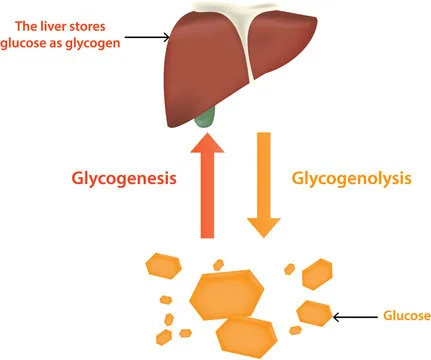
Glycogen is a branched glucose storage polymer; glycogenesis stores glucose and glycogenolysis releases glucose for blood (liver) or muscle use.
- Glycogen = branched polymer, storage form of glucose
- Stored in cytoplasm as granules:
- Protein core + polyglucose chains radiating → sphere
- Linear chains would pack glucose near core (high density)
- Branching → highest density at periphery
- Liver glycogen:
- Broken down to maintain blood glucose
- Mobilized between meals to prevent hypoglycemia
- Muscle glycogen:
- Broken down to fuel muscle during activity
- Plants store starch (long α-linked glucose chains)
Glycogenesis
- Starts with glycogenic protein
- G6P → G1P
- Activated by coupling to UDP → allows integration by glycogen synthase
- Reaction: G1P + UTP → UDP-glucose + PPi
- Glycogen synthase:
- Rate-limiting enzyme
- Forms α-1,4 glycosidic bonds (linear chains)
- Stimulated by G6P and insulin
- Inhibited by epinephrine and glucagon
- Branching enzyme (glycosyl α-1,4; α-1,6 transferase):
- Introduces α-1,6 branches
- Glycogen synthase then extends branch
Glycogenolysis
- Glycogen phosphorylase:
- Rate-limiting enzyme of breakdown
- Uses Pi (not water) to cleave → produces G1P → G6P
- Breaks α-1,4 bonds
- Stops at branch points (can’t break α-1,6)
- Regulation:
- Activated by glucagon in liver (glucose for body)
- Activated by AMP and epinephrine in muscle
- Inhibited by ATP
- Debranching enzyme (glucosyl α-1,4; α-1,4 transferase + α-1,6 glucosidase):
- Two-enzyme complex
- Breaks 1,4 bond near branch → forms new 1,4 bond
- Breaks 1,6 bond
- Moves most of branch to end of chain
- Releases single glucose from old branch
Glycogen storage diseases
- Isoforms = different versions of same protein
- Diseases cause accumulation or lack of glycogen in tissues
- Most common: von Gierke’s (defect in glucose-6-phosphatase)
- Affects gluconeogenesis
- Low blood sugar between meals
- Requires continuous feeding
9.6 Gluconeogenesis
Gluconeogenesis maintains blood glucose (mainly liver), is hormonally regulated, and bypasses irreversible glycolysis steps using key enzymes.
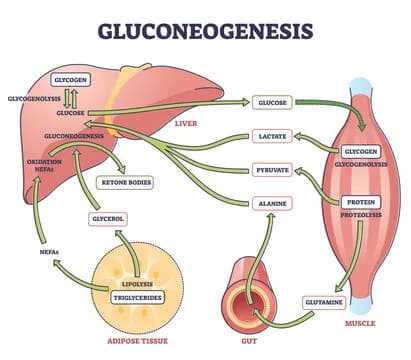
- Liver maintains blood glucose; kidney can also do it
- Promoted by glucagon and epinephrine
- Inhibited by insulin
- Sole source of glucose after 24 hours
Substrates
- Glycerol-3-phosphate (from stored fats in adipose)
- Lactate (anaerobic glycolysis)
- Glucogenic amino acids:
- All except leucine and lysine
- Converted to intermediates feeding gluconeogenesis
- Ketogenic amino acids:
- Converted into ketone bodies (alternative fuel)
Carbon source limits
- Dietary fructose and galactose can be converted
- Can’t convert acetyl-CoA → glucose (so fatty acids can’t produce glucose)
- Exception: odd-chain fatty acids → propionyl-CoA
Key conversions
- Lactate → pyruvate via lactate dehydrogenase
- Alanine via alanine aminotransferase
- G3P → DHAP via glycerol-3P dehydrogenase
Pyruvate carboxylase
- Mitochondrial enzyme
- Activated by acetyl-CoA
- Pyruvate → OAA
- OAA reduced to malate → exits via malate-aspartate shuttle
- In cytoplasm, malate oxidized back to OAA
- Acetyl-CoA activation means “don’t need more acetyl-CoA, make OAA instead”
- Acetyl-CoA comes from fatty acid oxidation → fatty acids must be burned
PEP carboxykinase (PEPCK)
- Cytoplasmic
- Induced by glucagon and cortisol → raises blood sugar
- OAA → PEP (requires GTP)
- PEP → F1,6BP
- Pyruvate carboxylase + PEPCK bypass pyruvate kinase
Fructose-1,6-bisphosphatase
- Key control point, rate-limiting step of gluconeogenesis
- Reverses PFK1:
- Removes phosphate from F1,6BP → F6P
- Activated by ATP
- Inhibited by AMP and F2,6BP
- F2,6BP is marker for “satisfactory energy levels” in cell
Glucose-6-phosphatase
- Located in ER lumen of liver cells
- Not in muscle → muscle glycogen can’t provide blood glucose
- Glucose from hepatic gluconeogenesis is not energy source for liver
Ketones
- Acetyl-CoA from fatty acids can’t become glucose
- Can become ketone bodies for brain fuel
Cori cycle
- RBCs deliver lactate to liver
- Lactate → pyruvate → glucose
9.7 Pentose Phosphate Pathway
PPP (HMP shunt) makes NADPH and ribose-5-phosphate, regulated by insulin and NADPH/NADP⁺ balance, and protects against oxidative damage.
- PPP = hexose monophosphate shunt (HMP)
- Produces NADPH and ribose-5-phosphate (R5P)
- Starts with G6P, ends with ribulose-5P (irreversible)
Key enzyme
- Rate-limiting: G6P dehydrogenase (G6PD)
- G6PD induced by insulin (abundant sugar shunted)
- Shunt inhibited by NADPH
- Activated by NADP⁺
Second part
- Produces R5P and other stuff
- Can feed back into glycolysis
- Uses transketolase and transaldolase
Functions of NADPH
- Electron donor, strong reducing agent
- Lipid + cholesterol biosynthesis
- Helps cellular bleach production (antibacterial)
- Maintains glutathione to protect vs reactive species
- NOT used as energy carrier
- Protects cells from free radical damage
G6PD deficiency
- Higher risk from oxidative stress
- Free radicals attack membrane lipids → cell lysis
- Also damage DNA → cancer
Spotted something wrong or unclear? Tell us — these notes are revised continuously.