
MCAT Biochemistry · Lesson 8
Biological Membranes
4 min read4 sectionsUpdated
4 sections
8.1 Fluid Mosaic Model
The plasma membrane is a semipermeable phospholipid bilayer with dynamic lipids and proteins that support protection, transport regulation, and signaling.
- Plasma membrane = semipermeable phospholipid bilayer
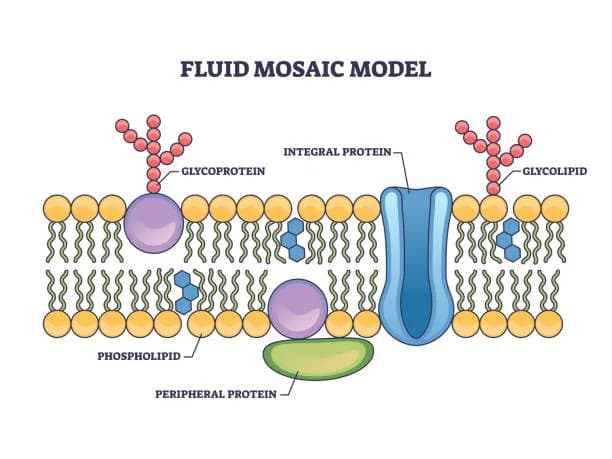
General structure and function
- Carbs associated with membrane-bound proteins make glycoprotein coat
- Cell walls of stuff have higher level of carbs
- Protects cell interior from environment
- Regulates traffic
- Contains proteins for signal transduction
Membrane dynamics
- Phospholipids move rapidly via simple diffusion
- Tags migrate with lipids until different types are intermixed
- Lipid rafts:
- Collections of similar lipids with/without associated proteins
- Attachment points for other biomolecules
- Travel in plane of membrane
- Important in signaling
- Lipids can move between membrane layers but it’s unfavorable
- Flippases assist transition
8.2 Membrane Components
Membranes are built from lipids, proteins, and carbohydrates; junctions (gap, tight, desmosomes) connect cells and control permeability and mechanical stability.
Lipids
- Structural role + fluidity
Fatty acids and triacylglycerols
- Triglycerides (triacylglycerols) = storage lipids in metabolism
- Unsaturated = healthier, liquid at room temp
- Mostly from diet, transported with chylomicrons
- Alpha-linolenic and linoleic acid
- Saturated = animal fats, processed foods
- Decrease membrane fluidity
- Trans fats:
- Decrease fluidity
- Increase melting point of membrane
Phospholipids
- Replace fatty acid tail with phosphate group → glycerophospholipid
- Assemble into micelles or liposomes (bilayer vesicles)
- Can make hydrophilic surface on lipoproteins (ex: VLDL)
- Attach water-soluble groups (ex: choline, inositol)
Sphingolipids
- Similar to phospholipids (2 tails + hydrophobic region)
- Classes differ in hydrophilic regions
- Includes:
- Ceramides
- Sphingomyelins
- Cerebrosides
- Gangliosides
Cholesterol and steroids
- Regulates membrane fluidity, important in steroids
- Prevents crystal formation → increases fluidity at lower T
- Holds layer intact at high T → limits phospholipid movement
- Cholesterol is ~20% of membrane by mass, ~50% by mol fraction
Waxes
- Very hydrophobic
- Found in plant cell membranes
- High melting point → stability/waterproofing
Proteins
- Transmembrane proteins span bilayer:
- Transporters, channels, receptors
- Embedded proteins can associate with interior or exterior
- Integral proteins:
- Associated with one or more membrane-associated domains
- Often catalytic activity linked to nearby enzymes
- Hydrophobic
- Peripheral proteins:
- Bound by interactions with bilayer
- Example: G proteins in GPCRs
- Involved in signal recognition
Carbohydrates
- Attached to proteins on extracellular surface
- Form a coat around the cell
- Signaling/recognition molecules
- ABO antigens are sphingolipids, differ only in sequence
Membrane receptors
- Transporters can be activated/deactivated by receptors
- Bio signaling involvement:
- GPCRs involved in multiple cascades
Cell-to-cell junctions
- Made of CAMs (cell adhesion molecules)
- Allow cells to recognize each other
Gap junctions
- Direct communication
- Found in small bunches
- Connexons:
- Formed by alignment/interactions of pores
- Pores made of connexin molecules
- Permit water and some solutes through
Tight junctions
- Prevent solutes leaking via paracellular route
- Physical link between cells → single layer of tissue
- Limit permeability to create voltage difference
- Form continuous band around cell
- Watertight seal → prevents transport
- Found in lining of renal tubules
Desmosomes
- Bind adjacent cells by anchoring to cytoskeleton
- Formed by interactions between transmembrane proteins
- Found at interfaces between epithelial layers
- Hemidesmosomes attach epithelial cells to basement membrane
8.3 Membrane Transport
Transport depends on concentration gradients and ΔG, using passive processes (diffusion/osmosis/facilitated diffusion) or active transport (primary/secondary) plus vesicle transport.
- Concentration gradients determine transport direction
- Negative = passive transport
- Positive = active transport
Simple diffusion
- Requires permeable membrane
Osmosis
- Water diffusion: moves from low → high solute concentration
- Tries to equalize molarity
- Isotonicity does not prevent movement
- Prevents net movement (cells don’t gain/lose water)
Osmotic pressure
- Colligative property:
- Depends on concentration of dissolved particles
- Other examples: vapor pressure depression, boiling point elevation
-
- = osmotic pressure
- = gas constant
- = temperature
- = van’t Hoff factor (# particles from molecule in solution)
- Glucose stays intact →
- NaCl →
- Osmotic pressure = “sucking pressure”
Facilitated diffusion
- Diffusion for molecules impermeable to membrane
- Carriers:
- Open to one side at a time
- Require conformational change
- Occluded state: open to neither side
- Channels:
- Open or closed
Active transport
- Movement against solute gradient
- Primary active transport:
- Uses ATP directly
- Secondary active transport:
- Coupled, no direct ATP coupling
- Uses energy from one solute moving down gradient to move another up gradient
- Symport = same direction
- Antiport = opposite direction
Endocytosis/Exocytosis
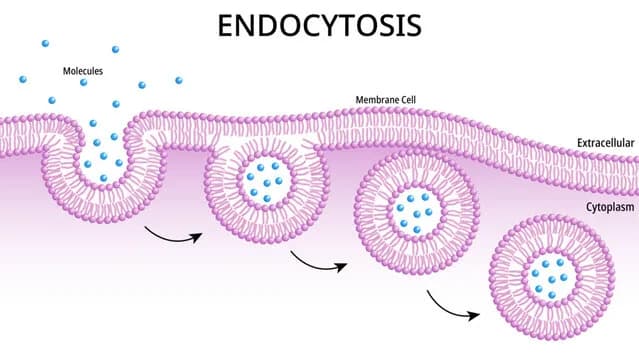
Endocytosis
- Membrane invaginates + engulfs material
- Pinocytosis = fluids
- Phagocytosis = solids (ex: bacteria)
- Initiated by substrate binding
- Vesicle coating proteins drive invagination (ex: clathrin)
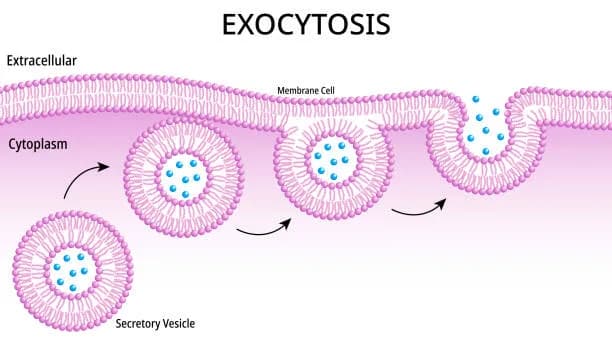
Exocytosis
- Secretory vesicles fuse with membrane
- Releases material to extracellular space
- Important in nervous system
- NT exocytosis is crucial in neuroscience
8.4 Specialized Membranes
Specialized membranes create electrical potentials (via ion gradients and pumps) and mitochondria have distinct outer/inner membranes that support respiration and ATP production.
Membrane potential
- Electrical potential difference across membrane
- Usually to mV
- Can rise to mV during depolarization
- Maintained via leak channels
- Na⁺/K⁺ pumps play big role
- Nernst equation calculates equilibrium potential:
- Membrane acts like a capacitor:
- Opposite charges maintained on each side
- More positive ions outside → more positive potential
Na⁺/K⁺ pump
- Steady-state resting relationship between diffusion and Na⁺/K⁺ ATPase
- Maintains resting concentration potentials
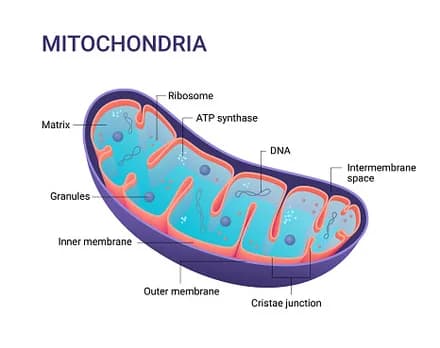
Mitochondrial membranes
Outer membrane
- Highly permeable due to large pores (passage of ions + small proteins)
- Surrounds inner membrane
- Has intermembrane space
Inner membrane
- Restricted permeability
- Infoldings (cristae) increase surface area
- Matrix inside is site of Krebs cycle respiration
- High cardiolipin
- No cholesterol
Spotted something wrong or unclear? Tell us — these notes are revised continuously.