
MCAT Biochemistry · Lesson 7
RNA and the Genetic Code
5 min read5 sectionsUpdated
5 sections
7.1 Genetic Code
Genes encode RNA/protein information, with mRNA carrying codons for translation, tRNA matching codons to amino acids, and rRNA forming the catalytic ribosome machinery.
- Gene = unit of DNA that encodes stuff
Types of RNA
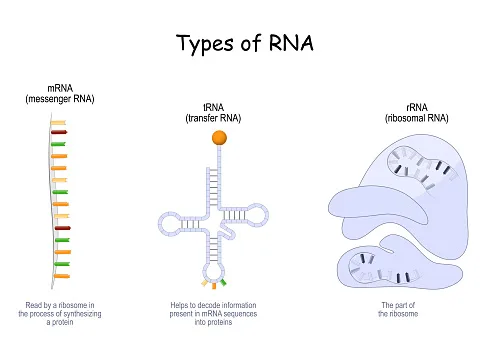
Messenger RNA (mRNA)
- Carries info specifying amino acid sequence
- Made from template DNA by RNA polymerase
- Only RNA that gets translated
- Eukaryotes: mRNA is monocistronic (different mRNA for different proteins)
- Prokaryotes: mRNA is polycistronic (starts translation at different locations)
tRNA
- Converts nucleic acid info → amino acids/peptides
- Folded RNA strand with anticodon
- Charged with amino acid
Aminoacyl-tRNA synthetase
- Requires 2 high-energy bonds from ATP
- Transfers activated amino acid to tRNA
Ribosomal RNA (rRNA)
- Synthesized in nucleolus
- Functions as ribosomal machinery
- Most rRNA are ribozymes
- Enzymes made of RNA instead of peptides
- Catalyze peptide bond formation
Codons
- 3-letter word
- codons
- Recognized by complementary anticodon
Mutations
- Degeneracy: more than one codon can specify a single amino acid
- Wobble: third base can differ (protects against mutations)
- Missense = substitution
- Nonsense = stop codon
- Frameshift = everything messed up
7.2 Transcription
Transcription makes mRNA from a DNA template using RNA polymerases and promoter regions, followed by eukaryotic processing like splicing, 5’ capping, and poly-A tailing.
- Transcription = mRNA made from DNA
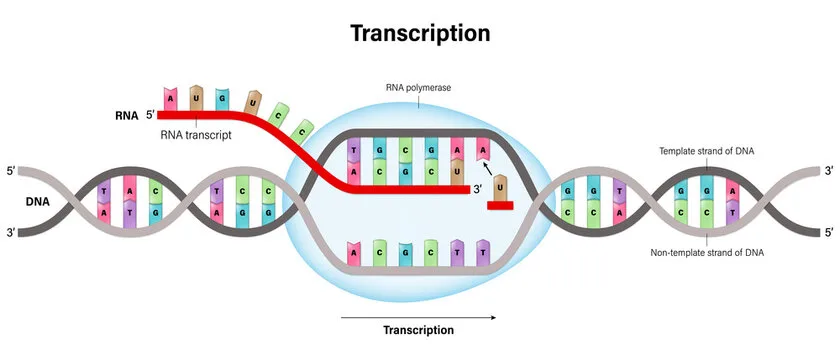
Mechanism
- Helicase + topoisomerase unwind DNA
- Template strand = antisense strand
- New RNA strand is antiparallel + complementary to template DNA
Promoter region
- RNA polymerase searches promoter regions
- RNA polymerase II is main enzyme transcribing mRNA
- Key promoter site: TATA box (high T/A content)
- Transcription factors help RNA pol bind + locate promoter
RNA polymerase types
- RNA pol I:
- Nucleolus
- rRNA
- RNA pol II:
- Nucleus
- hnRNA (preprocessed) and snRNA (small nuclear RNA)
- RNA pol III:
- Nucleus
- tRNA and some rRNA
Coding strand
- Not used as template
- Complementary to template strand
- Identical to mRNA except T → U
Gene numbering
- First RNA base transcribed = +1 of gene region
- Bases left of +1 are negative, right are positive
- No nucleotide is 0
- RNA pol II binds TATA box around -25
Post-transcriptional processing
- hnRNA must be processed before leaving nucleus for translation
Splicing
- Done by spliceosome
- snRNA couples with snRNPs
- snRNP recognizes both 5’ and 3’ splice sites
- Noncoding sequences removed as lariat (lasso) → degraded
5’ cap
- Protects mRNA from degradation in cytoplasm
3’ poly-A tail
- Protects against rapid degradation
- Acts like a time bomb: mRNA starts degrading after it leaves nucleus
- Longer tail → survives longer
- Mature mRNA transported into cytoplasm
- Alternative splicing → more proteins from limited genes
7.3 Translation
Translation uses ribosomes (rRNA + proteins) and tRNAs to build polypeptides through initiation, elongation, and termination, followed by folding and posttranslational modifications.
- mRNA created + processed → exits via nuclear pores → translated
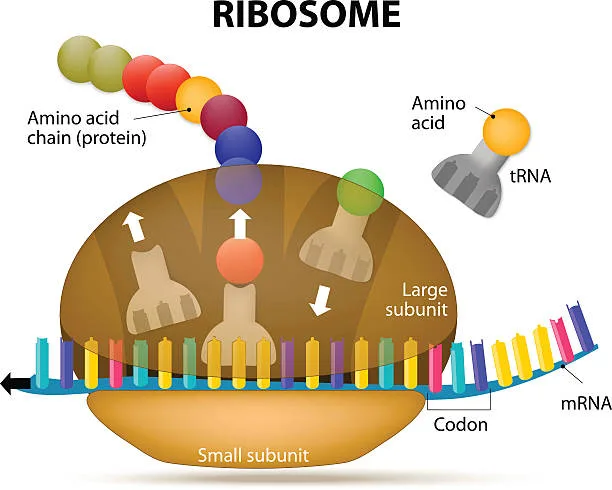
Ribosome
- Made of proteins + rRNA
- Has A, P, E sites
- Eukaryotic ribosomes: 28S, 18S, 5.8S, 5S rRNA
- RNA pol I transcribes 28S, 18S, 5.8S together as 45S precursor
- 45S processed → 18S (40S subunit) + 28S + 5.8S (60S subunit)
- RNA pol III transcribes 5S rRNA (in 60S)
- Subunits formed (40S + 60S) → assemble into 80S ribosome
Mechanism of translation
Initiation
- Small subunit binds Shine-Dalgarno sequence
- Charged initiator tRNA binds AUG start codon
- fMet is first amino acid
- Large subunit binds → initiation complex
- Assisted by initiation factors (IF)
Elongation
- Repeating 3-step cycle for each amino acid
- A site:
- Incoming aminoacyl-tRNA (next AA added)
- P site:
- Holds tRNA carrying growing polypeptide chain
- Where first AA binds
- Requires peptidyl transferase:
- Catalyzes peptide bond between AA in A site and growing chain in P site
- Peptide bond = amide bond
- E site:
- Uncharged tRNA pauses before exiting
- All 3 stages require energy
- Elongation factors (EF) recruit/locate aminoacyl-tRNA using GTP
- Signal sequence can direct ribosome to ER → protein to Golgi → secreted via vesicle
Termination
- When stop codon enters A site, release factor (RF) binds
- Water added to polypeptide chain
- Peptidyl transferase + termination factors hydrolyze chain
- Polypeptide released from tRNA in P site
- Ribosomal subunits dissociate
Post-translational processing
- Protein must fold correctly
- Chaperone proteins assist folding
- Cleavage modifications:
- Insulin cleaved from larger inactive peptide to active peptide
- Quaternary proteins require subunits to assemble
- Other modifications:
- Phosphorylation
- Carboxylation
- Glycosylation
- Prenylation
7.4 Control of Gene Expression in Prokaryotes
Prokaryotes regulate genes using operons with shared promoters/operators, using inducible (lac) or repressible (trp) systems with negative and positive control mechanisms.
Operon
- On/off switch where genes share common promoter
- Transcribed as a group
- Examples: trp operon, lac operon
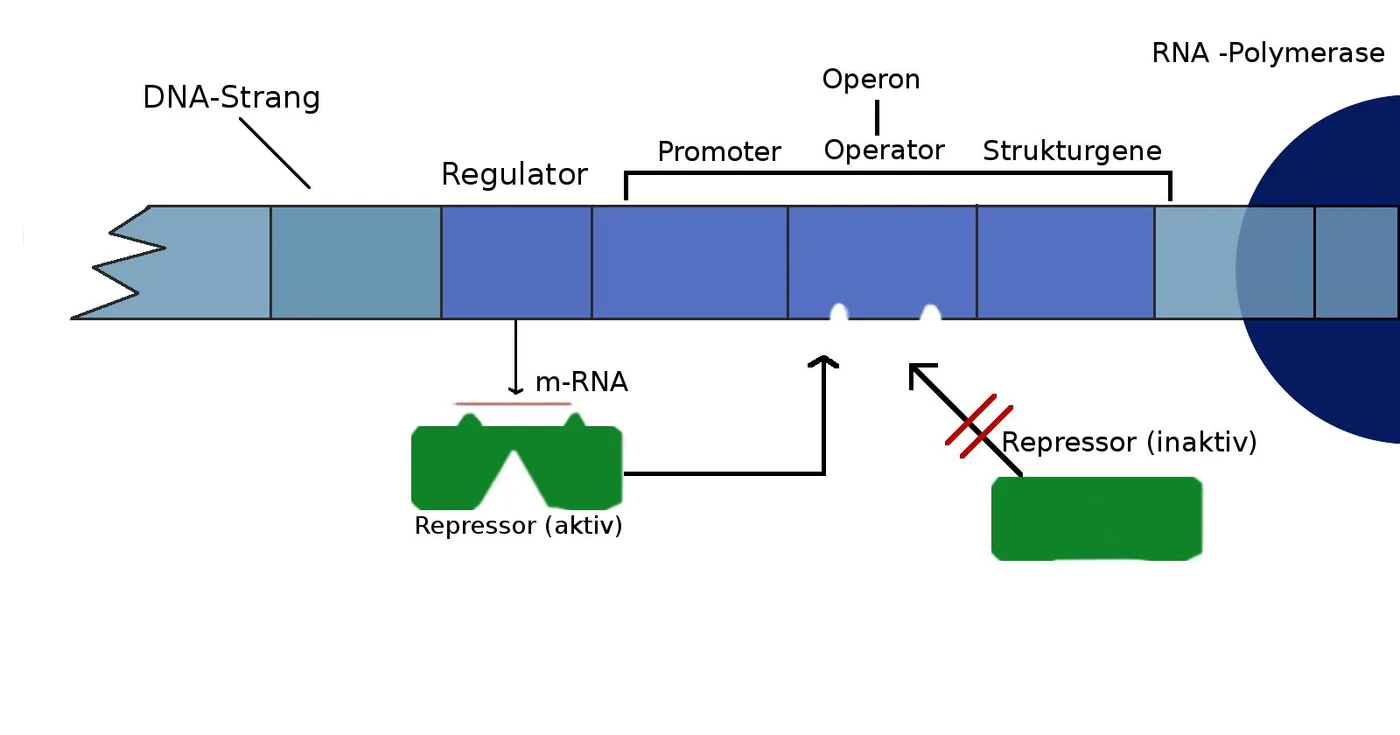
- Jacob–Monod model describes operon structure/function
- Operons contain:
- Structural genes
- Operator site
- Promoter site
- Regulator gene
Structural gene
- Codes for protein of interest
Operator site
- Nontranscribable region
- Binds repressor
Promoter site
- Where RNA polymerase binds
Regulator gene
- Upstream
- Codes for repressor
Inducible systems
- Repressor tightly bound to operator → roadblock
- Negative control mechanism
- Inducer binds repressor:
- Competitive inhibition idea
- Higher $$[inducer]$$ pulls more repressors off operator
- Lac operon is inducible
- CAP + cAMP binding enables CAP to bind promoter region
- Positive control mechanism
Repressible system
- Constant production of protein product
- Repressor inactive until binds corepressor
- Corepressor activates repressor → binds operator → stops transcription
- Trp operon is repressible
- High tryptophan = corepressor
- 2 molecules cause repressor to bind operator
7.5 Control of Gene Expression
Eukaryotic gene expression is regulated by transcription factors, enhancers, gene amplification/duplication, and chromatin remodeling via histone acetylation and DNA methylation.
Transcription factors (TFs)
- Transcription-activating proteins that search DNA for binding motifs
DNA-binding domain
- Binds specific sequences in promoter or DNA response element
- Recruits transcription machinery
Activation domain
- Binds multiple TFs + regulatory proteins (RNA pol + histone acetylases)
- Helps remodel chromatin
Gene amplification
- Enhancers increase RNA pol ability at a single promoter site
- Group of response elements controls expression of one gene
- cAMP binds CREB
- Cortisol binds cortisol receptor
- TFs bind their response elements
- Enhancers can be ~1000 bp away from the gene
Gene duplication
- Cells can duplicate relevant gene → higher expression
- Can also duplicate in parallel by opening genes with helicase
- Allows replication of only that gene
- Hundreds of copies can exist in parallel
Regulation of chromatin structure
- Heterochromatin:
- Tightly coiled DNA
- Dark under microscope
- Euchromatin:
- Looser DNA
- Chromatin remodeling regulates gene expression
Histone acetylation
- Recruits coactivators like histone acetylases
- Acetylates lysine residues on histone tails
- Acetylation decreases + charge → weakens histone–DNA interaction
- Easier access for transcription machinery to RNA
- Histone deacetylases remove acetyl groups → decrease gene expression
DNA methylation
- Adds methyl groups to cytosine and adenine nucleotides
- Silences gene expression
- Important in development
- Heterochromatin more heavily methylated
Spotted something wrong or unclear? Tell us — these notes are revised continuously.