
MCAT Biology · Lesson 1
The Cell
7 min read5 sectionsUpdated
5 sections
1.1 Cell Theory
This section lays out the basic rules of cell theory, including what cells are, where they come from, and how genetic information is passed on.
- Tenants
- All living things are composed of cells
- The cell is the basic functional unit of life
- Cells arise only from preexisting cells
- Cells carry genetic information in the form of DNA
- Info passed from parent to daughter cell
1.2 Eukaryotic Cells
This section covers the key structures inside eukaryotic cells and what each organelle actually does, plus some cytoskeleton and tissue basics.
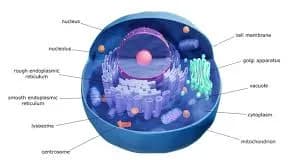
- Nuclear pores allow selective two way exchange of material between cytoplasm and nucleus
- Ribosomal RNA made in nucleolus
- Subsection of the nucleus
- Takes up 25% of nucleus volume, darker spot in picture
- Endosomes transport, package, and sort cell material traveling to and from the membrane
- Transports them to the trans golgi
- Works in conjunction with lysosomes
- ER
- Rough ER has ribosomes, translates protein directly into lumen
- Ribosomes may not have membrane, as found in bacteria that have no membrane bound organelles
- Smooth ER there for lipid synthesis, detoxification of drugs
- Also involved in transport of materials throughout cell, such as proteins
- Mitochondria
- Have their own DNA
- Circular and self replicating, through binary fission
- Double stranded
- Peroxisomes
- Contain hydrogen peroxide
- Breakdown of very long fatty acid chains with beta oxidation
- Microfilaments
- Made up of actin rods
- In muscle contraction, cytokinesis
- Forms cleavage furrow
- Microtubules
- Hollow polymers of tubulin
- Radiate throughout the cell, providing primary pathways
- Motor proteins like kinesin and dynein carry vesicles
- Make cilia
- Involved in movement of materials along surface, such as mucus
- Make flagella
- Move the cell itself, such as sperm cells
- Same structure with cilia
- 9 + 2, 9 pairs of microtubules with 2 microtubules in the center
- Centrioles
- In centrosome, organizing centers for microtubules
- Structured as 9 triplets of microtubules with hollow centers
- Attach to kinetochores and pull them apart
- Intermediate filaments
- Include keratin, desmin, vimentin, lamins
- Involved in cell to cell adhesion or maintenance of cytoskeleton
- Withstand force, anchor other organelles
- Epithelial tissue
- Have underlying layer of connective tissue, basement membrane
- Usually constitute parenchyma, functional parts of organ
- Nephrons in kidney, hepatocytes in liver
- Simple epithelia have one layer
- Stratified epithelia have multiple layers
- Pseudostratified epithelia appear to have multiple layers because of difference in cell height
- But only have one layer
- Shape
- Cuboidal cells cube
- Columnal long and thin
- Squamous flat and scale like
- Connective tissue
- Framework for epithelial cells
- Main contributors to support structure
- Most produce and secrete materials like collagen or elastin to form ECM
- Make stroma, bones, tendons, provide epithelial support, secrete substances to form ECM
1.3 Classification and Structure of Prokaryotic Cells
This section breaks down the features of prokaryotes, major differences between bacteria and archaea, and key structural components like walls and flagella.
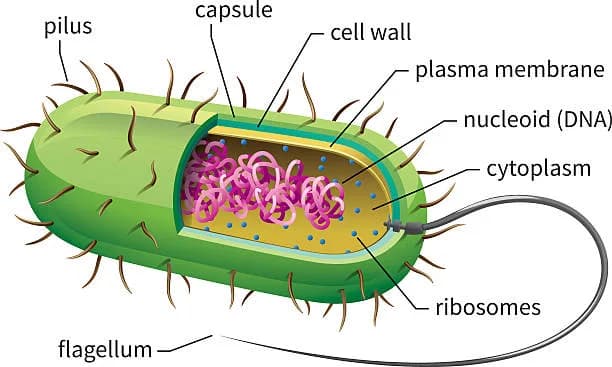
- Prokaryotes have no organelles
- Single circular DNA concentrated in nucleoid region
- Archaea
- Extremophiles
- Chemosynthetic, use sulfur and nitrogen
- Similar RNA polymerases as eukaryotes, use histones with DNA
- But single circular chromosome, use binary fission
- Resistant to antibiotics
- Bacteria
- All have cell membrane and cytoplasm
- Some have flagella or fimbriae (similar to cilia)
- Can target bacterial flagellum
- Small ribosome than eukaryotes
- Shapes
- Cocci = spherical
- Rod shaped = bacilli
- Spiral shapes = spirilli
- Aerobes and Anaerobes
- Obligate aerobes = requires oxygen
- Anaerobes = does not require oxygen
- Obligate anaerobes = can't survive in oxygen environment
- Facultative anaerobes = can use aerobic and anaerobic metabolism
- Aerotolerant anaerobes = not harmed by oxygen
- Cell wall
- Type determined by gram staining
- Crystal violet stain with safranin
- If gram positive absorbs stain
- Gram negative does not, appears pink red
- Gram positive
- Peptidoglycan
- Structural component, protects from organisms immune system
- Also has lipoteichoic acid, unsure
- Gram negative
- Very thin wall, much less peptidoglycan
- Peptidoglycan adjacent to membrane, separated by periplasmic space
- Have outer membranes with phospholipids
- And have lipopolysaccharides
- This triggers immune response
- Flagella
- Chemotaxis is ability to detect chemical stimuli and move towards or away
- Composed of filament, basal body, and hook
- Filament is hollow helical structure made of flagellin
- Basal body anchors flagellum to membrane and motor of flagellum
- Hook exerts torque on filament and basal body, spinning and moving bacteria
- Other organelles
- DNA coiled around histone like proteins in some bacteria
- DNA from other sources as plasmids
- Not part of genome, but confer antibiotic resistance
- No mitochondria, cell membrane used for ETC and ATP production
- 30S and 50S subunit ribosome
- Compared to 40S and 60S in eukaryotes
1.4 Genetics and Growth of Prokaryotic Cells
This section explains how bacteria reproduce, how they exchange genes, and what the classic bacterial growth curve looks like.
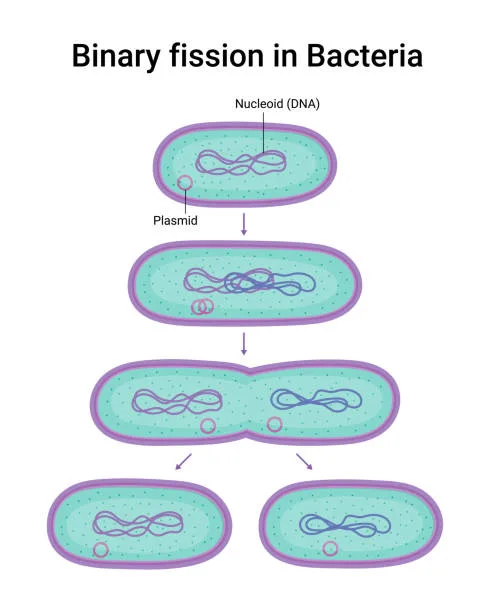
- Binary fission
- Asexual reproduction in eukaryotes
- Circular chromosome attaches to cell wall, replicates while cells grow
- Plasma membrane and cell wall grow inward along midline, make daughter cells
- Proceeds rapidly because fewer events than mitosis
- Does not cause genetic variability
- So does not account for increased resistance
- Since it makes identical copies
- Genetic Recombination
- Plasmids have other genes
- Episomes are subset of plasmids capable of integrating into genome
- Transformation
- Integration of foreign genetic material into host
- Comes from other bacteria
- Lyse and spill contents nearby bacterium
- Many gram negative rods do this
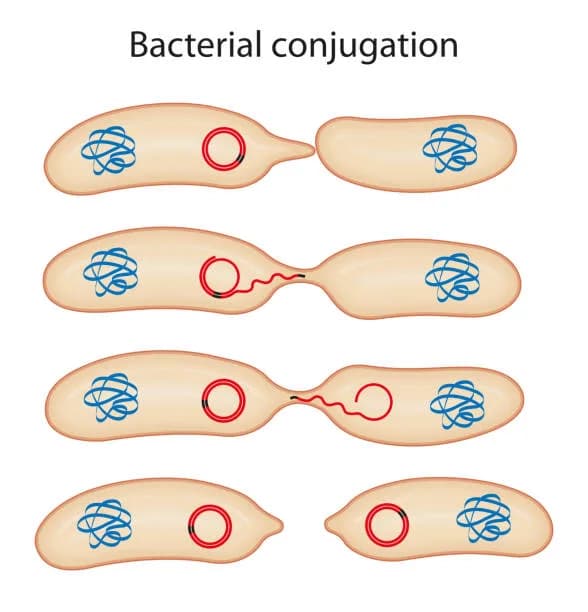
- Conjugation
- Mating, cells make conjugation bridge
- From donor male + to recipient female -
- Made from sex pili, bacteria must have sex factors like fertility factor (F)
- Cells with F plasmid are F+, those without are F-
- Cell with F+ replicates F factor, donates to F- to make new F+ cell
- How antibiotics are passed on
- Occurs quickly
- Donor cell tries to transfer full DNA sequence but bridge of sex pilus breaks beforehand
- Hfr (high frequency recombination) occurs for cells that underwent the change
- Transduction
- Genetic recombination requiring a vector
- Virus that carries material
- Cannot reproduce outside of cell, use bacteriophages to incorporate a segment of host DNA
- When bacteriophage traps bacterium, releases trapped DNA into cell
- Transferred DNA integrates into genome, giving new genes
- Transposons
- Genetic elements that can remove and insert from the genome
- Not limited to prokaryotes, happens in eukaryotes
- If inserted into coding region, gene can be disrupted
- Growth
- Bacteria reproduce via binary fission
- Implies colony is the same, no bacteria dividing faster
- Grows in a series of phases
- Lag phase: adapt to new conditions
- Exponential phase: rate much higher, called log phase
- Stationary phase: resources reduced from rapid growth
- Death phase: bacteria exceed carrying capacity, resources depleted
1.5 Viruses and Subviral Particles
This section goes over virus structure, how viruses replicate, major genome types, and the basics of prions and viroids.
- Viruses are not cells
- Can be 20–300 nanometers large
- Prokaryotes are 1–10 micrometers, eukaryotes 10× that
- Lack organelles and a nucleus
- Viral structure
- Have genetic material, protein coat, and sometimes envelope with lipids
- Genetic info circular/linear, single/double stranded, DNA/RNA
- Protein coat is capsid
- Surrounding envelope sensitive to heat, detergents, desiccation
- So enveloped viruses are easy to kill
- Viruses are obligate intracellular parasites
- Must replicate genetic info in a host cell since no ribosomes
- Hijack machinery, make progeny called virions
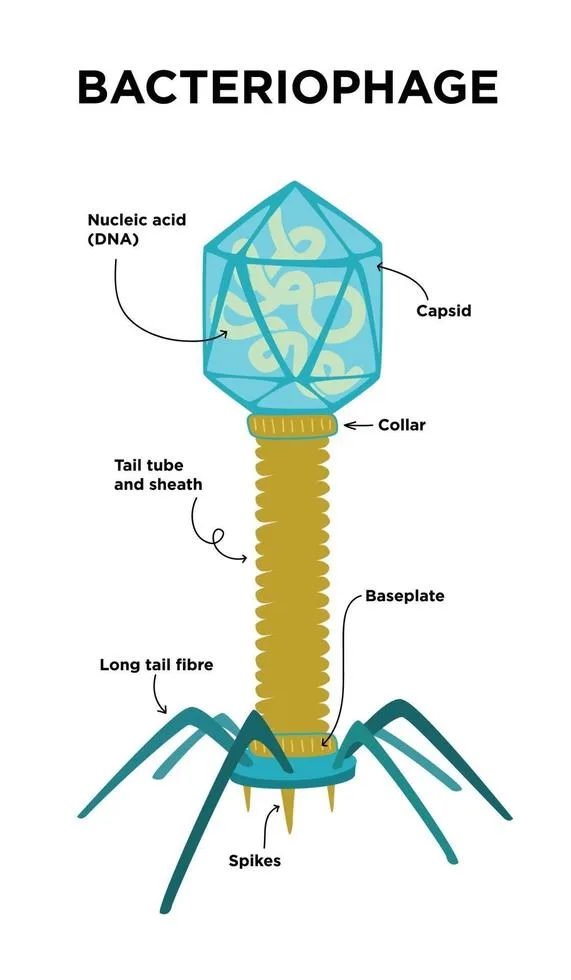
- Bacteriophages
- Infect bacteria
- Inject genetic info
- Have capsid, tail sheath, and fibers
- Tail sheath injects material, tail fibers recognize and connect to host cell
- Viral genomes
- Positive sense: genome directly translated to functional proteins
- Negative sense: template for complementary strand then translated, must carry RNA replicase
- Retroviruses
- Enveloped single stranded RNA
- Have reverse transcriptase, makes DNA from RNA
- DNA inserted into genome, acts like host DNA
- Only way to remove infection is kill cell
- HIV is retrovirus
- Viral life cycle
- Infection
- Infect specific set of cells
- Without receptors, cell is invisible
- Host cell can mistake virus for nutrient and bring it in
- Translation and progeny assembly
- Positive sense RNA stays in cytoplasm
- Negative sense needs complementary strand
- Viral RNA made into proteins
- Structural capsid proteins make more virions
- Must make new copies of RNA from inserted DNA
- Progeny release
- Cell death spills progeny
- Cell may lyse after too many virions
- Can leave through plasma membrane, extrusion
- Cell still usable by virus
- Infection
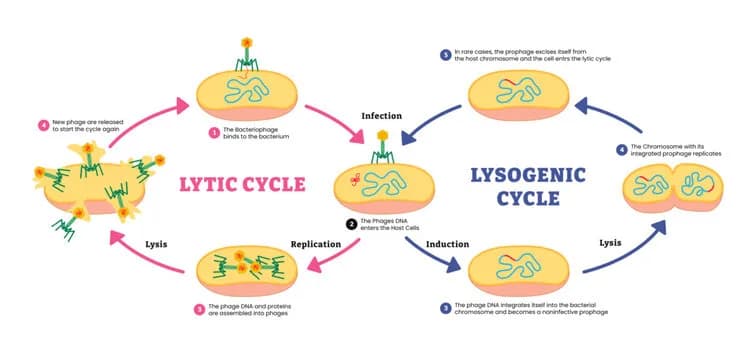
- Lytic and Lysogenic cycles
- Lytic
- Bacteriophage maximizes use of machinery
- Host cell lyses, releases virions
- Termed virulent
- Lysogenic
- Integrates into genome as provirus or prophage
- Can leave genome and enter lytic cycle
- Infection of one phage strain protects from superinfection
- If provirus is innocuous, evolutionary advantage
- Lytic
- Prions and Viroids
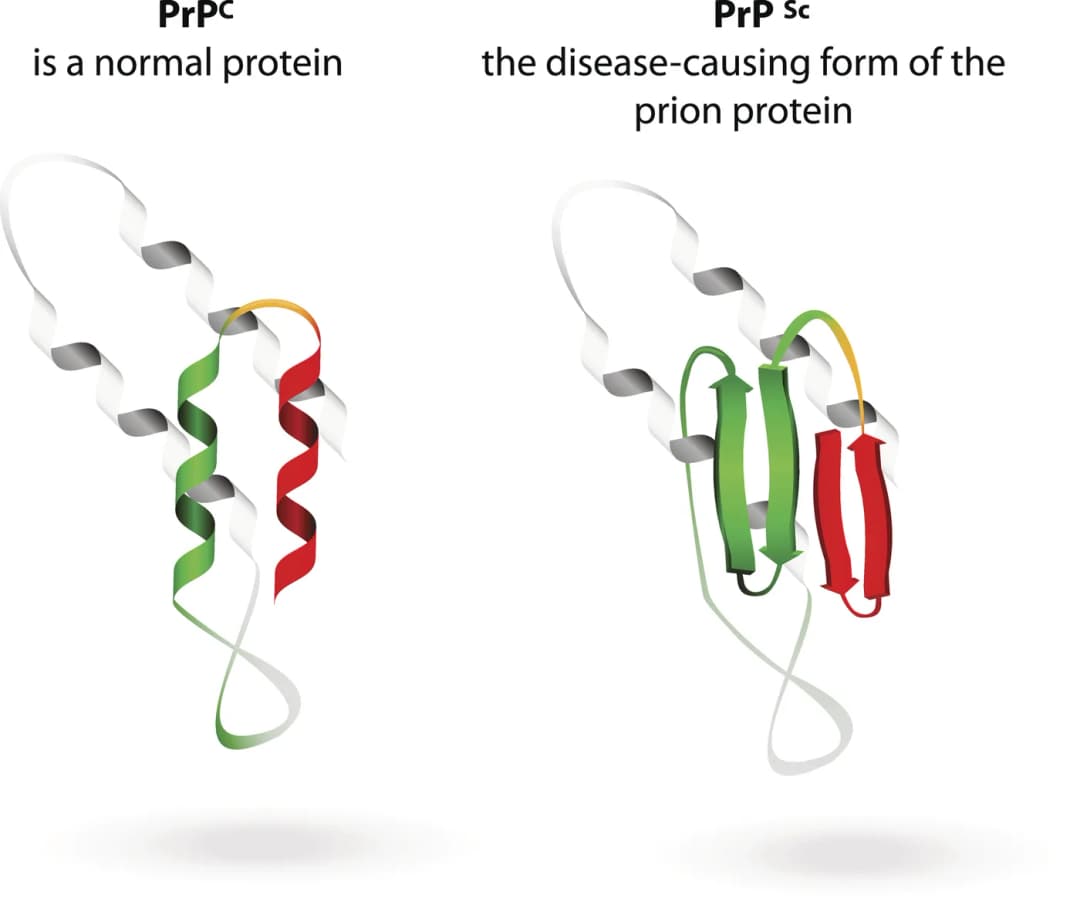
- Prions
- Infectious proteins
- Cause misfolding from alpha helix to beta sheet
- Reduces solubility and ability to degrade
- Cause mad cow, Creutzfeldt Jakob
- Viroids
- Short circular stranded RNA that infect plants
- Bind many RNA sequences, silence genes
- Stops protein synthesis, causing damage
- Hepatitis D is viroid
- Normally harmless but with Hep B, HDV silences hepatocytes
- Prions
Spotted something wrong or unclear? Tell us — these notes are revised continuously.