
MCAT General Chemistry · Lesson 1
Atomic Structure
10 min read4 sectionsUpdated
4 sections
1.1 Subatomic Particles
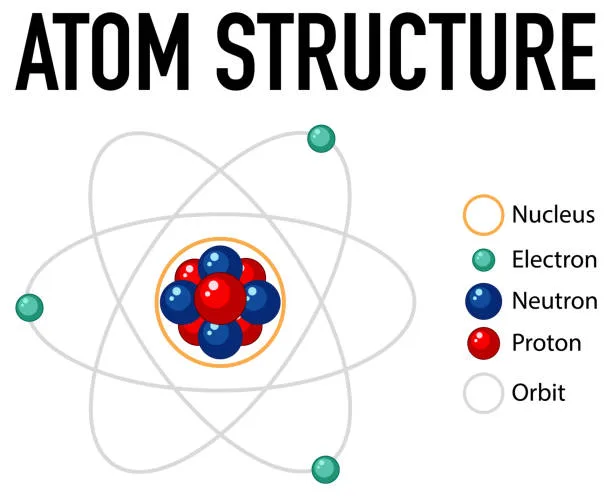
Atoms boil down to three particles: protons, neutrons, and electrons. Where each one lives explains an element's identity, its mass, and (thanks to electrons) basically all of its chemistry.
Every atom you'll meet on the MCAT is built from just three particles. Two of them sit packed in the nucleus; one of them does all the interesting stuff. Get these three down cold, and a surprising amount of gen chem stops feeling like memorization and starts feeling like common sense.
- Protons: the identity card
- Live in the nucleus, carry a charge of +1, and have a mass of about 1 amu
- The number of protons is the atomic number (). It's what makes an element that element. Six protons? That's carbon. Always.
- Change the proton count and you don't get a different version of the atom. You get a different element entirely
- Neutrons: the padding
- Also live in the nucleus, also weigh about 1 amu, but carry zero charge
- They add mass without changing identity or charge
- Mass number () = protons + neutrons, so neutrons = , a subtraction the MCAT expects you to do on autopilot
- Isotopes: same element, different weight
- Same number of protons, different number of neutrons → different mass numbers
- Carbon-12 and carbon-14 are both carbon; carbon-14 just packs two extra neutrons
- Since chemical behavior is driven by electrons (not neutrons), isotopes of an element react nearly identically
- Electrons: where the chemistry happens
- Charge of −1, with a mass about 1/2000 that of a proton, so light we ignore them when adding up an atom's mass
- In a neutral atom, electrons = protons. Lose or gain electrons and you've made an ion (cation if positive, anion if negative)
- Electrons occupy shells around the nucleus; the ones in the outermost shell are the valence electrons
- Valence electrons do all the bonding. Honestly, most of this course is just the story of valence electrons meeting other valence electrons
Want More Resources?
Khan Academy Video: Protons, neutrons, and electrons in atoms
- LibreTexts: Sub-Atomic Particles and The Properties of Protons, Neutrons, and Electrons.
Test Day Summary
= protons = identity. = protons + neutrons = mass. Electrons handle charge and bonding. If a question hands you , you should be able to rattle off 6 protons, 8 neutrons, and 6 electrons (if neutral) without breaking a sweat.
1.2 Atomic Mass vs Atomic Weight
Atomic mass is the mass of one specific atom. Atomic weight is the number on the periodic table: an average of all an element's isotopes, weighted by how common each one is.
Here's a distinction the MCAT loves because students mix it up constantly: atomic mass describes a single atom, while atomic weight describes the element as a whole. Let's break it down.
- The Atomic Mass Unit (amu): the ruler we use for atoms
- One amu is defined as exactly 1/12 the mass of a carbon-12 atom
- , which is why nobody writes atomic masses in grams
- An atom's mass in amu is roughly equal to its mass number (), since protons and neutrons each weigh about 1 amu
- Hydrogen: the classic isotope lineup
- Protium: 1 proton, 0 neutrons (plain old hydrogen, over 99.98% of what's out there)
- Deuterium: 1 proton + 1 neutron
- Tritium: 1 proton + 2 neutrons (this one's radioactive)
- Same element, three different masses. That's isotopes in a nutshell.
- The mole connection
- One mole = particles (Avogadro's number)
- The payoff: one mole of an atom has a mass in grams equal to that atom's mass in amu. One carbon-12 atom weighs 12 amu, so one mole of carbon-12 weighs exactly 12 g.
- Atomic Weight: the number on the periodic table
- A weighted average of all an element's naturally occurring isotopes, based on how abundant each one is
- Think of it like a course grade. If the final is worth 75% of your grade and the midterm 25%, the final drags the average toward itself. Abundant isotopes do the same thing to atomic weight.
- Classic example: chlorine is roughly 75% Cl-35 and 25% Cl-37, so its atomic weight lands around 35.5 amu, much closer to the more common isotope
Want More Resources?
Khan Academy Video: Atomic number, mass number, and isotopes
- LibreTexts: Atomic Masses.
Test Day Summary
Atomic mass belongs to one specific isotope. Atomic weight is the periodic table number, a weighted average. If a question hands you percent abundances, multiply each isotope's mass by its fraction, add everything up, and you're done.
1.3 Rutherford, Planck, and Bohr
Energy comes in discrete packets (Planck), and hydrogen's electron sits at fixed energy levels (Bohr). Put those together and you get why elements emit and absorb only specific colors of light.
Before chemistry got fully weird (that's the next section), physicists nailed down a few ideas that still show up all over the MCAT: atoms have a dense nucleus, energy comes in packets, and electrons can only sit at certain energy levels.
- Rutherford's contribution: the nucleus
- His gold foil experiment showed that an atom's positive charge and nearly all of its mass sit in a tiny, dense nucleus, surrounded by mostly empty space
- Planck's big idea: energy is quantized
- Energy isn't a smooth continuum. It comes in discrete packets called quanta.
- , where h = 6.626 \times 10^{-34}\ \text{J·s} (Planck's constant) and is the frequency of the light
- Translation: higher frequency means higher energy. This equation follows you from gen chem into physics and biochem, so make it automatic.
- The Bohr model: electrons on fixed tracks
- Bohr pictured electrons circling the nucleus in set orbits, like planets around a sun. Wrong in the details, but it works for hydrogen, and the MCAT still tests it.
- Angular momentum is quantized: , where is the principal quantum number. Only certain orbits are allowed. No in-between.
- Each orbit has a set energy: , where (the Rydberg constant)
- Why negative? Zero energy is defined as the electron sitting infinitely far from the nucleus. A bound electron has less energy than that, so its value comes out negative. Less negative means higher energy and a bigger orbit.
- Ground state: , the lowest energy arrangement. Excited state: any higher .
- Emission and absorption: the elevator rule
- Picture the energy levels as floors in a building served by an elevator that only stops at exact floors. There is no floor 2.5.
- Absorb a photon with exactly the right energy and the electron rides up. When it falls back down, it emits a photon.
- The photon's energy matches the gap exactly: , where a negative result means energy is emitted
- Connect energy to wavelength with , where (the speed of light). Bigger jump, more energy, shorter wavelength.
- Line spectra: every element's fingerprint
- Since only exact jumps are allowed, each element emits and absorbs only specific wavelengths, and that pattern of lines is unique to the element
- This is literally how astronomers know what distant stars are made of. Not bad for a few lines on a screen.
- Hydrogen's emission series (know where each one lands):
- Lyman series: transitions down to (ultraviolet, the shortest wavelengths)
- Balmer series: transitions down to (visible light)
- Paschen series: transitions down to (infrared)
- Absorption spectra are the mirror image: dark lines at those exact same wavelengths, where the element soaked up incoming light
Want More Resources?
Khan Academy Video: Electronic structure: Bohr model through Absorption and emission
- LibreTexts: Line Spectra and the Bohr Model.
Test Day Summary
and handle nearly every calculation here. Ground state is . Mnemonic: for hydrogen's series, remember the landing floors. Lyman lands on 1, Balmer on 2, Paschen on 3.
1.4 Quantum Mechanical Model of Atoms
The modern model swaps fixed orbits for probability clouds called orbitals. Four quantum numbers act like each electron's home address, and a few filling rules tell you exactly where every electron lives.
The Bohr model works beautifully for hydrogen, then falls apart for everything else. The modern fix is humbling: you can't track an electron's path at all. You can only say where it's likely to be.
- Orbitals, not orbits
- Electrons occupy fuzzy regions of probability around the nucleus called orbitals. No fixed tracks, just neighborhoods where an electron is likely to be found.
- Heisenberg Uncertainty Principle
- You can't know an electron's exact position and its momentum at the same time. Pinning down one blurs the other.
- The four quantum numbers: an electron's home address
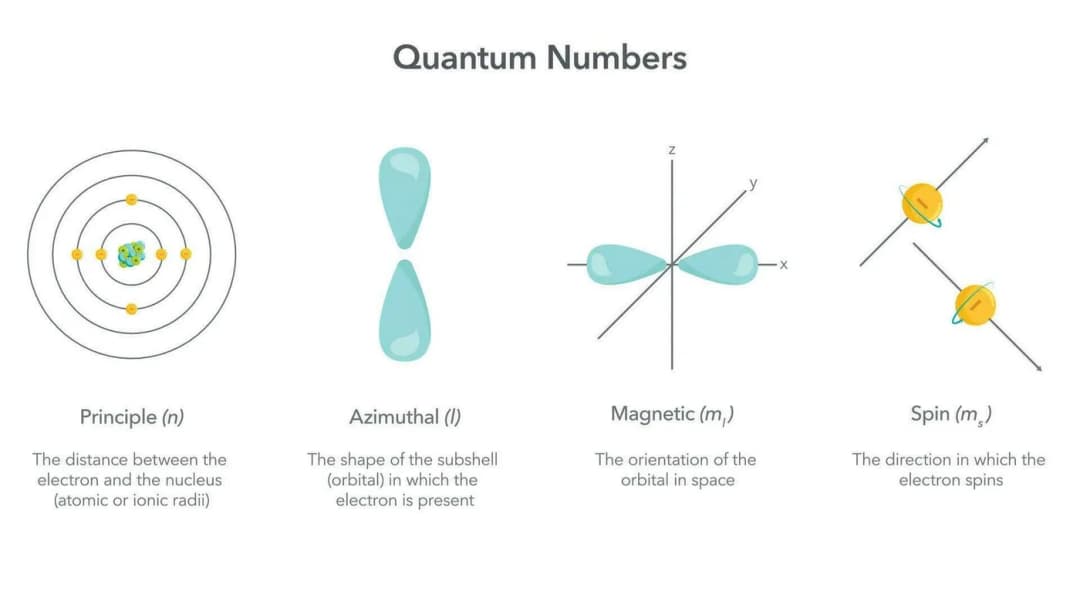
- Every electron gets described by four numbers: . Think of them as state, city, street, and house number.
- Pauli Exclusion Principle: no two electrons in an atom can share all four numbers. Nobody gets the same full address.
- Principal Quantum Number (): the shell
- Sets the electron's energy level and rough distance from the nucleus. Higher means higher energy and a bigger radius.
- Max electrons per shell:
- Azimuthal Quantum Number (): the subshell
- Sets the subshell's shape. The letters s, p, d, f correspond to = 0, 1, 2, 3.
- Allowed values run from 0 up to , so shell number contains subshells
- The cheat sheet:
Subshell Azimuthal Quantum # (l) # of e⁻ s 0 2 p 1 6 d 2 10 f 3 14 - Max electrons per subshell:
- Magnetic Quantum Number (): the orbital
- Picks out which orbital within the subshell, which really means its orientation in space
- Allowed values run from to , so an s subshell has 1 orbital, p has 3, d has 5, and f has 7
- Sanity check: if (an s subshell), then can only be 0. One subshell, one orbital.
- Spin Quantum Number (): the electron itself
- Only two options: or
- Each orbital holds at most two electrons, and they must have opposite spins (thanks, Pauli)
- Electrons with the same spin value are said to have parallel spins
- Electron Configurations: filling the building
- Notation like
2p⁴reads: shell 2, subshell p, 4 electrons living there - Electrons fill from lowest energy up (the Aufbau principle), which sometimes looks out of order on paper: 4s fills before 3d, and 6s before 5d
- Hund's Rule: within a subshell, electrons take their own orbital before pairing up, like strangers on a bus grabbing empty rows before sharing a seat. Maximize unpaired, parallel spins.
- Paramagnetic: has unpaired electrons and gets pulled into magnetic fields. Diamagnetic: all electrons paired, slightly repelled.
- Mnemonic: unPAIRed makes it PARamagnetic.
- When atoms lose electrons to form cations, the s electrons leave before d, even though s filled first
- Zn:
[Ar] 4s² 3d¹⁰becomes Zn²⁺:[Ar] 4s⁰ 3d¹⁰
- Zn:
- Notation like
- Valence Electrons
- The outermost electrons, sitting in the highest energy s and p subshells
- These are the ones that show up for bonding, which is why the next lesson (the periodic table) is really just a map of valence electron patterns
Want More Resources?
Khan Academy Video: Heisenberg uncertainty principle
Khan Academy Video: Paramagnetism and diamagnetism
- LibreTexts: Quantum Numbers for Atoms and Electronic Structure of Atoms.
Test Day Summary
Given , allowed runs from 0 to . Given , allowed runs from to . Every orbital caps at 2 electrons with opposite spins. If you can write the configuration for any element and its common ions, you're in good shape.
Spotted something wrong or unclear? Tell us — these notes are revised continuously.