
MCAT General Chemistry · Lesson 2
The Periodic Table
5 min read4 sectionsUpdated
4 sections
2.1 The Periodic Table
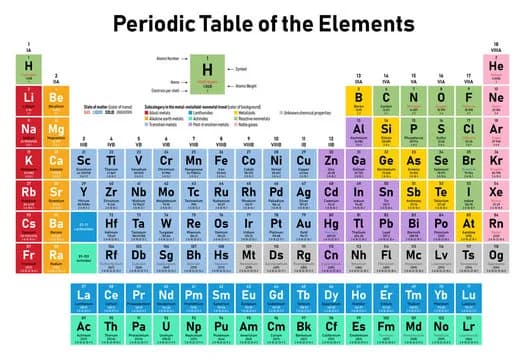
This section explains how the periodic table was developed, its structure (periods and groups), and the distinctions between representative and non-representative elements.
Khan Academy Video: Periodic table: Classification of elements
- Mendeleev published the first version of the periodic table in 1869.
- Revised by Henry Moseley.
- Divided into periods (rows) and groups/families (columns).
- Roman numeral of group represents valence electrons.
A elements (Representative elements)
- Valence electrons in s or p subshells.
- Groups 1,2, and 13-18
B elements (Non-representative elements)
- Includes transition elements (s and d subshells) and lanthanide/actinide series (s and f subshells).
Some unexpected combinations
- Chromium:
4s¹ 3d⁵ - Copper:
4s¹ 3d¹⁰
2.2 Types of Elements
This section categorizes elements as metals, nonmetals, or metalloids, describing their key physical and chemical properties.
Metals
- Lustrous (shiny), malleable, ductile (can be drawn into wires).
- Low effective nuclear charge, low electronegativity, high electro-positivity.
- Large atomic radius, small ionic radius, low ionization energy, low electron affinity.
- Most have 2 or more oxidation states.
- Good conductors because valence electrons move freely.
- Active metals: valence electrons in s orbital.
- Transition metals: valence in s and d orbitals.
- Lanthanides/actinides: valence in s and f orbitals.
- Some are nonreactive (e.g., gold), good for jewelry.
Nonmetals
- Located on upper right side of table.
- Brittle, no luster, poor conductors.
- Do not easily give up electrons.
Metalloids (Semimetals)
- Found along stair-step line separating metals and nonmetals.
- Properties intermediate between metals and nonmetals.
- Physical properties vary widely; reactivity depends on what element they react with.
- Example: Boron acts as nonmetal with Na but very reactive with F.
- Often brittle but good conductors.
2.3 Periodic Properties of Elements
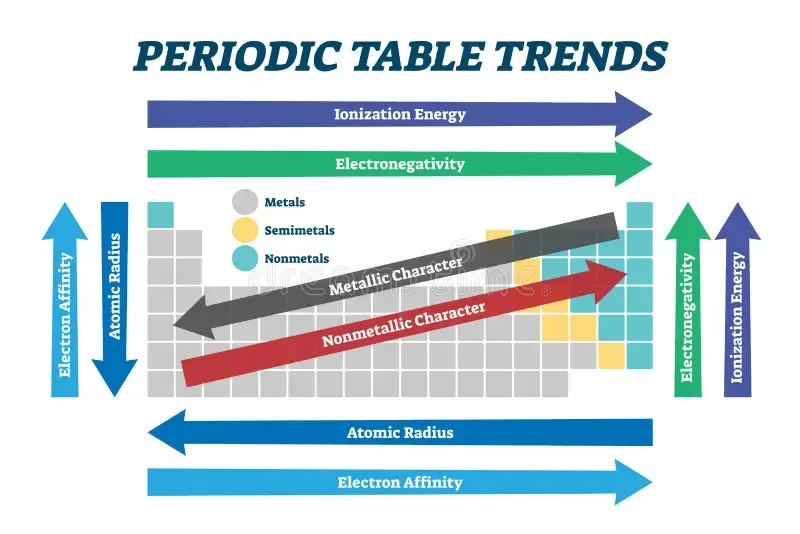
This section describes how atomic structure and electron configuration explain periodic trends such as atomic size, ionization energy, electron affinity, and electronegativity.
- Moving left → right, protons are added → nucleus becomes more positive → electrons pulled closer to center.
- Effective nuclear charge (Zeff): measure of net positive charge experienced by outer electrons.
- Moving down a group, principal quantum number increases → valence electrons farther from nucleus.
- Increased shielding cancels some of nucleus’s positive pull → Zeff roughly constant within group.
- Zeff represents how strongly protons pull on electrons.
- Example: Cl (17p, 17e⁻) balanced; K⁺ (19p, 17e⁻) has stronger pull due to extra protons.
- Elements gain or lose electrons to reach a stable octet.
Atomic and Ionic Radii
- Atomic radius: half the distance between centers of two atoms of same element.
- Must be measured with multiple atoms (since atoms are always moving).
- Across a period: electrons added → greater nuclear pull → smaller radius.
- Down a group: more inner shells → valence farther from nucleus → larger radius.
- Largest radius: Cs; smallest: He (Francium rare).
- More valence electrons → smaller radius; more electron shells → larger radius.
- Neutrons do not affect atomic radius.
Ionic Radii
- Metals: lose electrons → become cations (smaller).
- Nonmetals: gain electrons → become anions (larger).
- Metalloids: can gain or lose electrons, trend depends on position relative to metalloid line.
- Nonmetals near metalloid line → need more electrons → larger ionic radius.
- Metals near metalloid line → lose more electrons → much smaller ionic radius.
- Metals near Group I → fewer electrons lost → smaller radius reduction.
- Anions: larger than atoms (e.g., F → F⁻).
- Cations: smaller than atoms (e.g., K → K⁺).
Ionization Energy
- Energy required to remove an electron from gaseous species.
- Endothermic (requires heat input).
- Higher Zeff or electrons closer to nucleus → harder to remove → higher ionization energy.
- Trend: increases left → right, bottom → top.
- Removing multiple electrons gets progressively harder (due to increasing positive charge).
- Group I & II have low ionization energies → very active, rarely found neutral.
- Group VIII (noble gases) → very high ionization energies (already stable).
Electron Affinity
- Energy released when an atom gains an electron.
- Halogens: very high electron affinities (one electron completes octet).
- Exothermic (releases heat).
- Stronger nuclear pull → greater energy release.
- Trend: increases left → right, decreases top → bottom (valence farther from nucleus).
- Metals have low electron affinities.
Electronegativity
- Attractive force an atom exerts on shared electrons in a bond.
- Proportional to ionization energy.
- Noble gases (first three): negligible electronegativity (don’t form bonds).
- Pauling scale: ranges from 0.7 (Cs) to 4.0 (F).
- Trend: increases left → right, bottom → top.
2.4 Chemistry of Groups
This section overviews properties of specific element groups, emphasizing valence patterns, reactivity, and characteristic traits.
Alkali Metals (Group IA)
- Low density, low Zeff, large radii, low ionization energy, low electronegativity.
- React violently with water.
- Very active metals.
Alkaline Earth Metals (Group IIA)
- Similar to alkali metals but with higher Zeff and smaller atomic radii.
- Active metals; not found in natural state.
- Form divalent cations (+2 charge).
Chalcogens (Group VIA)
- Mixed group of nonmetals and metalloids with 6 valence electrons.
- Biologically important:
- Oxygen: essential for life.
- Sulfur: in amino acids.
- Selenium: protects against oxidative stress.
- Heavier members are metallic and toxic.
Halogens (Group VIIA)
- Highly reactive nonmetals with 7 valence electrons.
- Exist as gases, liquids, or solids.
- React vigorously with active metals → form ionic bonds (no electron sharing).
- Found as ions (halides) or diatomic molecules (e.g., Cl₂).
Noble Gases (Group VIIIA)
- Inert, minimal reactivity, full valence shell.
- Low boiling points.
- Used in lighting sources (e.g., neon lights).
Transition Metals (Group B)
- Can exhibit multiple oxidation states (lose different numbers of electrons).
- Example: Cu⁺ / Cu²⁺, Mn²⁺–Mn⁷⁺ (except +5).
- Variable oxidation states → different colors.
- Form hydration complexes with water or ligands (e.g., AgCl soluble in NH₃).
- Causes d-orbitals to split into two energy sublevels → absorb specific light wavelengths.
- Reflected light determines observed color.
- Example: carotene absorbs blue light → appears yellow (complementary color).
Spotted something wrong or unclear? Tell us — these notes are revised continuously.