
MCAT General Chemistry · Lesson 3
Bonding and Chemical Interactions
3 min read7 sectionsUpdated
7 sections
3.1 Bonding
The octet rule, exceptions to it, and the basic types of chemical bonds: ionic, covalent, and coordinate covalent.
- Properties of a compound differ from properties of individual elements.
- Example: chlorine and sodium are dangerous alone, but NaCl is safe.
- Octet rule: elements want 8 valence electrons.
Incomplete octet
- H (2), He (2), Li (2), Be (4), B (6)
Expanded octet
- Period 3 or greater can have >8 electrons due to larger orbital shells.
- P = 10, S = 12, Cl = 14
- Atoms in 3rd period have d-orbitals that can hold additional electrons.
- Normal octet uses only s and p orbitals.
Odd # of electrons
- Example: NO has 11 valence electrons and cannot distribute evenly.
Types of bonds
- Ionic: electrons transferred to atom with high electron affinity (e.g., NaCl); electrostatic attraction forms lattice.
- Covalent: electrons shared.
- Equal sharing = non-polar
- Unequal sharing = polar
- Coordinate covalent: both shared electrons from one atom.
London dispersion forces (LDS)
- Noble gases are uncharged and form no covalent bonds → experience only LDS.
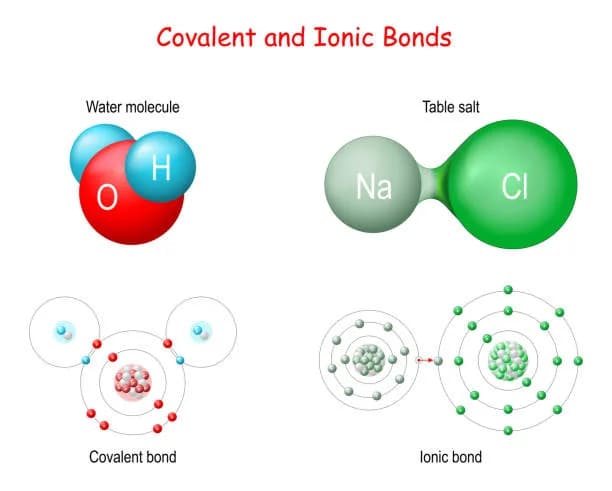
3.2 Ionic Bonds
Ionic bonding involves electron transfer and strong electrostatic attraction, resulting in characteristic physical properties.
- Form between atoms with different electro-negativities.
- Produce cations and anions.
- Generally metal + nonmetal.
- High melting/boiling points.
- Dissolve in water; conduct electricity in aqueous or molten states.
- Form crystal lattices to maximize attraction and minimize repulsion.
Khan Academy Video: Ionic Bonds
3.3 Covalent Bonds
Covalent bonds arise when atoms share electron pairs; bond order, polarity, and molecular properties depend on electronegativity differences.
Khan Academy Video: Covalent Bonds
- Unfavorable to form ions when electro-negativities are similar (costs more energy than gained).
- Covalent compounds have discrete molecular units → weak interactions → lower MP/BP and poor conductivity.
Bond order
- Number of shared electron pairs.
- Bond order ↑ → bond length ↓
- Bond order ↑ → bond energy ↑
Polarity
- Caused by electronegativity differences.
- Similar electronegativity → non-polar (difference ≈ 0.5).
- Diatomic elements: H, N, O, F, Cl, Br, I.
- Polar covalent: difference 0.5–1.7 → partial dipole.
- Dipole moment is vector:
Coordinate covalent
- Both shared electrons from same atom.
- Example: NH₃ donating to BF₃.
- Once formed, looks identical to covalent bond.
- Base donates electron pair; acid accepts.
Notation
- Bonding electrons = electrons in valence shell.
- Lewis structure tracks bonded and non-bonded electron pairs.
3.4 Formal Charge
Formal charge compares the assigned electrons in a Lewis structure to the atom’s normal valence count.
- Formula: F = valence - #nonbonding - 1/2(#bonding)
- "Dots minus sticks" method.
- Example: NH₄⁺ → charge on N = 5 − 1/2(8) = +1
- Underestimates effects of electronegativity differences.
- Resonance structures influence formal charge distribution.
- CO₃²⁻ resonance → average FC = −2/3.
Khan Academy Video: Dot Structures
3.5 Resonance
Resonance structures depict different electron arrangements; the real structure is a hybrid of all contributors.
Khan Academy Video: Resonance Structures
- Use double-headed arrows between resonance structures.
- Real compound is hybrid of contributing structures.
- Negative charge resides on most electronegative atom.
- Example: in [NCO]⁻, electrons mainly on O.
3.6 Exceptions to the Octet Rule
Some atoms cannot follow the octet rule due to too few electrons, too many electrons, or odd electron counts.
- Incomplete octet: H, He, Li, Be, B
- Expanded octet: elements in period ≥ 3 (P, S, Cl, etc.)
- Odd-electron species: e.g., NO
- Example: sulfate ion can have 12 valence electrons.
3.7 VSEPR Theory and Molecular Geometry
VSEPR theory predicts molecular shapes by assuming electron pairs repel and arrange themselves as far apart as possible.
- Predicts molecular geometry.
- Electron pairs want to be as far apart as possible.
- X–A–X arrangement can be linear.
Table: Regions of Electron Density and Shapes
| Regions of e⁻ Density | Example | Shape | Angle |
|---|---|---|---|
| 2 | BeCl₂ | Linear | 180° |
| 3 | BH₃ | Trigonal planar | 120° |
| 4 | CH₄ | Tetrahedral | 109.5° |
| 5 | PCl₅ | Trigonal bipyramidal | 90°, 120°, 180° |
| 6 | SF₆ | Octahedral | 90°, 180° |
Electronic geometry
- Arrangement of all electron pairs (bonding + lone).
- CH₄, NH₃, H₂O have same electronic geometry: 4 electron pairs around central atom.
Molecular geometry
- Only considers bonding pairs.
- Coordination number = number of atoms bonded to central atom.
Polarity
- Bond dipoles do not always create a molecular dipole.
Spotted something wrong or unclear? Tell us — these notes are revised continuously.