
MCAT General Chemistry · Lesson 4
Compounds and Stoichiometry
4 min read6 sectionsUpdated
6 sections
4.1 Molecules and Moles
This section explains the distinction between molecules and compounds, the concept of the mole, molar mass, and equivalents. It also covers normality and molarity for solution calculations, highlighting how to compare quantities in chemical reactions.
- Molecules vs Compounds
- Molecule: 2+ atoms held with covalent bonds.
- Compound: pure substance composed of 2+ elements in fixed proportion.
- Ionic compounds do not form true molecules → form lattice structures; use formula unit instead of molecule for calculations.
- Molecular and Formula Weight
- Atomic weight: weighted average of isotopic masses.
- Molecular weight: sum of atomic weights in a molecule.
- Formula weight: used for ionic compounds.
- Mole
- Quantity of substance equal to the number of particles in 12 g of carbon-12.
- Avogadro's number:
- Mass of 1 mole of compound (g) = molecular weight (amu).
- Molar mass: g/mol.
- Molecular weight: amu/molecule.
- Equivalent Weight
- Number of moles of the particle of interest produced per mole of compound.
- HCl donates 1 H⁺, H₂SO₄ donates 2 H⁺.
- Normality
- Example: 2 M of Mg(OH)₂ → .
- Diprotic solutions have smaller molarity for same normality.
- Molarity = Normality / n.
- Equivalents allow direct comparison of quantities in reactions.
Khan Academy Video: Stoichiometry and the mole
4.2 Representation of Compounds
Describes how compounds are represented and quantified, including structural formulas, empirical and molecular formulas, and percent composition.
- Structural Formulas
- Show bonds between atoms.
- Law of Constant Composition
- Pure samples of a compound have identical elemental mass ratios.
- Example: H₂O always has 2 H atoms for 1 O atom.
- Empirical vs Molecular Formula
- Empirical: simplest whole-number ratio.
- Molecular: actual number of atoms.
- Percent Composition
- Use empirical formula to derive molecular formula if needed.
4.3 Types of Chemical Reactions
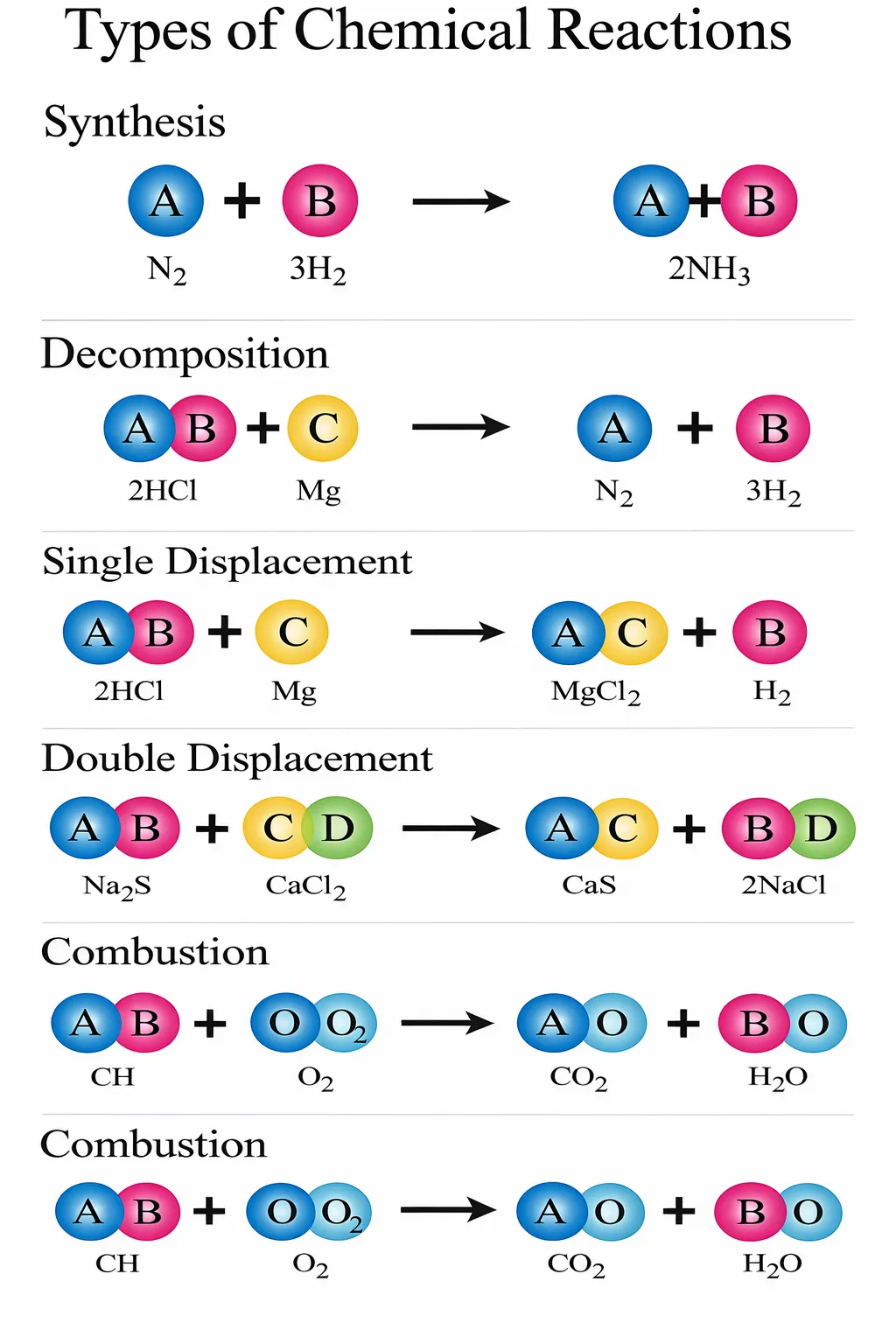
Introduces main reaction types including combination, decomposition, combustion, single and double displacement, and neutralization.
Khan Academy Video: Chemical equation and reactions
- Combination: 2+ reactants → 1 product
- Example:
- Decomposition: 1 reactant → 2+ products
- Example:
- Combustion: Fuel + O₂ → CO₂ + H₂O
- Single Displacement: Atom/ion replaced by another
- Example:
- Double Displacement (Metathesis): AB + CD → AD + CB
- Example:
- Neutralization: Acid + Base → Salt + Water
- Example:
4.4 Balancing Chemical Equations
Emphasizes conservation of mass and charge in chemical reactions and the use of stoichiometric coefficients.
- Reactions must conserve mass and charge.
- Use stoichiometric coefficients to balance equations.
4.5 Applications of Stoichiometry
Explains how to use stoichiometry for mole ratios, limiting reagents, and yield calculations.
- Stoichiometric Ratios
- Multiply reactant moles by molar ratios to find product amounts.
- Limiting Reagent
- Determines maximum possible product.
- Reactants that remain → excess reagents.
- Principle: compare reactants in moles; the lowest is limiting.
- Yield
- Theoretical yield: maximum predicted product.
- Actual yield: experimentally obtained.
Khan Academy Video: Percent Yield
4.6 Ions
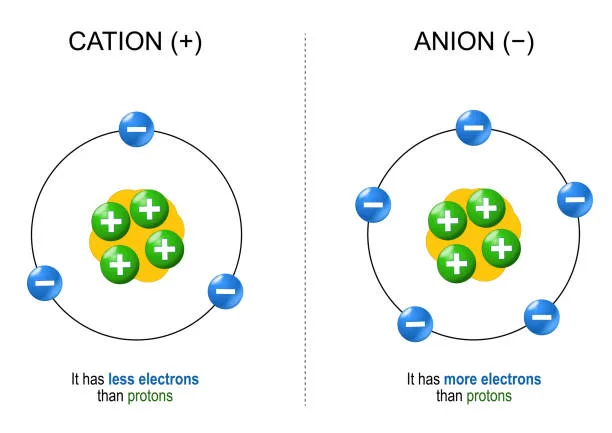
Covers cations, anions, naming conventions, ion charges, and electrolytes.
- Cations and Anions
- H can be H⁺ or H⁻.
- Ionic compounds held by ionic bonds.
- Naming Metals
- Indicate charge with Roman numerals or -ous/-ic suffix.
- Example: Fe²⁺ = ferrous, Fe³⁺ = ferric.
- Nonmetal Anions
- Add -ide: hydride, oxide, sulfide.
- Polyatomic Oxyanions
- Less O → -ite, More O → -ate
- Prefixes: hypo-, per-
- Examples: NO₂⁻ = nitrite, NO₃⁻ = nitrate, ClO⁻ = hypochlorite, ClO₄⁻ = perchlorate
- Ion Charges
- Group elements → predictable monatomic ions.
- Transition metals → multiple oxidation states.
- Solution color can indicate oxidation state.
- Electrolytes
- Strong: dissociate fully → NaCl, KI.
- Weak: partially dissociate → Hg₂I₂.
- Nonelectrolytes: do not ionize → O₂, CO₂, glucose.
Spotted something wrong or unclear? Tell us — these notes are revised continuously.