
MCAT Organic Chemistry · Lesson 7
Aldehydes & Ketones II
2 min read3 sectionsUpdated
3 sections
7.1 General Principles of Enolates
This section explains the acidity of alpha-hydrogens in aldehydes and ketones, formation of enolate intermediates, and the influence of steric hindrance on reactivity.
- Acidity of alpha-Hydrogens
- Alpha carbon = adjacent to carbonyl carbon
- H attached to alpha-C = alpha-H
- O atom pulls e⁻ from C-H bonds → easier deprotonation
- Conjugate base stabilized by resonance (a-C, carbonyl C, carbonyl O) → enolate intermediate
- E⁻ withdrawing O stabilizes carbanion (negatively charged C atom)
- Alpha-H ketones slightly less acidic than aldehydes
- Alkyl groups destabilize carbanions (opposite effect to carbocation stabilization)
- Steric Hindrance
- Aldehydes more reactive to nucleophiles than ketones
- Ketone alkyl groups hinder nucleophile approach → higher energy, crowded intermediate → less likely to react
7.2 Enolate Chemistry
Enolate chemistry covers keto-enol tautomerization, enolate formation, Michael addition, kinetic vs. thermodynamic enolates, and enamine intermediates.
- Keto-Enol Tautomerization
- Enol = C=C bond + alcohol (-OH)
- Tautomers differ in proton placement and double bond
- Equilibrium favors keto form
- Chiral alpha-C → racemic mixture during interconversion (alpha-racemization)
- Enols = key intermediates in aldehyde/ketone reactions
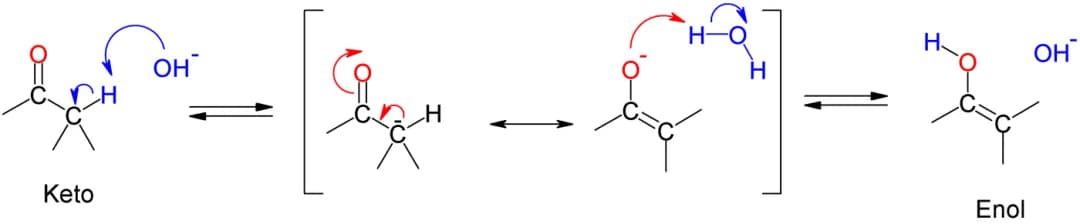
- Deprotonation of alpha-C
- Strong bases: OH⁻, LDA, KH
- Michael Addition
- Carbanion attacks alpha,beta-unsaturated carbonyl (C=C next to carbonyl)
- Resonance stabilization of intermediate drives reaction
- Kinetic vs. Thermodynamic Enolates
- Two enolate forms possible with asymmetric ketone
- Kinetic = rapid, less stable, less substituted → low temp, bulky strong base, irreversible
- Thermo = slow, more stable, more substituted → high temp, small base, reversible
- Enamines
- Tautomers of imines (C=N)
- N may be bonded to alkyl group or substituent
7.3 Aldol Condensation
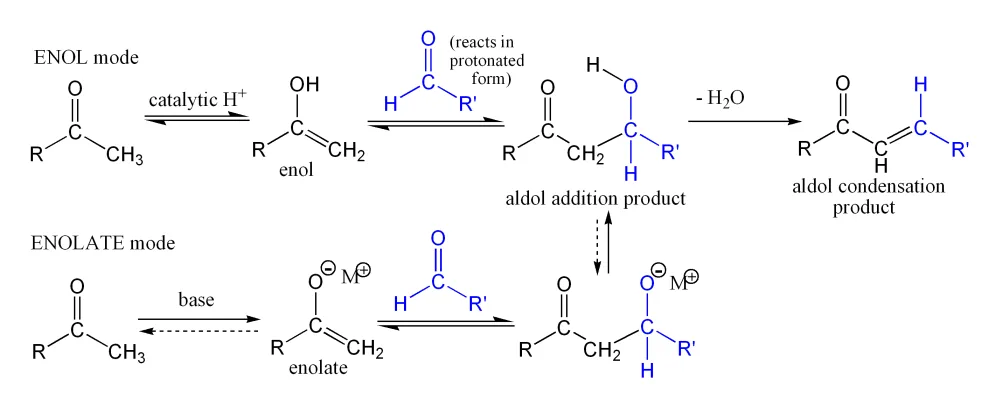
Aldol condensation is nucleophilic addition where aldehydes/ketones act as both nucleophile (enolate) and electrophile (keto). The reaction can produce beta-hydroxy carbonyls and alpha,beta-unsaturated carbonyls via dehydration.
- Mechanism
- Nucleophilic enolate attacks electrophilic carbonyl of another molecule
- Forms 3-hydroxybutanal (aldol, contains aldehyde + alcohol)
- Dehydration
- Strong base + high temp → E1/E2 elimination of water
- Produces alpha,beta-unsaturated carbonyl
- Reaction Control
- Best with single type of aldehyde/ketone
- Multiple types → uncontrolled products
- Prevented if molecule has no alpha-H (quaternary alpha-C)
- Terminology
- Condensation = joining 2 molecules with loss of small molecule (water)
- Dehydration = water eliminated
- Retro-Aldol Reaction
- Reverse aldol
- Aqueous base + heat
- Useful for breaking alpha/beta carbon-carbon bonds
- Stabilized via enolate intermediate
Spotted something wrong or unclear? Tell us — these notes are revised continuously.