
MCAT Organic Chemistry · Lesson 6
Aldehydes & Ketones I
2 min read3 sectionsUpdated
3 sections
6.1 Aldehydes and Ketones Description Properties
This section introduces aldehydes and ketones, emphasizing the carbonyl group's structure, nomenclature, physical properties, and formation methods. Aldehydes are more reactive due to sterics, and carbonyls act as electrophiles.
- Carbonyl = double bond between carbon and oxygen

- Present in both aldehydes and ketones
- Carbonyl can act as nucleophile (condensation) or electrophile (nucleophilic addition)
- Ketone: 2 alkyl groups bonded; aldehyde: 1 alkyl + 1 H
- Ketone carbonyl never terminal; aldehyde always terminal
- Strong smelling compounds
Nomenclature
- Aldehydes: replace -e with -al

- Methanal = formaldehyde
- Ethanal = acetaldehyde
- Propanal = propionaldehyde
- Butanal = butyraldehyde
- Pentanal = valeraldehyde
- Ring-attached aldehyde: -carbaldehyde (e.g., cyclopentane carbaldehyde)
- Ketones: replace -e with -one
- Substituents: oxo- or keto-
- 2-propanone = dimethyl ketone = acetone
- 3-oxobutanoic acid
- Cyclopentanone
Physical Properties
- Dipole stronger than alcohols; =O more e⁻ withdrawing than -OH
- Increased interactions → higher BP than alkanes, lower than -OH (no H bonding)
- Carbonyl carbon = common electrophile
- Aldehydes more reactive than ketones (less steric hindrance, fewer e⁻ donating alkyl groups)
Formation
- Aldehydes from primary alcohols via PCC
- Stronger oxidants → -COOH
- Ketones from secondary alcohols via Na/K dichromate salts, CrO₃, PCC
- Reaction stops at ketone stage
6.2 Nucleophilic Addition Reactions
Aldehydes and ketones undergo nucleophilic addition at the carbonyl carbon. Reactions include hydration, formation of acetals/hemiacetals, imines/enamines, and cyanohydrins.
General Mechanism
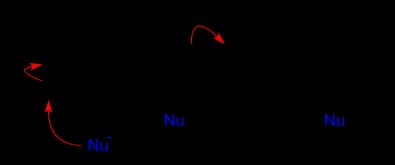
- Nucleophilic addition to carbonyl
- Carbonyl C electrophilic → nucleophile attacks → covalent bond forms, pi bond breaks, e⁻ goes to O
- Forms tetrahedral intermediate
- Carbonyl reforming requires a good leaving group
- O⁻ usually protonated → -OH
Hydration
- Water + aldehyde/ketone → geminal diols
- Nucleophilic O attacks electrophilic C
- Slow, can be acid/base catalyzed
- Product: 2 OH groups
Acetals and Hemiacetals
- 1 equivalent -OH → hemiacetal/ketal (retains hydroxy group)
- 2 equivalents -OH → acetal/ketal via SN1, anhydrous acid
- 2 OR groups; OH from hemiacetal → OR
- Carbocation formed, water lost
- Used as protecting groups
- Deprotection: aqueous acid + heat → carbonyl
Imines and Enamines
- N-based nucleophiles react with electrophilic carbonyl
- Ammonia + carbonyl → imine (N=C) via condensation
- Ammonia derivatives: hydroxylamine, hydrazine, semicarbazide → oximes, hydrazones, semicarbazones
- Imines tautomerize → enamines (double bond + N group)
Cyanohydrins
- HCN as nucleophile
- Triple bond + electronegative N
- Acidic (pKa = 9.2)
- CN⁻ attacks carbonyl C → stable C-C bond
- Aldehydes more reactive than ketones → major product formation
6.3 Oxidation Reduction Reactions
Aldehydes and ketones undergo oxidation and reduction. Aldehydes can form carboxylic acids, and both can be reduced to alcohols using hydride reagents.
Oxidation of Aldehydes
- Stronger than PCC → carboxylic acids
- Oxidizing agents: KMnO₄, CrO₃, Ag₂O, H₂O₂
- Converts aldehyde CH=O → COOH
Reduction by Hydride Reagents
- Aldehydes/ketones → alcohols
- Common reagents: LAH, NaBH₄
- Opposite of PCC oxidation
Spotted something wrong or unclear? Tell us — these notes are revised continuously.