
MCAT Organic Chemistry · Lesson 2
Isomers
2 min read3 sectionsUpdated
3 sections
2.1 Structural Isomers
Structural isomers differ in connectivity; physical properties don’t change composition, but chemical properties do and depend on functional groups.
- Physical properties: melting point, boiling point, solubility, odor, color
- Chemical properties:
- Reactivity of molecule
- Changes chemical composition
- Dictated by functional groups
2.2 Stereoisomers
Stereoisomers share connectivity but differ in spatial arrangement; includes conformational isomers, cyclic strain, chirality, enantiomers, diastereomers, cis/trans, and meso compounds.
Conformational isomers
- Differ in rotation around single (σ) bonds
- Rotation around single bonds produces strain
Newman projection
- Straight-chain representation
- Minimize steric repulsion → carbons 180° apart
- Staggered conformation = anti
- Gauche = groups 60° apart
- Eclipsed = groups in line (120° apart)
- When groups are close, energy ↑ → molecule rotates to lower energy
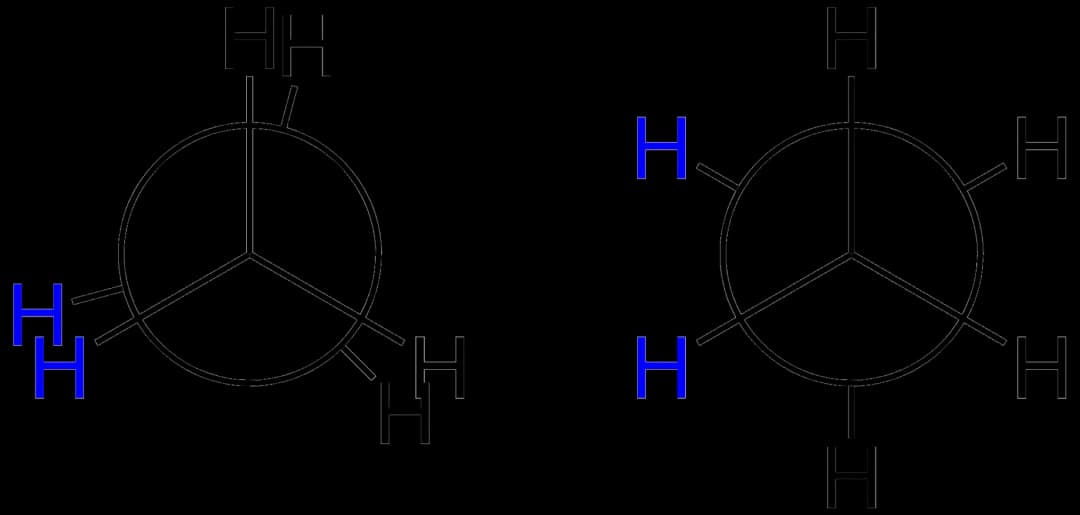
Cyclic conformations
- Types of strain:
- Angle (deviation from ideal bond angles)
- Torsional (eclipsing or gauche interactions)
- Nonbonded (groups competing for same space; flagpole interactions in cyclohexane)
- Cycloalkane conformations:
- Cyclobutane → puckered
- Cyclopentane → envelope
- Cyclohexane → chair, boat, twist (skew) boat
- Chair = most stable (minimizes all three strains)
- Axial and equatorial positions alternate
- Bulkiest group prefers equatorial
Chirality
- A chiral object is not superimposable; asymmetrical
- Mirror image = enantiomer
- Diastereomers differ at one or more (but not all) chiral centers
Enantiomers
- Optically active
- Rotate plane-polarized light
- Polarizer allows only specific light orientations
- Rotate right (clockwise) = dextrorotatory (D), “+”
- Rotate left (counterclockwise) = levorotatory (L), “−”
Specific rotation equation
-
- = rotation in degrees
- = observed rotation
- = concentration (g/mL)
- = path length (dm)
- Racemic mixture: equal + and − enantiomers → optical activity cancels
- Can separate enantiomers by reacting them with a single enantiomer of another compound → forms diastereomers → separated via crystallization, filtration, distillation
Diastereomers
- Non–mirror-image configurational isomers
- Multiple chiral centers
- Formula: stereoisomers
- Can rotate light, but rotation relationships not predictable
Cis–trans isomers
- Previously “geometric isomers”
- Differ in position around double or triple bonds
Meso compounds
- Have chiral centers and a plane of symmetry
- Not optically active
- Molecular equivalent of a racemic mixture
2.3 Relative and Absolute Configurations
E/Z naming for alkenes, R/S for chiral centers, Fischer projections, and how relative vs. absolute configurations behave.
E and Z (alkenes)
- Z = higher-priority groups on same side
- E = higher-priority groups on opposite sides
- E/Z are diastereomers
R and S (chiral centers)
- R = clockwise rotation
- S = counterclockwise rotation
Fischer projections
- Horizontal lines = out of page (wedges)
- Vertical lines = into page (dashes)
- Intersection = carbon atom
- Switching two pairs of substituents = rotation 180° → stereochemistry retained
- Switching one pair = inversion of stereochemistry
- Rotating Fischer projection 90° also inverts configuration
Relative vs. absolute configuration
- Relative configuration retained when stereocenter bonds aren’t broken
- Joining molecules keeps groups around chiral centers the same
- Absolute configuration retained if R or S designation is preserved
- Adding two R molecules gives an R product
Spotted something wrong or unclear? Tell us — these notes are revised continuously.