
MCAT Physics · Lesson 9
Atomic and Nuclear Phenomena
2 min read4 sectionsUpdated
4 sections
9.1 Photoelectric Effect
Light incident on a metal can eject electrons if its frequency exceeds a threshold. Energy of photons determines whether electrons are emitted and their kinetic energy.
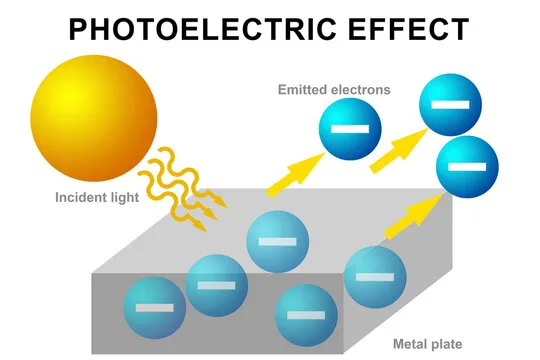
- Key concepts:
- Electrons emitted from metal by high-frequency light
- Current depends on number of electrons ejected
- Intensity vs. frequency: Higher intensity → more photons, but only photons above threshold frequency eject electrons
- Threshold frequency: Minimum frequency to eject electron (depends on metal)
- Photon energy: (h = Planck’s constant, f = frequency)
- Kinetic energy of ejected electrons: (W = work function)
9.2 Absorption and Emission of Light
Electrons absorb or emit discrete photon energies corresponding to energy level differences. This underpins spectroscopy and fluorescence.
- Absorption: Electron moves from lower → higher energy level
- Emission: Electron falls from higher → lower energy level, photon emitted
- Fluorescence: UV light excites electron, visible light emitted as electron returns to ground state
- Energy/frequency relationship: Photon energy = difference between electron levels
9.3 Nuclear Binding Energy and Mass Defect
Nuclei have less mass than the sum of protons and neutrons; difference is converted to energy via E = mc².
- Mass defect:
- Binding energy: Energy required to break nucleus
- Strong nuclear force: Binds nucleons, counteracts proton-proton repulsion
- Weak nuclear force: Smaller effect, contributes to stability
- Most stable nucleus: Iron (peak binding energy per nucleon)
9.4 Nuclear Reactions
Nuclei undergo fusion, fission, or radioactive decay. Conservation of mass number and atomic number applies.
- Fusion: Small nuclei combine → larger nucleus + energy (e.g., 4H → 1He in stars)
- Fission: Large nucleus splits → smaller nuclei + energy; can induce chain reactions
- Radioactive decay:
- Alpha (α): emitted; massive, low penetration
- Beta (β⁻): Electron emitted; more penetrating, neutron → proton
- Positron (β⁺): Positively charged electron emitted (no mass); proton → neutron
- Gamma (γ): High-energy photon emitted; no change in A or Z
- Electron capture: Inner electron absorbed by nucleus → proton converted to neutron
- Half-life: Time for half of nuclei to decay
- Exponential decay:
- Decay constant:
- Number of nuclei:
Spotted something wrong or unclear? Tell us — these notes are revised continuously.