
MCAT Physics · Lesson 8
Light and Optics
4 min read4 sectionsUpdated
4 sections
8.1 Electromagnetic Spectrum
This section covers the full range of electromagnetic waves, their properties, and the visible spectrum. It explains wave propagation, speed, and basic color perception.
- Includes radio waves on long λ, low f/E end, and gamma rays on short λ, high f/E end.
- Electromagnetic waves:
- Changing magnetic fields induce changing electric fields and vice versa.
- Oscillating fields generate oscillations in the other field.
- Transverse waves: electric and magnetic field vectors perpendicular to propagation.
- Spectrum: Full range of frequencies and wavelengths.
- Wave speed: All waves travel at .
- Color and visible spectrum:
- Visible range: violet (400 nm) → red (700 nm)
- Light of all colors appears white.
- Reflected light shows as that color.
- Blackbody:
- Ideal absorber of all wavelengths.
- Appears black if cooler than surroundings.
8.2 Geometrical Optics
Explains how light behaves in straight lines, reflects, refracts, and forms images with mirrors and lenses, including focal lengths, magnification, and optical aberrations.
- Rectilinear propagation: Light travels in straight lines in a medium.
Reflection
- Rebounding of incident waves at medium boundary.
- Reflected waves bounce back; Θ1 = Θ2.
- Normal line perpendicular to boundary.
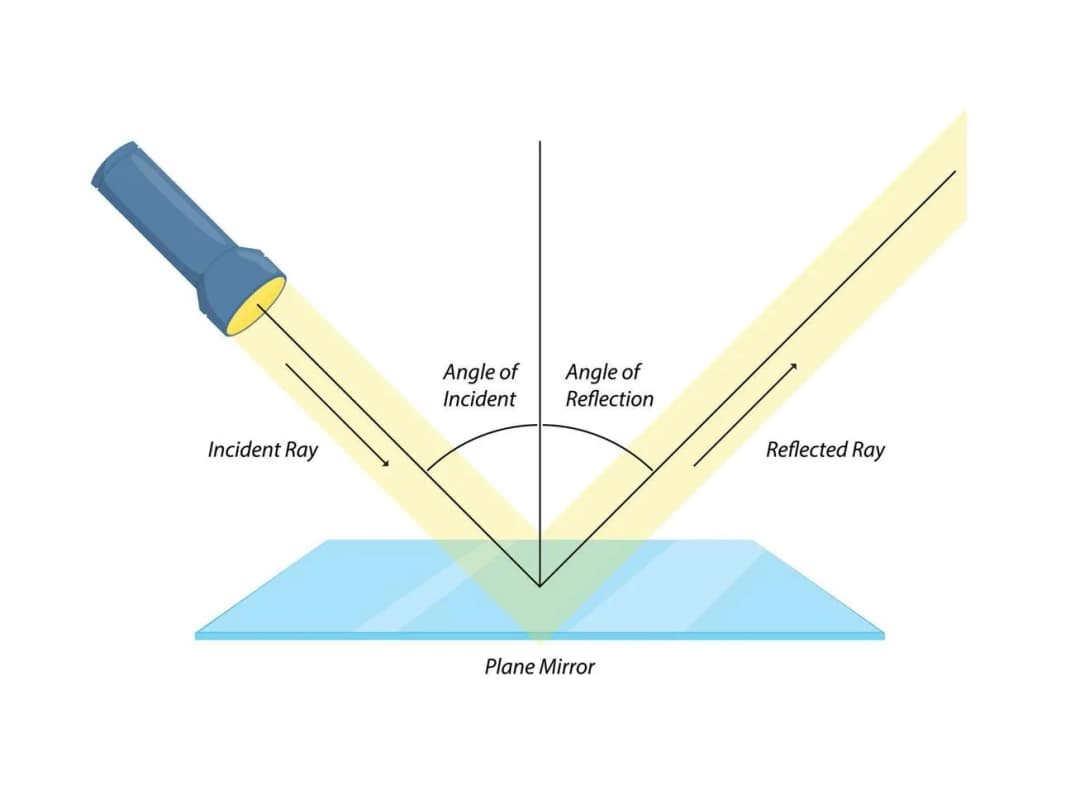
Plane mirrors
- Images: real or virtual
- Real: light converges at image, can project onto screen.
- Virtual: appears to come from position, does not converge.
- Parallel incident rays remain parallel after reflection.
- Plane mirrors flat; image distance behind mirror = object distance in front.
Spherical mirrors
- Center of curvature C, radius r
- Inside sphere → concave (converging)
- Outside sphere → convex (diverging)
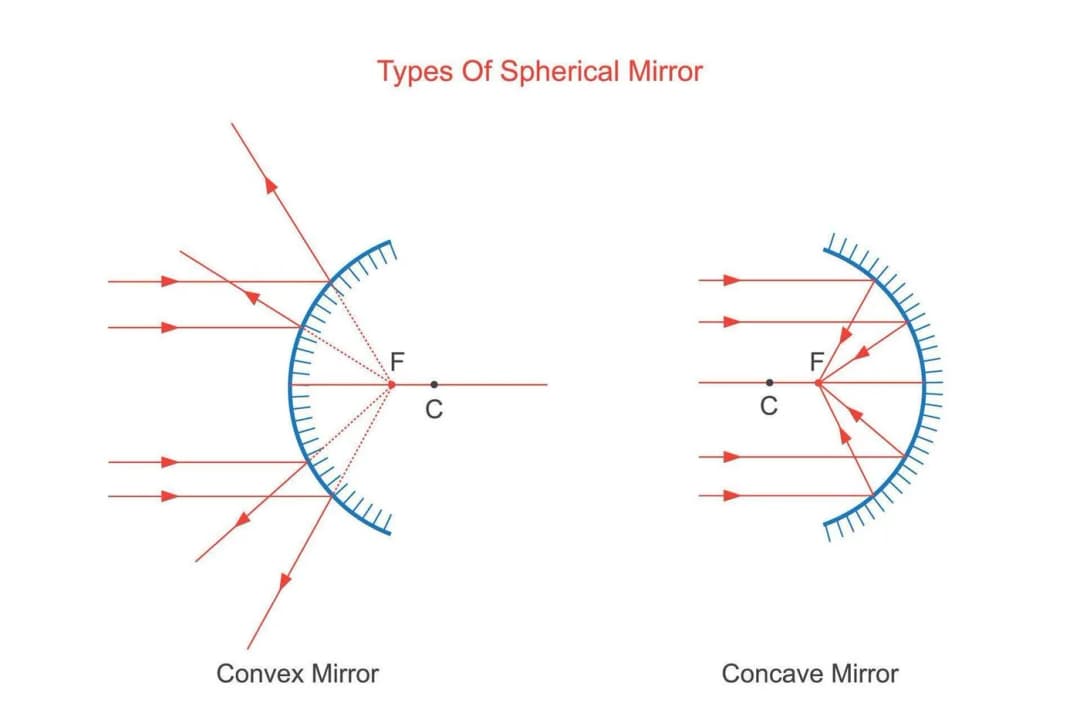
- Focal length:
- Distances:
- = object distance
- = image distance
- Mirror equation:
- Sign conventions:
- → real, in front
- → virtual, behind
- Plane mirror:
- Magnification:
- Negative: inverted, positive: upright
- |m|<1 → smaller, =1 → same size, >1 → larger
- Ray diagrams for approximating image type:
- Concave mirror rays:
- Parallel → through focal point
- Through focal point → parallel
- Strikes vertex → reflects symmetrically
- Examples:
- A = real, inverted, magnified
- B = no image, rays parallel
- C = virtual, upright, magnified
- Small diverging mirror → smaller image
- Concave mirror rays:
Refraction
- Bending of light between media
- Index:
- Vacuum: 1, air ≈ 1
- Snell's law:
- Moving to higher → smaller Θ
- Total internal reflection:
- High n → low n
- Refracted angle > incident
- Critical angle:
- Angle > Θc → total internal reflection
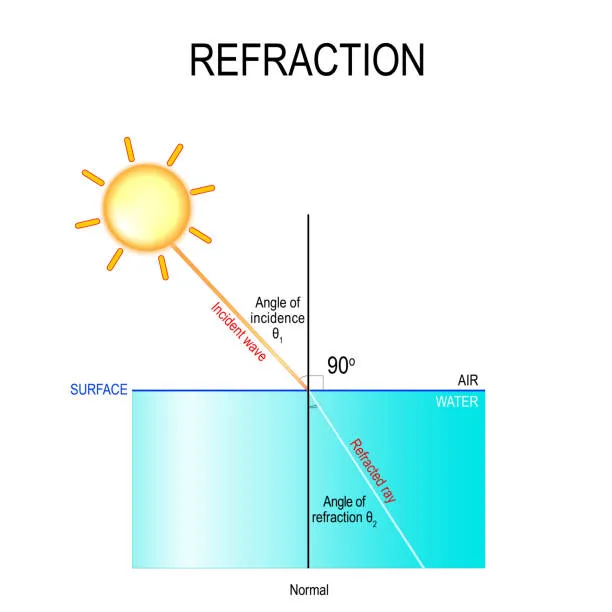
Lenses
- Refract light through two surfaces; can be thin spherical.
- Two focal points, measured from center.
- Converging lens: thicker at center
- Diverging lens: thinner at center
- Real lenses: thickness matters
- Eye uses real lens: cornea + lens → adjust focal length
- Sign conventions differ slightly from mirrors.
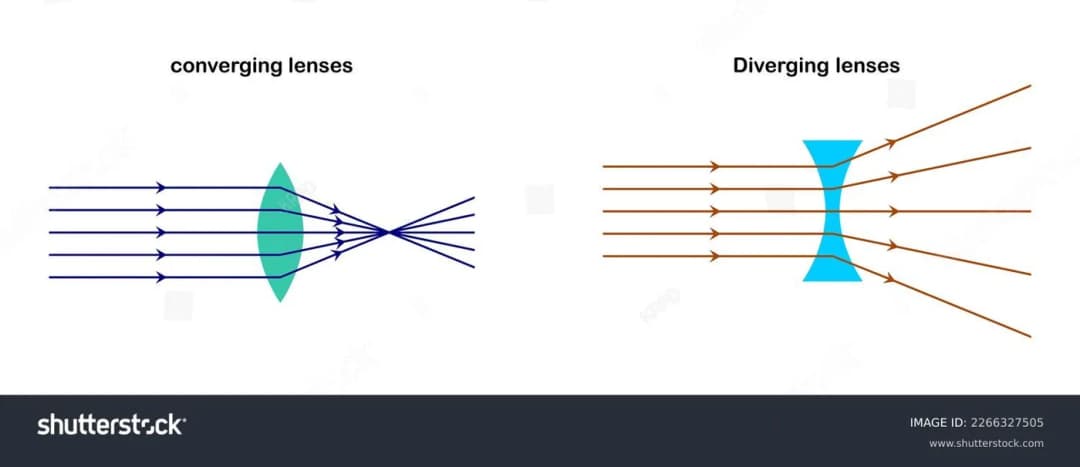
- Power:
- (diopters)
- Nearsighted → diverging lens
- Farsighted → converging lens
- Eye power ~60 D; contacts 0.25–8 D
- Multiple lens systems:
- Magnification:
- Aberrations:
- Spherical: peripheral blur from parallel rays
- Chromatic: dispersion causes rainbow halo
- Dispersion: Different wavelengths travel at different speeds → separate
- Violet λ < red λ
- Red light refracted less
8.3 Diffraction
Light spreads when passing through slits or around obstacles, producing interference patterns. This includes single slit, multiple slits, diffraction gratings, and X-ray diffraction.
- Single slit:
- Narrow opening → spreading of light
- Slit + lens → bright central fringe, alternating dark fringes
- Central fringe twice as wide as side fringes
- Minima: (a = slit width)
- Multiple slits:
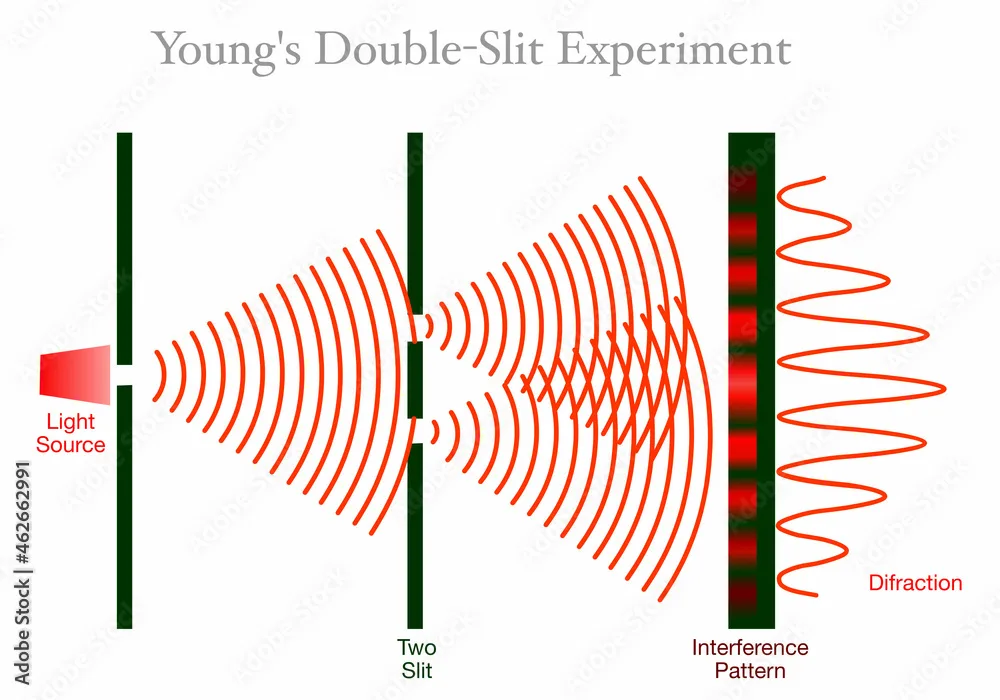
- Interference: displacement adds → maxima (bright), minima (dark)
- Young's experiment: parallel slits interfere
- Small angles: sin ≈ tan
- Diffraction gratings:
- Multiple slits in pattern → colorful patterns (CD rainbow)
- Thin films → interference patterns (soap bubbles)
- X-ray diffraction:
- Bending light to model molecules
- Combined with protein crystallography
- Dark/light fringes → 2D images
8.4 Polarization
Polarization restricts light to certain electric field directions. Light can be plane or circularly polarized and has applications in optics and stereochemistry.
- Plane polarized light:
- Electric fields aligned
- Used in diagnostics
- Unpolarized light:
- Fields in multiple directions
- Occurs in stereoisomers
- Rotates CCW or CW depending on chiral centers
- Polarizers:
- Allow specific field orientation
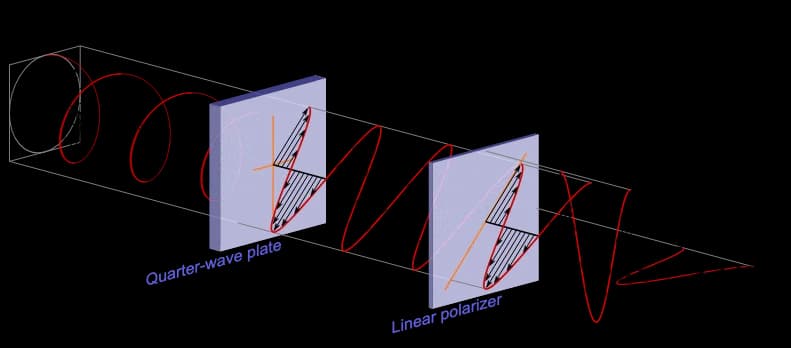
- Second polarizer angle controls transmitted light
- Perpendicular polarizers → no light
- Circular polarization:
- Rare, caused by pigments/filters
- Uniform amplitude, changing direction
- Helical E and B field vectors perpendicular
Spotted something wrong or unclear? Tell us — these notes are revised continuously.