
MCAT Physics · Lesson 7
Waves and Sound
2 min read2 sectionsUpdated
Jump to a section2
2 sections
7.1 General Wave Characteristics
Waves can be transverse or longitudinal, described by wavelength, frequency, speed, and amplitude. Superposition, standing waves, and resonance govern their interactions and natural frequencies.
- Wave Types:
- Transverse waves: oscillation ⟂ to propagation (e.g., wave in stadium)
- Longitudinal waves: oscillation ∥ to propagation, compressions and rarefactions (e.g., slinky)
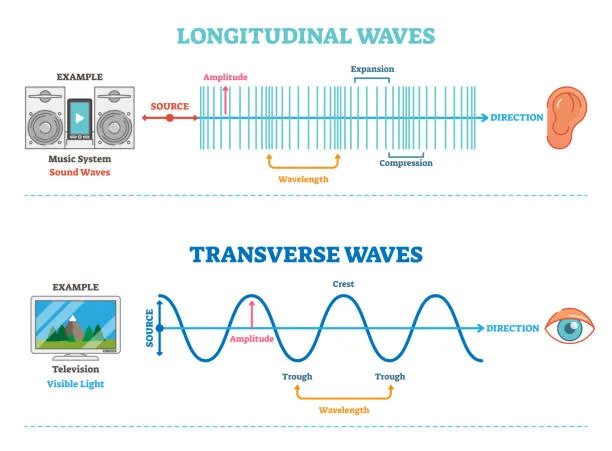
- Wave properties:
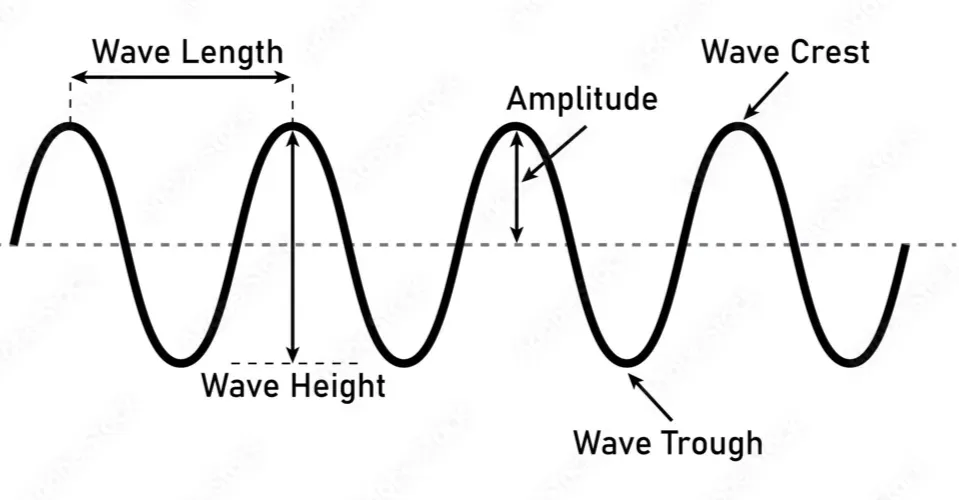
- Wavelength: distance between crests
- Frequency: Hz (cycles per second)
- Propagation speed:
- Period:
- Angular frequency: (rad/s)
- Amplitude (A): max displacement from equilibrium
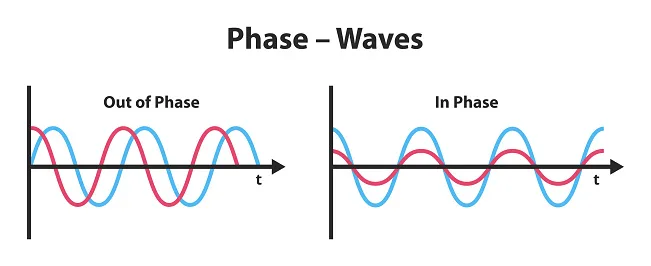
- Phase:
- In phase: crests/troughs align → difference 0
- Out of phase: crests do not align
- Superposition:
- Constructive: amplitudes add
- Destructive: amplitudes subtract (noise cancelling)
- Traveling and standing waves:
- Traveling: moves, reflected/inverted at boundary
- Standing: fixed nodes, fluctuating antinodes
- Resonance:
- Natural frequencies → object vibrates
- Timbre: quality of sound (single or multiple frequencies)
- Forced oscillation: amplitude maximized when applied f ≈ natural f
- Damping reduces amplitude
7.2 Sound
Sound is a longitudinal wave in a medium. Pitch, Doppler effect, intensity, standing waves, and applications like ultrasound are discussed.
- Propagation:
- Cannot travel through vacuum
- (B = bulk modulus, ρ = density)
- Air: 343 m/s
- Production:
- Mechanical disturbance of particles; solids vibrate for musical sounds
- Pitch depends on air column length
- Human voice: vocal cords; tension controls pitch
- Frequency and pitch:
- Low f → low pitch, high f → high pitch
- <20 Hz: infrasonic, >20 kHz: ultrasonic
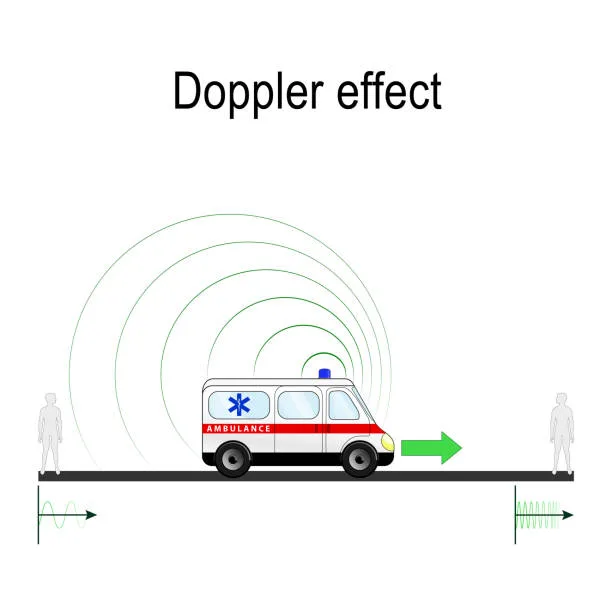
- Doppler effect:
- Perceived f differs if source/detector moves
- Top sign: toward, bottom: away
- Applies to sound and light (blue/red shift)
- Shock waves:
- Object ≥ speed of sound → overlapping wave fronts → sonic boom
- Intensity and loudness:
- Intensity: (power per area)
- I ∝ A², I ∝ 1/r²
- Softest sound:
- Sound level: (dB)
- Attenuation: damping reduces amplitude
- Beat frequency:
- Standing waves:
- 2 waves f traveling opposite → amplitude oscillates
- Nodes: no movement; antinodes: max movement
- Strings:
- Secured ends → nodes
- Wavelength: , f = nv/2L, n = harmonic
- Open pipes:
- Antinodes at open ends, L = λ/2 for first harmonic
- Harmonics: L = λ/2, λ, 3λ/2 …
- Closed pipes:
- Node at closed, antinode at open
- Only odd harmonics: , f = nv/4L
- First overtone = 3rd harmonic
- Ultrasound:
- High f sound waves beyond hearing
- Imaging via reflection; doppler mode measures flow
- Applications: prenatal imaging, kidney stone fragmentation, tumor ablation, dental cleaning
Spotted something wrong or unclear? Tell us — these notes are revised continuously.