
MCAT Physics · Lesson 2
Work and Energy
3 min read3 sectionsUpdated
Jump to a section3
3 sections
2.1 Energy
This section defines energy, its different forms, and how it is conserved or transferred. Covers kinetic, potential, and mechanical energy, as well as conservative vs nonconservative forces.
- Energy
- System's ability to do work → make something happen
- Kinetic Energy
- Formula:
- Energy of motion, SI unit: Joule (kg·m²/s²)
- Example: Sliding down ramp → use velocity & mass in equation
- Potential Energy
- Associated with position
- Gravitational PE: (datum = zero energy position)
- Elastic PE: (k = spring constant, x = displacement)
- Total Mechanical Energy
- First law of thermodynamics → energy conserved, losses appear as heat in open system
- Conservative forces: gravity, electrostatic → round trip path change = 0
- Convection is heat transfer, not force
- (also equals work by nonconservative forces)
- Example: Throwing baseball → work done by air resistance = energy lost
2.2 Work
Defines work as energy transfer, describes calculations for different forces, and introduces power and the work-energy theorem.
- Work
- Process transferring energy between systems (not a form of energy itself)
- SI unit: Joule
- Only two energy transfer methods: work & heat
- Stationary object → no work done
- Formula:
- F = magnitude of applied force
- d = displacement magnitude
- Θ = angle between force & displacement (dot product)
- Example: Uniform circular motion → force ⊥ displacement → W = 0
- Pressure and Volume
- Pressure & volume inversely related
- Work = area under P-V curve
- Gas expansion → +W, compression → -W
- Isochoric (constant volume) → W = 0
- Isobaric (constant pressure) →
- Variable pressure →
- Power
- Rate of energy transfer:
- SI unit: Watt (J/s)
- Measures rate of energy expenditure over time
- Example: 300 hp car → given unlimited time, could reach unlimited velocity
- Work-Energy Theorem
- Relation between work & kinetic energy:
- Allows calculation of work without knowing individual forces/displacements
- Work done ∝ change in KE of object
2.3 Mechanical Advantage
Explains how simple machines reduce required force, distribute work over distance, and define mechanical efficiency.
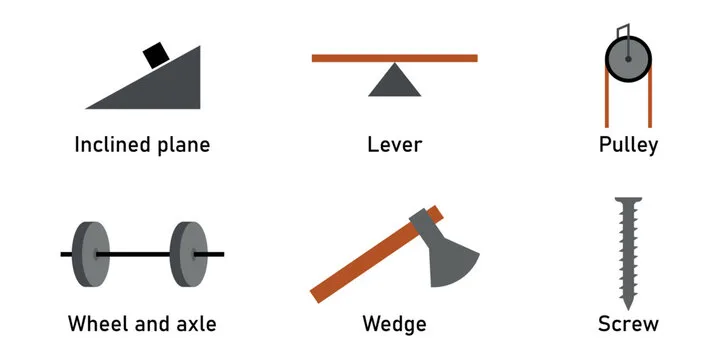
- Simple Machines
- Inclined plane
- Wedge (2 inclined planes)
- Wheel & axle
- Pulley
- Screw (rotating inclined plane)
- Mechanical Advantage (MA)
- Ratio:
- Compares force exerted by machine to force applied
- Inclined Plane
- Force required:
- Work done: cos θ → always = 1
- Pulleys
- Reduce necessary force at cost of increased distance
- Single rope → force = mg
- Multiple ropes → force distributed (T₁ + T₂ = mg)
- Each rope supports half the weight → half force required
- Must pull rope twice as far to lift object same height
- Accelerating box:
- Efficiency
- No machine 100% efficient
- Expressed as percentage
- Compares output vs input work
Spotted something wrong or unclear? Tell us — these notes are revised continuously.