
MCAT Physics · Lesson 1
Kinematics and Dynamics
4 min read6 sectionsUpdated
6 sections
1.2 Right Hand Rule
This section explains the right-hand rule for determining the direction of a cross product, the basics of vector operations, and distinctions between dot and cross products.
- Right Hand Rule
- Thumb → direction of A
- Fingers → direction of B
- Palm → direction of C
- Example:
- C = A × B, D = B × A
- A: X = -3 N, Y = 0
- B: X = 0, Y = 4 N
- Magnitude: 12
- Angle between vectors: 90°, sin 90° = 1
- C → into page, D → out of page
- Vector Operations
- Vector addition is commutative: A + B = B + A
- Vector subtraction is not commutative: same magnitude, different direction
- Dot Product
- Produces a scalar from two vectors
- Formula:
- Cross Product
- Use right-hand rule for direction
- Formula:
- Result is always perpendicular to the plane of the two vectors → in or out of page
1.3 Displacement and Velocity
Covers definitions of speed, velocity, and displacement, highlighting the difference between scalars and vectors, and average vs instantaneous values.
- Instantaneous speed = instantaneous velocity (scalar)
- Speed = magnitude of velocity vector
- Average velocity = change in position / time
- If net displacement = 0 → average velocity = 0 (e.g., rotation of Earth)
- Velocity () = rate of change of displacement
1.4 Forces and Acceleration
Introduces Newtonian mechanics, units of force, friction types, acceleration, and equilibrium concepts.
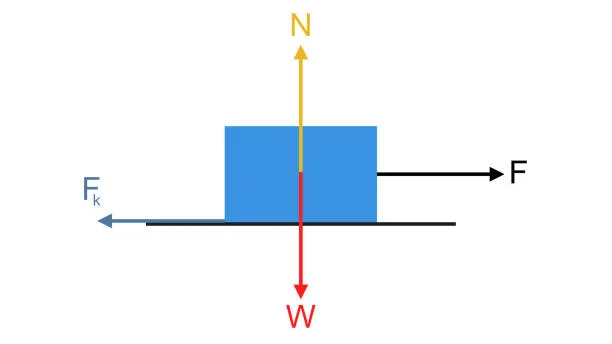
- Force
- Unit: N = kg·m/s²
- Gravitational constant:
- Static Friction
- Between stationary object & surface
- Coefficient depends on materials
- Friction opposes motion
- Max static friction example: 50 N < F_max < 100 N
- Kinetic Friction
- Between sliding object & surface
- Formula:
- Constant value, independent of surface area & velocity
- → moving objects slide easier
- Inclined Planes
- Friction depends on normal force
- As incline ↑ → normal force ↓ → frictional force ↓
- Acceleration
- Average: Δv/Δt
- Instantaneous:
- Positive slope on v-t graph → acceleration in same direction
- No force → no acceleration, constant velocity
- Translational equilibrium: forces equal in magnitude
1.5 Newton's Laws
Covers the three fundamental laws of motion describing inertia, acceleration, and action-reaction pairs.
- First Law (Inertia)
- Object at rest or in motion remains so
- Second Law
- Acceleration occurs when net force ≠ 0
- Direction of acceleration = direction of net force
- Third Law
- Every action → equal & opposite reaction
1.6 Motion with Constant Acceleration
Explains linear, projectile, and circular motion, including free fall and kinematics equations for constant acceleration.
- Linear Motion
- Equations of motion:
- Positive motion → downward negative
- Constant acceleration if air resistance negligible
- Equations of motion:
- Free Fall
- Drag neglected → constant acceleration =
- Drag present → acceleration ↓ until terminal velocity
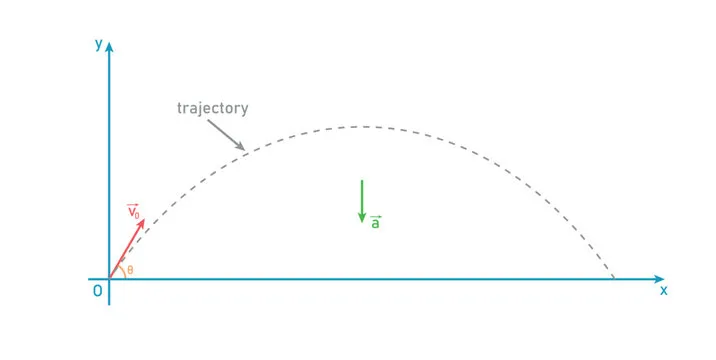
- Projectile Motion
- Force only in vertical direction
- Time in flight: , set Y = 0
- X-component:
- Max horizontal distance at 45° angle
- Circular Motion
- Displacement = 0 after one cycle
- Uniform circular motion:
- Instantaneous velocity tangent to path
- Centripetal force points radially inward:
- Centrifugal force: reactionary, antiparallel to centripetal
1.7 Mechanical Equilibrium
Discusses rotational equilibrium, torque, and conditions for static equilibrium.
- Rotational Equilibrium
- Force applied to rotate around fulcrum → creates torque
- Lever arm = distance from force to pivot
- Torque formula:
- Equilibrium → vector sum of torques = 0
- Clockwise → negative, counterclockwise → positive
- Example:
- Force exerted by fulcrum = combined mass of blocks & seesaw ×
Spotted something wrong or unclear? Tell us — these notes are revised continuously.