
MCAT Organic Chemistry · Lesson 12
Separations and Purifications
6 min read3 sectionsUpdated
Jump to a section3
3 sections
12.1 Solubility Based Methods
Uses differences in solubility and polarity to separate compounds, mainly through extraction, filtration, and recrystallization.
Extraction
- Transfer of dissolved compound from starting solvent into another solvent where product is more soluble
- Based on “like dissolves like”
- Need 2 immiscible solvents (can’t mix)
- Temporarily mixed by shaking so solute can pass between solvents
Example
- Solution of isobutyric acid and diethyl ether → can extract acid with water
- Both acid and water are polar and soluble
- Acid transfers to aqueous layer when mixed
- Ether layer = organic phase
- After mixing, layers separate
- Use separatory funnel to isolate
- Turn stopcock to drain one layer
- Organic layer usually on top, but can be opposite
- Position of layers determined by density
- Often repeat draining of aqueous layer to transfer all of acid
- Evaporate solvent using rotary evaporator (rotovap)
- Can also use same principle to remove unwanted impurities
- Small amount of solute used to extract/remove them
- This is called a wash
Filtration
- Isolates a solid from a liquid
- Pour mixture onto paper that only allows solvent to pass through
- Like a coffee filter
- Solid leftover = residue
- Flask full of liquid = filtrate
- Gravity filtration:
- Uses its own weight
- Common when the product of interest is in the filtrate
- Vacuum filtration:
- Solvent forced through by vacuum
- Solvent kept warm/hot to keep product soluble so it doesn’t precipitate
Recrystallization
- Method for purifying crystals in solution
- Dissolve product in minimum amount of hot solvent, then let it recrystallize
- Solvent chosen so product is soluble at high temp but not at low temp
- When solution cools, product recrystallizes and leaves impurities behind
12.2 Distillation
Separates liquids based on boiling point differences using vaporization and condensation.
- Takes advantage of differences in boiling points
- Vapor → condensate drips into vessel → end product = distillate
- How you make ethanol from mixtures with water, since ethanol boils at a lower temp
Simple distillation
- Used to separate liquids that:
- Boil below 150 ºC
- Have at least ~25 ºC difference in boiling points
- Prevents compound degradation and minimizes second compound going into distillate
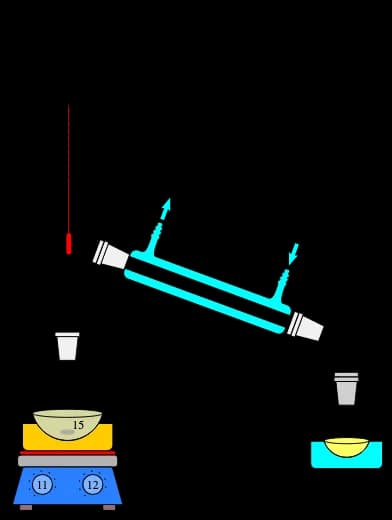
- Setup:
- Distilling flask with combined liquid solution
- Distillation column with thermometer and condenser
- Receiving flask collects the distillate
- Superheating:
- Happens when liquid heated above its boiling point without vaporizing
- Gas bubbles can’t overcome atmospheric pressure and surface tension
Vacuum distillation
- Used when you want to distill a liquid with boiling point over 150 ºC
- Lower ambient pressure → decreases temp needed to boil
- Helps avoid degrading product
Fractional distillation
- Separates liquids with similar boiling points
- Fractional column has increased surface area (glass beads, steel wool)
- As vapor rises:
- Condenses on surfaces and refluxes back down
- Rising heat causes it to evaporate again
- Condenses again higher in the column
- Each evaporation–condensation cycle enriches the lower-boiling component
- When vapor reaches top of column, it’s mostly the lowest BP compound and goes into receiving flask
12.3 Chromatography
Separates and identifies compounds based on how they partition between stationary and mobile phases, using properties like polarity, size, and charge.
- Uses physical and chemical properties to separate and identify compounds in a mixture
- Place sample onto solid medium (adsorbent)
- Run mobile phase (liquid or gas) through stationary phase
- Compounds adhere to stationary phase with different strengths
- Migrate at different speeds = partitioning
- Different compounds have different partitioning coefficients
- Often separate based on polarity, but can also use size, charge
Thin-layer and paper chromatography
- Very similar, differ only in medium:
- Thin-layer: silica gel or alumina on an inert backing
- Paper: cellulose paper
- Sample placed directly onto adsorbent (spotting)
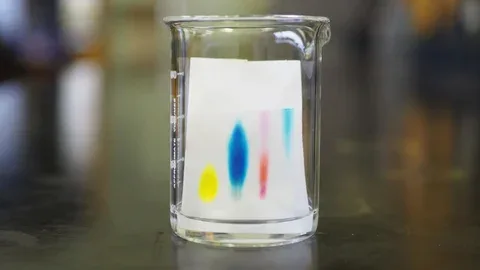
- Plate is developed by placing it upright in a developing chamber
- Bottom has a shallow pool of solvent (eluent)
- Spots must sit above solvent level
- Solvent creeps up plate by capillary action, carrying compounds at different rates
- If using more polar solvent:
- Polar compounds may not travel as fast
- Rf values decrease
- When solvent front nears top, plate is removed and dried
- Mobile phase is often an organic solvent that doesn’t bind strongly to gel
- Nonpolar compounds move more quickly while polar ones stick to gel
- More nonpolar samples end up further up the plate
- Less polar compound → moves fastest → highest Rf
- Compound that travels fastest is also first to elute
Reverse-phase chromatography
- Exact opposite of normal TLC:
- Stationary phase is nonpolar
- Polar molecules move up plate quickly
- Nonpolar molecules stick to stationary phase
- Plate is usually white, so:
- Put under UV light to see spots
- Or stain with iodine, acid, or vanillin
- Staining usually destroys ability to recover the compound
Rf (retardation factor)
- Used in preparative TLC:
- Larger plate with larger spot of sample
- Sample separates into bands
- Bands scraped off and washed to isolate pure compounds
Column chromatography
- Column filled with silica or alumina beads as adsorbent
- Gravity pulls solvent and compounds down the column
- Can force solvent through using gas pressure (flash column chromatography)
- Can change polarity of eluent to help elute compounds
- Solvent drips out end of column, and fractions collected over time
- Solvent evaporated, leaving behind compound
Ion-exchange chromatography
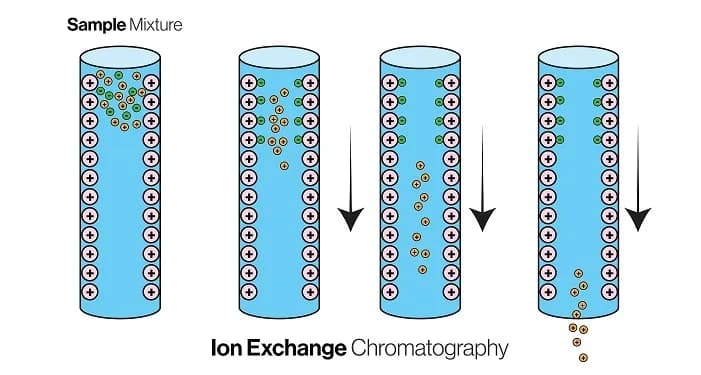
- Beads coated with charged substances
- Attract/bind molecules with opposite charge
- Example: positively charged beads bind negatively charged DNA backbone
- After other compounds pass through, a salt gradient elutes the charged molecules that stuck
Size-exclusion chromatography
- Beads contain tiny pores of varying size
- Small compounds enter pores and are slowed down
- Large compounds can’t enter and travel around beads → move faster
- Vary pore size to tune for different molecular weights
Affinity chromatography
- Protein of interest bound by column with high affinity for that protein
- Beads coated with receptor or specific antibody for protein
- Stationary phase can also be metals like nickel for engineered proteins
- To elute:
- Wash column with free receptor/target/antibody
- Competes with bead-bound receptor and frees protein
- Or use eluents with varying pH or salinity to disrupt bonds
- Wash column with free receptor/target/antibody
- Recovered substance can sometimes bind to eluent
- If eluent is something like an inhibitor, it may be hard to remove
Gas chromatography (GC) / vapor-phase chromatography (VPC)
- Eluent is a gas instead of liquid
- Adsorbent is crushed metal or polymer in a long (e.g., ~30 ft) column
- Column is coiled inside an oven to control temp
- Mixture injected and vaporized
- Gaseous compounds travel at different rates based on how strongly they adhere to adsorbent
- Separate in space by the time they reach end of column (retention time)
- Injected compounds must be volatile:
- Low melting point
- Sublimable solids or vaporizable liquids
- Compounds registered by detector
- Often:
- Separate by GC, then inject into mass spectrometer (GC–MS)
- Mass spectrometer:
- Ionizes and fragments compounds
- Separates fragments by mass-to-charge ratio
- Used to determine molecular weight
High-performance liquid chromatography (HPLC)
- Eluent is liquid, passing through a packed column
- Very similar to column chromatography, but more controlled
- Sample injected into column and separates as it flows through
- Compounds pass a detector and are collected as solvent exits
- Interface is computerized, similar to GC
- “High performance” comes from computer control of:
- Solvent gradients
- Temperature
Spotted something wrong or unclear? Tell us — these notes are revised continuously.