
MCAT Psychology & Sociology · Lesson 5
Motivation, Emotion, and Stress
4 min read3 sectionsUpdated
Jump to a section3
3 sections
5.1 Motivation
Motivation is the driving force behind behavior, which can originate internally (intrinsic) or externally (extrinsic). Several theories explain motivation, including instinct, arousal, drive reduction, need-based, and incentive-based models. Motivation can also be influenced by physiological, emotional, and social factors.
Extrinsic vs. Intrinsic Motivation
- Extrinsic: External forces, tangible rewards (e.g., studying for a good grade, competition)
- Intrinsic: Internal interest, personal satisfaction (e.g., studying to master content)
Instinct Theory
- Innate fixed patterns of behavior in response to stimuli
- Examples: thumb sucking for stress in babies; some instincts disappear with age
- Derived from Darwin's evolution
- William James: 20 physical instincts, 17 mental instincts
- Some instincts conflict, can be overridden by experience
- Suckling and carrying food → motivates eating
Arousal Theory
- Arousal = psychological & physiological state of being awake/reactive to stimuli
- Involves brain stem, ANS, endocrine system
- People act to maintain optimal arousal; increase arousal if low
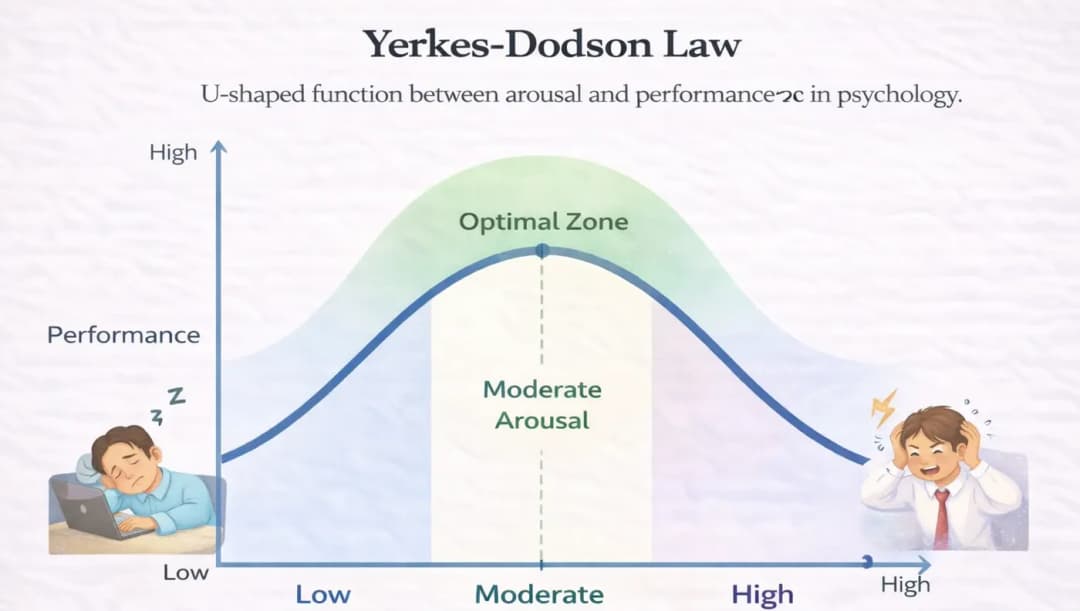
- Yerkes-Dodson law: U-shaped function between arousal and performance
- Very high or low arousal → worse performance
- Low arousal good for cognitive tasks, high for physical tasks
- Simple tasks require higher arousal than complex tasks
Drive Reduction Theory
- Drives = internal states of tension activating goal-directed behavior
- Originate internally, independent of external factors
- Help maintain homeostasis
- Primary drives: food, water, warmth (negative feedback loop)
- Secondary drives: learned drives (e.g., get into medical school, emotion-based)
- Motivation eliminates uncomfortable states; physiological imbalances trigger drives
Need-Based Theories
- Motivation influenced by needs; energy allocated to satisfy needs
- Maslow’s hierarchy of needs: pyramid from bottom → top
- Physiological → Safety/Security → Love/Belonging → Self-Esteem → Self-Actualization
- Unmet lower levels dominate motivation
- Self-Determination Theory (SDT):
- Autonomy: control over actions
- Competence: excel at difficult tasks
- Relatedness: feel accepted and connected
- All three needed for healthy motivation and relationships
Additional Theories and Applications
- Incentive Theory: behavior motivated by reward/punishment
- Expectancy-Value Theory: motivation = expectation of success × value of goal
- Motivation can extend beyond survival (e.g., eating for pleasure)
Opponent Process Theory
- Destructive motivations (e.g., drug use) trigger physiological counteractions
- Frequent drug use → body adapts → tolerance and withdrawal
- Example: alcohol → increased arousal, withdrawal symptoms
Sexual Motivation
- Driven by E, P, and androgens
- Smell can influence sexual desire
- Cultural norms affect expression and acceptability of sexual behaviors
- Example: different reactions to pornography between men and women
5.2 Emotions
Emotions are instinctive responses influenced by physiology, behavior, and cognition. Several theories explain emotion processing, and brain structures like the limbic system, PFC, and ANS modulate emotional experience and memory.
Elements of Emotion
- Physiological: HR, BP, skin temp, breathing rate
- Behavioral: facial expressions, body language
- Cognitive: subjective interpretation of feelings
Universal Emotions
- Happiness, sadness, contempt, surprise, fear, disgust, anger
Theories of Emotion
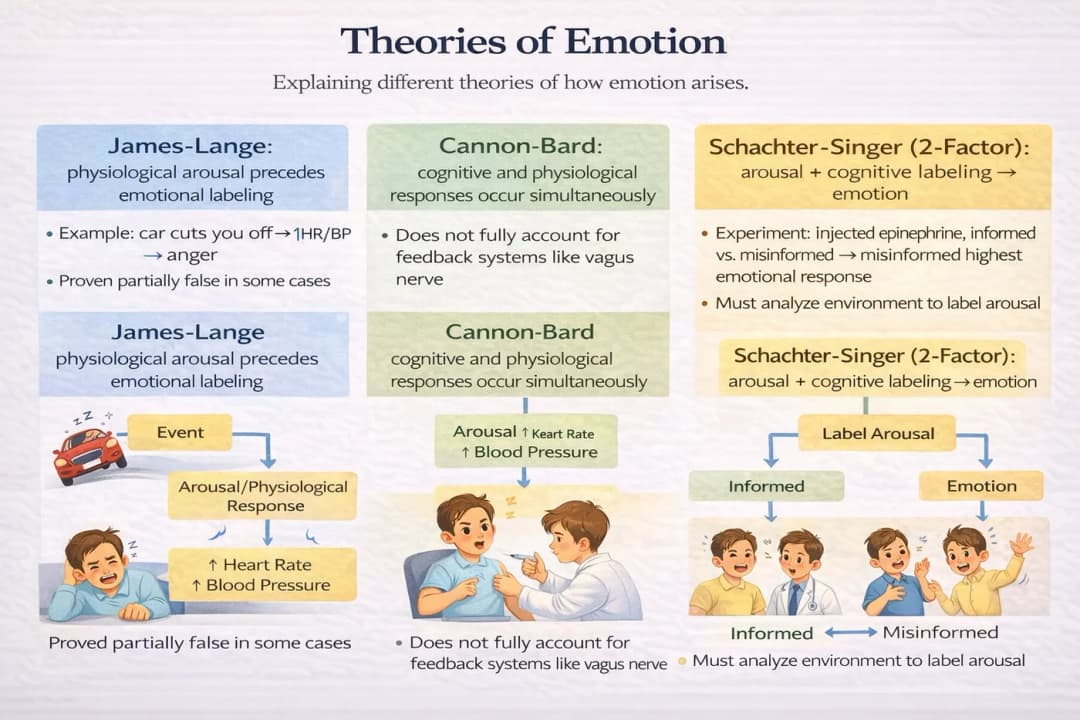
- James-Lange: physiological arousal precedes emotional labeling
- Example: car cuts you off → ↑HR/BP → anger
- Proven partially false in some cases
- Cannon-Bard: cognitive and physiological responses occur simultaneously
- Does not fully account for feedback systems like vagus nerve
- Schachter-Singer (2-Factor): arousal + cognitive labeling → emotion
- Experiment: injected epinephrine, informed vs. misinformed → misinformed highest emotional response
- Must analyze environment to label arousal
Limbic System
- Structures: amygdala, thalamus, hypothalamus, hippocampus, fornix, septal nuclei, cortex
- Amygdala: processes attention/emotional cues, fear, facial expressions
- Lesions → inability to learn new fears
- Right hemisphere more active; women > men
- Thalamus: sensory relay to cortex
- Hypothalamus: releases NTs, modulates homeostasis, influences emotions
- Hippocampus: creates long-term memories, contextualizes emotional experiences
- Emotional memory: stores feelings associated with events
- Prefrontal Cortex:
- Planning, decision-making, personality
- Left PFC: positive emotions, right PFC: negative
- Dorsal: attention/cognition, ventral: emotion
- Ventromedial: decision-making, emotion control
- ANS: mediates physiological responses
- ↑Skin temp → anger; ↓Skin temp → fear
- ↑HR → anger/fear; ↓HR → happy
5.3 Stress
Stress is the cognitive and physiological response to challenges or threats. Stressors can be positive (eustress) or negative (distress) and are managed through appraisal, coping strategies, and physiological adaptation.
Cognitive Appraisal
- Primary appraisal: initial evaluation → irrelevant, benign-positive, stressful
- Secondary appraisal: evaluation of coping ability if threat detected
- Harm = damage, Threat = potential future damage, Challenge = potential to overcome
- Example: spiders → stress for some, irrelevant for others
- Reappraisal may be required in dynamic situations
Types of Stressors
- Minimal → catastrophic
- Distress: unpleasant stressors
- Eustress: positive stress (graduation, marriage)
- Measured via social readjustment scale
- Psychological stressors: pressure, control, predictability, frustration, conflict
- Controllability → ↓stress, unpredictability → ↑stress
- Example: firefighters, police
Conflict Stress
- Approach: 2 desirable options
- Avoidance: 2 negative options
- Approach-Avoidance: one choice with + and - elements
- Example: job promotion → more money (+), more responsibility (-)
Physiological Response: General Adaptation Syndrome (Selye)
- Alarm: initial reaction, ↑sympathetic activity, ACTH → cortisol, medulla → E & NE
- Resistance: continuous hormone release maintains sympathetic activation
- Exhaustion: cannot maintain response, ↑susceptibility to illness
Emotional and Behavioral Responses
- Irritability, moodiness, tension, fearfulness, helplessness
- Chronic stress → mental health disorders
Coping and Stress Management
- Active coping: overcome stressor, social support
- Cognitive strategies: reframe feelings, positive reappraisal, distancing
- Maladaptive coping: drugs, alcohol
- Stress management: exercise, relaxation, spiritual practice
Spotted something wrong or unclear? Tell us — these notes are revised continuously.