
MCAT Psychology & Sociology · Lesson 4
Cognition, Consciousness, and Language
12 min read6 sectionsUpdated
6 sections
4.1 Cognition
Cognition is how the brain processes and relates to information, with the frontal lobe being important. This section covers core cognition models and developmental changes across the lifespan.
- Cognition is how brain processes and relates to information
- Front lobe important
- Information processing model
- Took computer steps, applied to brain
- Pavio's dual encoding theory
- Verbal association and visual images used to process and store info
- Word dad and picture of dad = information
- 4 pillars
- Thinking requires sensation, encoding, storage of stimuli
- Stimuli must be analyzed to be used in decision making
- Decisions made in one situation can be extrapolated and used to help solve new problems
- Situational modification
- Problem solving dependent on cognitive level, context/complexity of problem
- Cognitive development
- Ability to think and solve problems
- Physical tasks mastered, then abstract thinking
- Cliché such as don't count chickens before they hatch, need abstract
- Patients with schizophrenia think it is about chickens
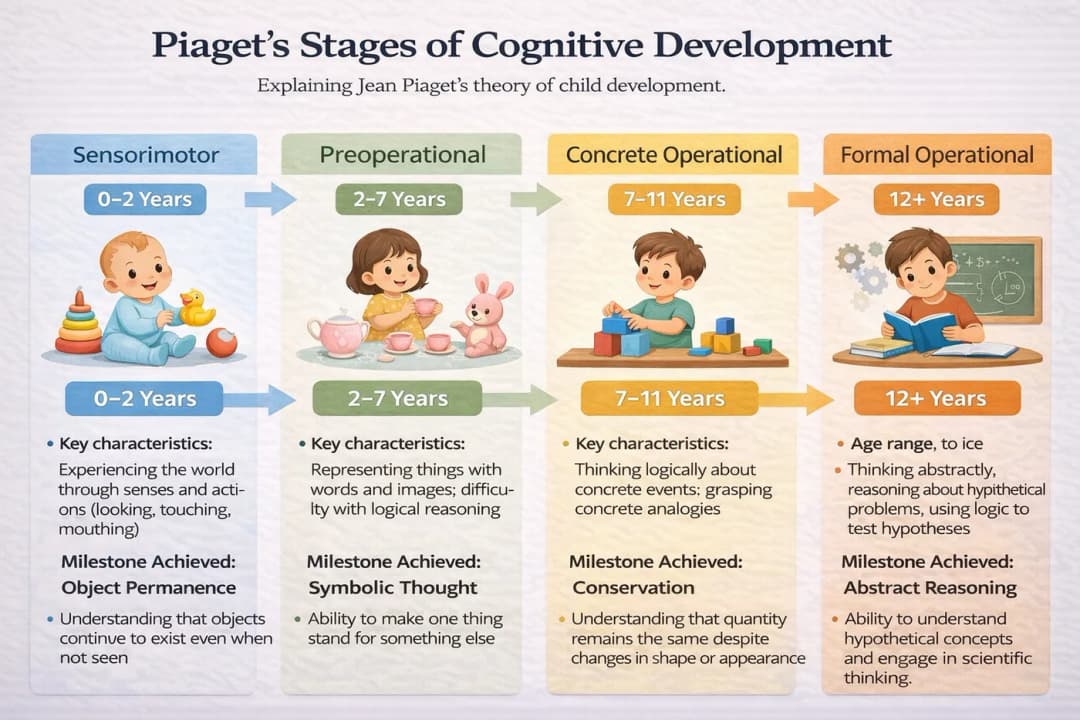
- Piaget's stages of cognitive development
- Infants learn through interaction with environment
- Have grasping reflex, learn you can grasp stuff, pattern is schemata
- Schema is concept, behavior, or sequence
- New information processed through adaptation
- Assimilation is classifying new info into existing schemata
- Accomodation is existing schemata modified to encompass new info
- Sensorimotor stage
- From birth until
- Child manipulates environment to meet physical needs
- Primary circular reactions = repetition of body movement, originally by chance
- Sucking thumb, because they find it soothing
- Secondary circular reactions = manipulation outside of body
- Throwing toys from high chair
- Gets response from environment, parent picks up toy
- Object permanence ends stage
- Objects exist even when out of view
- Peek a boo exciting because they think they've just come into existence
- Object permanence marks beginning of representational though
- Child makes mental representations of objects and events
- Preoperational stage
- to years old
- Symbolic thinking, egocentrism, centration
- Symbolic thinking = ability to pretend, make believe, have imagination
- Egocentrism = inability to imagine what others may think
- Centration = tendency to focus on one aspect of phenomenon
- Inability to understand conversation
- Can't tell difference between slices of pizza, or big slice
- Concrete operational stage
- to years old
- Children can understand conversation, consider perspectives of adults
- Can use logical thought
- Can't think abstractly
- Formal operational stage
- years of age, can think logically about abstract ideas
- Pendulum experiment, manipulate variables to affect frequency
- Adolescents would hold all but one constant
- Infants learn through interaction with environment
- Role of culture
- Some cultures place higher value on social learning, cultural traditions
- Others value knowledge
- Influence rate of cognitive development
- Lev Vygotsky proposed that development determined by internalization of culture
- Help from adults or other children can develop as a person
- Cognitive changes late adulthood
- Reaction time increases, time based memory decreases
- Initially through IQ declined between separated into type
- Fluid intelligence is problem solving skills
- Peak in early adulthood
- Crystallized intelligence is use of learned skills
- Peaked in middle adulthood
- Fluid intelligence is problem solving skills
- Activities of daily living linked with decline in intellectual abilities
- Stop doing life = bad
- Intellectual activities, socializing, stimulating environment = protective
- Dementia = impaired memory, judgement and confusion
- Personality changes
- Caused by Alzheimer's, or vascular dementia (high BP and microscopic clots)
- Hereditary, environmental, biological factors
- Genetics can predispose, such as down and fragile X
- Exposure such as fetal alcohol syndrome
- Reduced cognitive development, different facial features
- From trauma to brain
- Delirium is rapid fluctuation in cognitive function
4.2 Problem Solving and Decision Making
Problem solving uses strategies like trial-and-error, algorithms, and reasoning (deductive/inductive). Decision-making is shaped by heuristics, biases, intuition, emotion, and theories of intelligence.
- Mental set = tendency to approach problems similar way
- Inappropriate mental set impedes problem solving
- If stuck on problem, must frame it a different way
- Types of problem solving
- Trial and error
- Various solutions tried until find one that works
- Only effective with few possible solutions
- Algorithm
- Formula to solve problem
- Deductive reasoning (top down)
- Starts from general rules, draws conclusions
- Logic puzzles
- Inductive reasoning (bottom up)
- Creates a theory via generalization
- Start with specific instances, draw a conclusion from them
- Trial and error
- Heuristics, biases, intuition, emotion
- Heuristics
- Rules of thumb, simplified principles used to make decisions
- Availability heuristic when we decide how likely something is
- Can be incorrect
- Do more words start with K or have K as third letter
- Think of ones with third letter, think answer is start with K = wrong
- Representative heuristic
- Categorizing items on basis of prototypical, stereotypical, or representative image
- Flip coin, landing on heads = %, but people will overestimate based on pattern
- Use of stereotype while ignoring factors is base rate fallacy
- Often used by experts, in chess must think moves ahead
- Many possible moves, heuristics rule out some
- Bias and overconfidence
- Disconfirmation principle, evidence obtained from testing show solution doesn't work
- Confirmation bias is tendency to focus on information that fits beliefs
- Attributes to overconfidence, ones over beliefs are infallible
- Belief perseverance = inability to reject belief despite evidence against
- Intuition
- Acting on perceptions that aren't supported
- Person feels like something is correct
- Physician can tell MI without looking at EKG
- Recognition primed decision model
- Brain sorts to match pattern
- Emotion
- Subjective experience of person in situation
- How they feel influences thinking and making decisions
- Angry = risky decision making
- Emotions from how they expect to feel from decision involved
- Heuristics
- Intellectual functioning
- Multiple intelligences
- Gardner's theory, more all compassing
- Western culture values linguistic, logical-mathematical intelligence over others
- Others are musical, spatial, bodily, interpersonal, intrapersonal
- Because they are only abilities on IQ test
- Variations on ability
- Spearman's g factor, general intelligence factor
- Theory based on observation that performance on tasks is positively correlated
- So underlying factor/variable plays role
- Tests generate intelligence quotient
- Pinned by Alfred Binet, IQ = mental/chronological age x
- Some argue intelligence = genetic
- Many different determinants, genes, environment, education
- School increases IQ
- Different ways to measure other than IQ
- Multiple intelligences
4.3 Consciousness
Consciousness includes alertness, sleep, and altered states. This section covers sleep stages and rhythms, dreaming theories, sleep-wake disorders, hypnosis, and meditation.
- States of consciousness
- Alertness
- Awake, able to think, process information
- Physiological arousal, cortisol levels higher, EEG shows waking
- Fibers in prefrontal cortex interact with reticular formation
- Keeps cortex awake and alert
- Alpha and beta waves
- Beta waves = high frequency, when alert or concentrating
- Alpha waves = awake but relaxed, eyes closed
- Slower, more synchronized
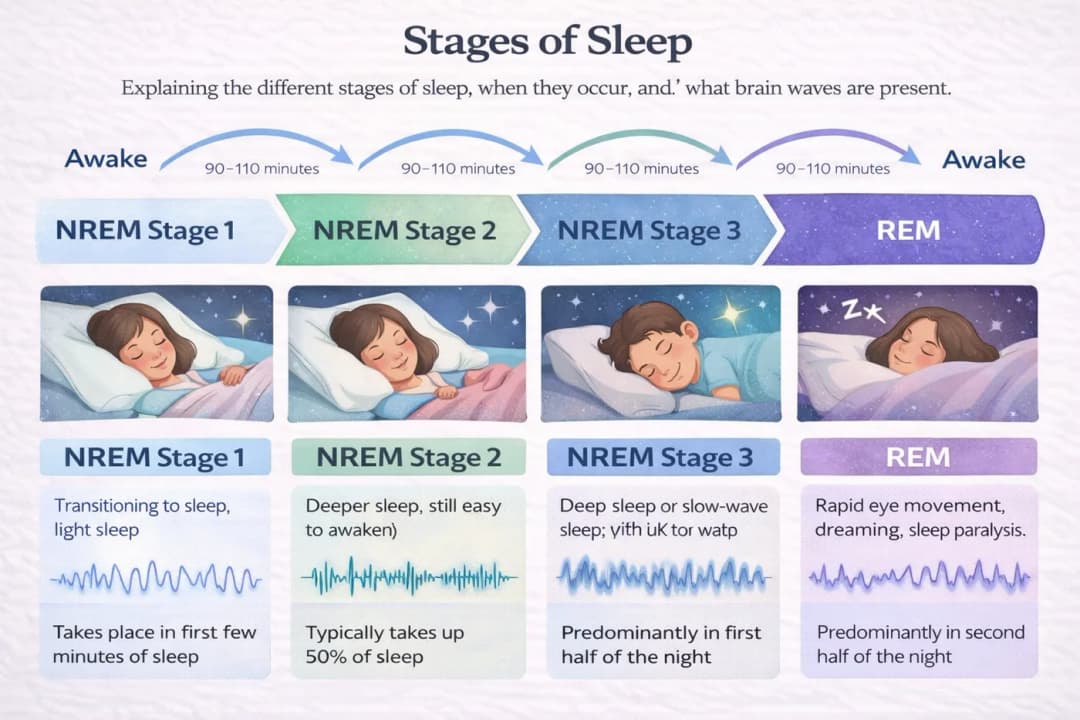
- Sleep
- Sleep deprivation = diminished cognitive performance, chronic diseases
- Stages
- Brain wave activity recorded with EEG
- Stage
- Theta waves, irregular waveforms, slow f, high voltage
- Stage
- Sleep spindles and k complexes
- Stage and
- Slow wave sleep (SWS)
- Delta waves, activity slower, only a few waves per s are seen
- Harder to awake
- Cognitive recovery, memory consolidation, increased growth hormone
- Mnemonic
- Beta, alpha, theta, delta = BAT-D
- Bat sleeps during the Day
- Stages - are non rapid eye movement (NREM) sleep
- REM is interspersed between cycles of NREM sleep
- Arousal levels reach wakefulness, muscles paralyzed (paradoxical sleep)
- Where dreaming occurs, memory consolidation
- Alertness
- Sleep cycles and changes
- Sleep cycle is single complete progression through stages
- Early on SWS predominates, then REM does
- Length of cycle is min in children, in adults
- Sleep cycle deepens () then lightens () then REM, or , REM
- Changes in sleep cycle cause many health problems
- Bad memory, performance, can't recognize bad performance
- Sleep and circadian rhythms
- Approximates hour cycle affected by external cues such as light
- Sleepiness attributed to melatonin, hormone from pineal gland
- Retina has connections to hypothalamus, controls pineal gland
- Less light causes more melatonin
- Cortisol is steroid made by adrenal cortex
- Increase during morning, increase light increases corticotropin releasing factor (CRF)
- From hypothalamus
- CRF releases adrenocorticotropic hormone (ACTH) from anterior pituitary
- Stimulates more cortisol release
- Dreaming
- Most dreaming from REM, but after stage then dreamlike state
- % of dreaming in REM, tend to be longer and more vivid
- Activation synthesis theory
- Dreams caused by widespread, random activation of neural circuitry
- Mimic sensory information, stored memories, desires, needs, experiences
- Problem solving dream theory
- Dreams solve problems while you sleep
- Interpret obstacles differently
- Cognitive process dream theory
- Merely sleeping counterpart stream of consciousness
- Thinking about upcoming trip, dream shifts rapidly
- Neurocognitive models of dreaming seek to unify biological and psychological perspectives
- Sleep wake disorders
- Dyssomnias = disorders that make it difficult to fall, stay, or avoid sleep
- Insomnia = difficulty falling or staying asleep, common, anxiety
- Narcolepsy = involuntary control of sleep
- Cataplexy = loss of muscle control and intrusion of REM sleep
- Sleep paralysis, can't move despite being awake
- Hypnagogic/ hyponopompic, hallucinations going to sleep or awakening
- Sleep apnea = inability to breathe during sleep
- Obstructive = physical blockage in pharynx, preventing airflow
- Central is brain failing to send signals to breathe
- Parasomnias = abnormal movements or behaviors during sleep
- Night terrors = periods of intense anxiety during SWS
- Symp overdrive, difficult to wake, doesn't remember dream
- Sleepwalking = occurs during SWS, don't remember
- Awakening doesn't harm them
- Usually during NREM sleep
- Night terrors = periods of intense anxiety during SWS
- Dyssomnias = disorders that make it difficult to fall, stay, or avoid sleep
- Sleep deprivation
- Multiple nights of poor quality
- Can cause psychosis
- People often exhibit REM rebound
- Hypnosis
- Person is highly suggestible
- Starts with hypnotic induction, relaxes and increases []
- Not same in media
- Used for pain control, psychological therapy, memory enhancement, addiction
- Requires willing personality and lack of skepticism
- Meditation
- Central part of many religions
- Quieting of mind, promotes relaxation, decreases HR and BP
- Resembles stage sleep with theta and slow alpha waves
4.4 Consciousness Altering Drugs
Psychoactive drugs alter CNS activity as depressants, stimulants, opioids, and hallucinogens. This section summarizes major drug classes, key mechanisms, and addiction via reward circuitry.
- Depressants
- Reduce NS activity, relaxation and anxiety
- Alcohol
- Increases activity of GABA, causing generalized inhibition
- Increases dopamine levels, causing euphoria
- Alcohol myopia, inability to recognize consequences
- One of most widely abused drugs
- Alcoholism runs in families, children have depression
- Causes cirrhosis, liver failure, pancreatic damage, cancer
- Barbiturates and benzodiazepines
- Barbiturates were anxiolytic and sleep medication
- Replaced by benzos, harder to OD
- Barbiturates = - barbital, benzos = -lam/pam
- Can be addictive, death if taken with alcohol
- Stimulants
- Amphetamines
- Increased arousal, increase DA, NE, 5HT
- Reduction in appetite, decreased sleep, increased HR, BP
- Euphoria, hypervigilance, anxiety, paranoia
- Prolonged use = stroke/brain damage
- Cocaine
- Decreases reuptake of DA, NE, 5HT
- Effects like amphetamines
- Also anesthetic and vasoconstrictive, used in surgeries in vascularized areas
- Crack is form that can be smoked
- Ecstasy (3,4 methylenedioxy-N-methylamphetamine, MDMA)
- Hallucinogen with amphetamine
- Increased HR, BP, blurry vision, sweating, nausea, hyperthermia
- Club or rave drug
- Amphetamines
- Opiates and opioids
- Opiates are naturally occurring (morphine, codeine), opioids are semisynthetic (oxycodone, hydrocodone, heroin)
- Bind to opioid receptors in PNS and CNS, causing decreased pain, euphoria
- OD by respiratory suppression
- Heroin made as substitute for morphine, injected converts it to morphine
- Used to be most widely abused, now that is prescription
- Methadone is treatment
- Hallucinogens
- Lysergic acid diethylamide (LSD)
- Peyote, mescaline, ketamine, psilocybin containing mushrooms
- Complex interactions with 5HT, cause distortions of fantasy
- Marijuana
- Leaves and flowers of cannabis sativa and indica
- Active chemical is tetrahydrocannabinol (THC)
- Acts at cannabinoid, glycine, and opioid receptors
- Gets you high
- Drug Addiction
- Related to mesolimbic reward pathway
- Increases nucleus accumbens, VTA
- Connection between is medial forebrain bundle MFB
- Addiction pathway activated by substance that produce dependence
- Also gambling, falling in love
- NT is DA
4.5 Attention
Attention filters sensory input so some information gets processed and stored while the rest is lost. This section contrasts selective attention with divided attention and controlled vs automatic processing.
- Selective Attention
- Focusing on one part of sensory input, ignoring other parts
- Acts as filter
- Between sensory stimuli and processing stimulus
- If not attended to, then lost
- Cocktail party phenomenon
- Talking to friend, notice if someone says your name
- Selective attention is filter that allows us to focus, but process other stimuli
- Divided attention
- Ability to multitask
- Most complex/new tasks require undivided attention, utilize effortful (controlled) processing
- Familiar routines done with automatic processing
- Automatic processing is like driving
- Doesn't allow for innovation or rapid response to change
4.6 Language
Language has core components (phonology, morphology, semantics, syntax, pragmatics) and develops in stages from babbling to mastery. This section also covers language theories, cognition effects, and major brain areas and aphasias.
- Components
- Phonology = sound of language
- % sounds of speech in English, IPA
- Must learn when differences in sound = differences in meaning (Categorical perception)
- Morphology = structure of words
- Words made of building blocks, morphemes
- Redesigned = re-, -design-, - ed
- Semantics = association of meaning with word
- Words can refer to categories (women) or specific members (mommy)
- Developing children may refer to all women as mommy
- Syntax = how words are put together
- Effect of word order on meaning, grammar
- Pragmatics = dependence of language on context and preexisting knowledge
- Be more formal to stranger
- Affected by prosody = rhythm, cadence, and inflection in voices
- Phonology = sound of language
- Language development
- Babbling
- Random words
- - months
- to months
- Children add one word per month
- to months
- Child learns dozens of word, can use inflection
- Combines words, eat apple
- to years
- Can speak in longer sentences, vocabulary grows exponentially
- Grammatical errors as they internalize complex rules of grammar
-
- Language rules are largely mastered
- Language learning easy for kids
- Babbling
- Language theories
- Nativist (biological)
- Noam Chomsky, innate capacity for language
- Transformational grammar, children can learn easy (so innate)
- Ability is language acquisition device (LAD)
- Theoretical pathway that allows infants to process and absorb language rules
- Critical period is between years and puberty
- Child that was feral, couldn't learn language later on
- Sensitive period is time when environmental input has maximal effect
- Learning (behaviorist)
- Proposed by BF Skinner
- Language through operant conditioning
- Babies show preference for phenomes of parents languages
- Language acquisition through reinforcement
- Parents repeat sounds that sound like language of parents
- Theory doesn't explain explosion in vocab
- Social interactionist theory
- Focuses on interplay between biological and social processes
- As language develops, brain groups sounds and meanings together
- Nativist (biological)
- Influence of language on cognition
- Whorfian hypothesis (linguistic relativity hypothesis)
- Perception of reality is determined by content of language
- Language effects the way we think, not other way around
- Inuit's are better at discriminating between types of snow
- Whorfian hypothesis (linguistic relativity hypothesis)
- Brain areas and language
- Both are dominant hemisphere (usually left)
- Broca's is inferior frontal gyrus, controls motor function of speech
- Wernicke's area is superior temporal gyrus of temporal lobe
- Areas connected by arcuate fasciculus
- Bundle of axons that associate language comprehension and speech production
- Aphasia is deficiency of language production or comprehension
- Broca's aphasia = comprehension intact, can't produce language
- Wernicke's aphasia = motor production good, but comprehension lost
- Conduction aphasia if arcuate fasciculus affected
- Patient can't repeat something said
- Very rare
Spotted something wrong or unclear? Tell us — these notes are revised continuously.