
MCAT Psychology & Sociology · Lesson 3
Learning and Memory
3 min read3 sectionsUpdated
Jump to a section3
3 sections
3.1 Learning
This section covers mechanisms of learning, including habituation, associative learning (classical and operant conditioning), reinforcement schedules, shaping, cognitive and biological factors, and observational learning.
- Non-Associative Learning
- Habituation: decrease in response to repeated stimulus
- Dishabituation: recovery of response after a second stimulus
- Example: merging onto a highway after driving for a while
- Associative Learning
- Linking two stimuli or behavior with consequence
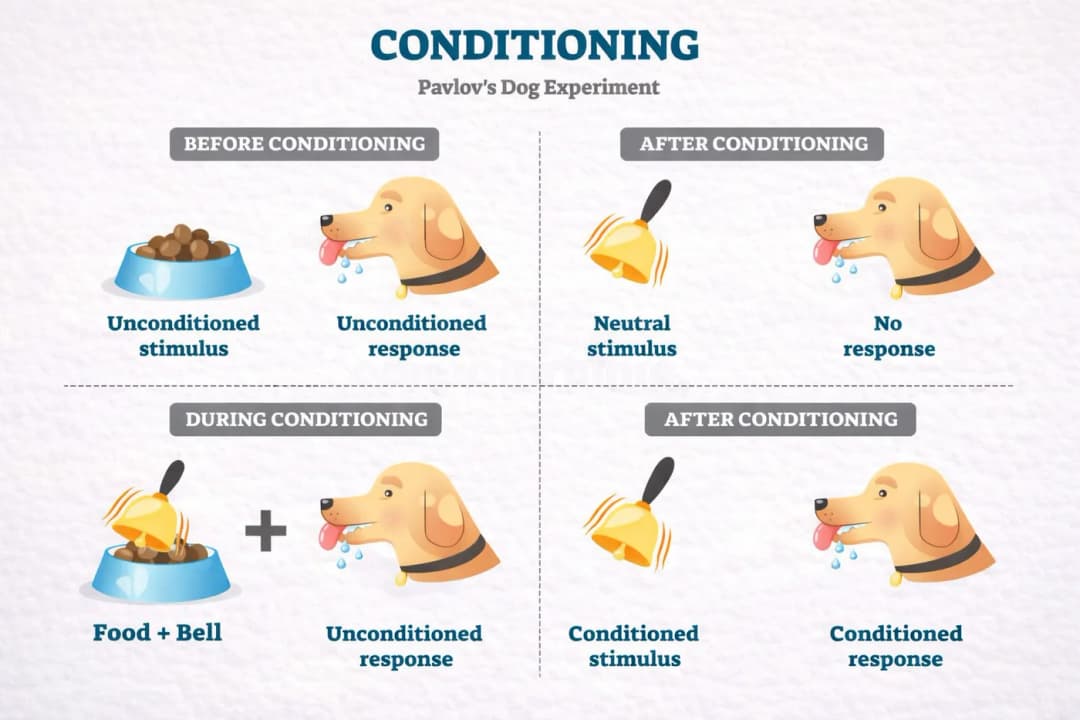
- Classical Conditioning (Pavlov)
- Unconditioned stimulus (US): evokes innate response (meat)
- Unconditioned response (UR): innate reflexive response
- Neutral stimulus (NS): initially no response (bell)
- Conditioned stimulus (CS): NS after association with US
- Conditioned response (CR): learned response to CS
- Acquisition: process of pairing
- Extinction: habituation to CS
- Spontaneous recovery: response reappears after extinction
- Generalization: similar stimulus evokes response (Little Albert)
- Discrimination: distinguish between stimuli
- Operant Conditioning (Skinner)
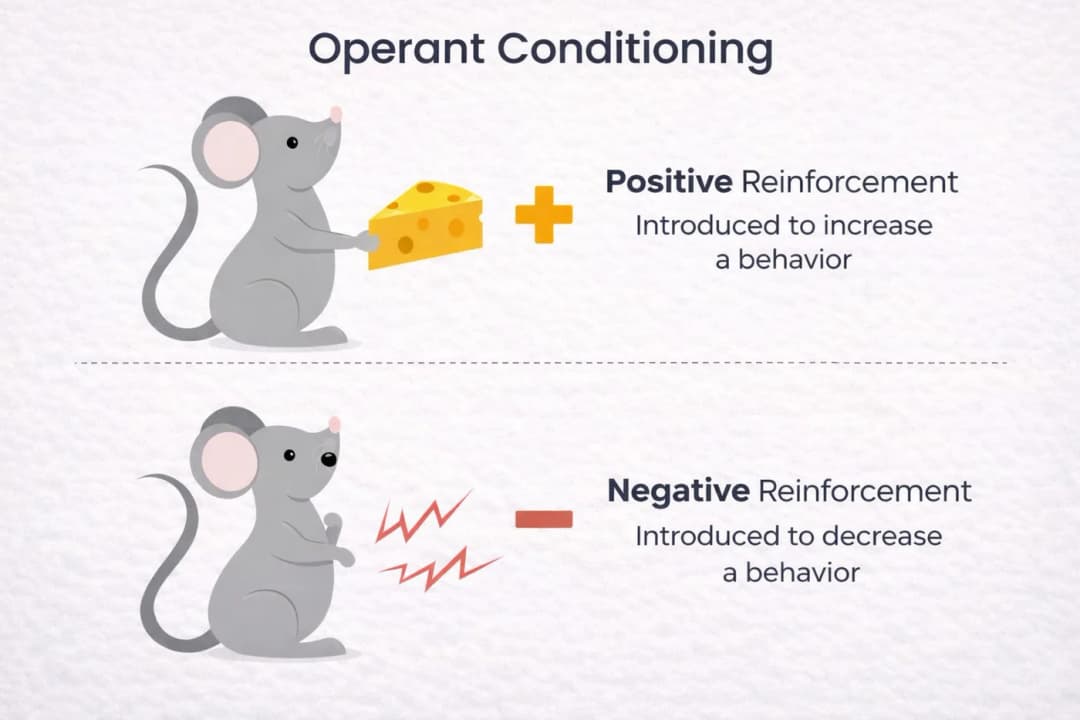
- Reinforcement: increases behavior likelihood
- Positive: add positive incentive
- Negative: remove unpleasant stimulus
- Escape learning: remove existing unpleasantness
- Avoidance learning: prevent unpleasantness
- Primary reinforcer: inherently rewarding (food)
- Secondary reinforcer: conditioned (clicker for dolphin)
- Punishment: decreases behavior likelihood
- Positive: add unpleasant consequence
- Negative: remove desired stimulus
- Reinforcement Schedules
- Fixed Ratio (FR): reward after fixed # behaviors
- Variable Ratio (VR): reward after varying # behaviors, average constant; very rapid, resistant to extinction (e.g., gambling)
- Fixed Interval (FI): reward first behavior after fixed time
- Variable Interval (VI): reward first behavior after varying time
- Shaping
- Reward progressively specific behaviors
- Example: train bird to turn 90°, 180°, 270° before full rotation
- Cognitive/Biological Factors
- Latent learning: learning without reward, expressed when reward introduced
- Problem solving: trial-and-error vs analytical
- Preparedness: natural predisposition to learn behavior
- Instinctive drift: difficulty overcoming innate behaviors
- Observational Learning
- Learning by watching others
- Example: children imitate adults' aggressive actions
- Mirror neurons: frontal & parietal lobes, fire when performing or observing, relate to empathy and vicarious emotions
3.2 Memory
Explains encoding, storage, and retrieval processes, types of memory, mnemonics, forgetting mechanisms, and factors affecting memory.
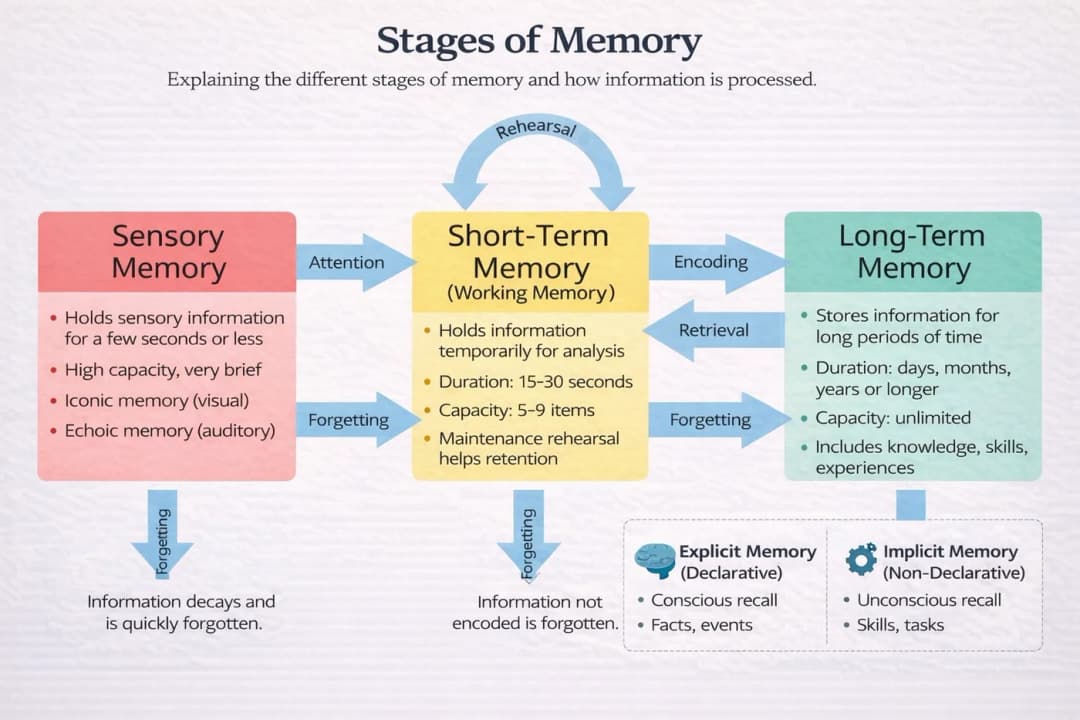
- Encoding
- Automatic processing: info gained without effort
- Controlled (effortful) processing: requires attention; can become automatic
- Types: visual, acoustic, semantic (strongest)
- Self-reference effect: relate info to self for better encoding
- Maintenance rehearsal: repetition
- Mnemonics:
- Method of loci: associate items with locations
- Peg-word system: associate items with rhyming numbers
- Chunking: group items
- Storage
- Sensory memory: iconic (visual), echoic (auditory); <1s
- Short-term memory: fades in ~30s, 7±2 items, hippocampus
- Working memory: integrates short-term memory, attention, executive function
- Long-term memory: recall knowledge, hippocampus → cerebral cortex
- Implicit: skills, conditioned responses
- Explicit: declarative
- Semantic: facts
- Episodic: experiences
- Retrieval
- Recognition: identify learned info (MCQ)
- Relearning: faster memorization on second attempt
- Spreading activation: semantic networks, priming aids recall
- Context/state-dependent memory: physical location or mental/emotional state aids recall
- Serial position effect: primacy & recency effect
- Forgetting
- Brain disorders
- Alzheimer's: loss of Ach, progressive dementia, retrograde memory loss, beta-amyloid plaques
- Korsakoff's syndrome: thiamine deficiency, retrograde amnesia, confabulation
- Agnosia: inability to recognize objects/people/sounds
- Decay: memory trace fades over time (Ebbinghaus curve)
- Interference
- Proactive: old info interferes with new
- Retroactive: new info interferes with old
- Aging: minimal impact, vivid memories in 20s, prospective memory intact in event-based tasks
- Memory reconstruction: faulty, influenced by misinformation effect and source monitoring errors
- Brain disorders
3.3 Neurobiology of Learning and Memory
Covers the physiological basis of learning and memory, including neuroplasticity, synaptic pruning, and long-term potentiation.
- Neuroplasticity
- Early brain development: rapid neural connections, recovery after damage
- Adult brain: limited regeneration
- Synaptic pruning: eliminates weak connections
- Mechanisms
- Stimulus → neuron activation → NT release → stimulation of postsynaptic neuron
- Repeated stimulation → increased efficiency & receptor density
- Long-term potentiation (LTP): strengthening of synapses, neurophysiological basis for long-term memory
Spotted something wrong or unclear? Tell us — these notes are revised continuously.