
MCAT Psychology & Sociology · Lesson 7
Psychological Disorders
3 min read3 sectionsUpdated
3 sections
7.1 Understanding Psychological Disorders
Psychological disorders can be approached via biomedical or biopsychosocial frameworks. Classification relies on DSM, which organizes disorders based on symptom descriptions. Interventions may target biological, psychological, or social components.
Approaches
- Biomedical: focuses on biological roots and symptom reduction; may miss lifestyle/socioeconomic factors
- Biopsychosocial: considers multiple components
- Psychological: thoughts, emotions, behaviors
- Social: environmental factors
- Direct therapy: medication, therapy
- Indirect therapy: social support, education, empowerment
Classification
- DSM: Diagnostic and Statistical Manual of Mental Disorders
- Initially for statistics; now diagnostic
- 20 disorder classes
- Examples: anxiety, depression, PTSD, bipolar, GAD (>2% prevalence)
7.2 Types of Psychological Disorders
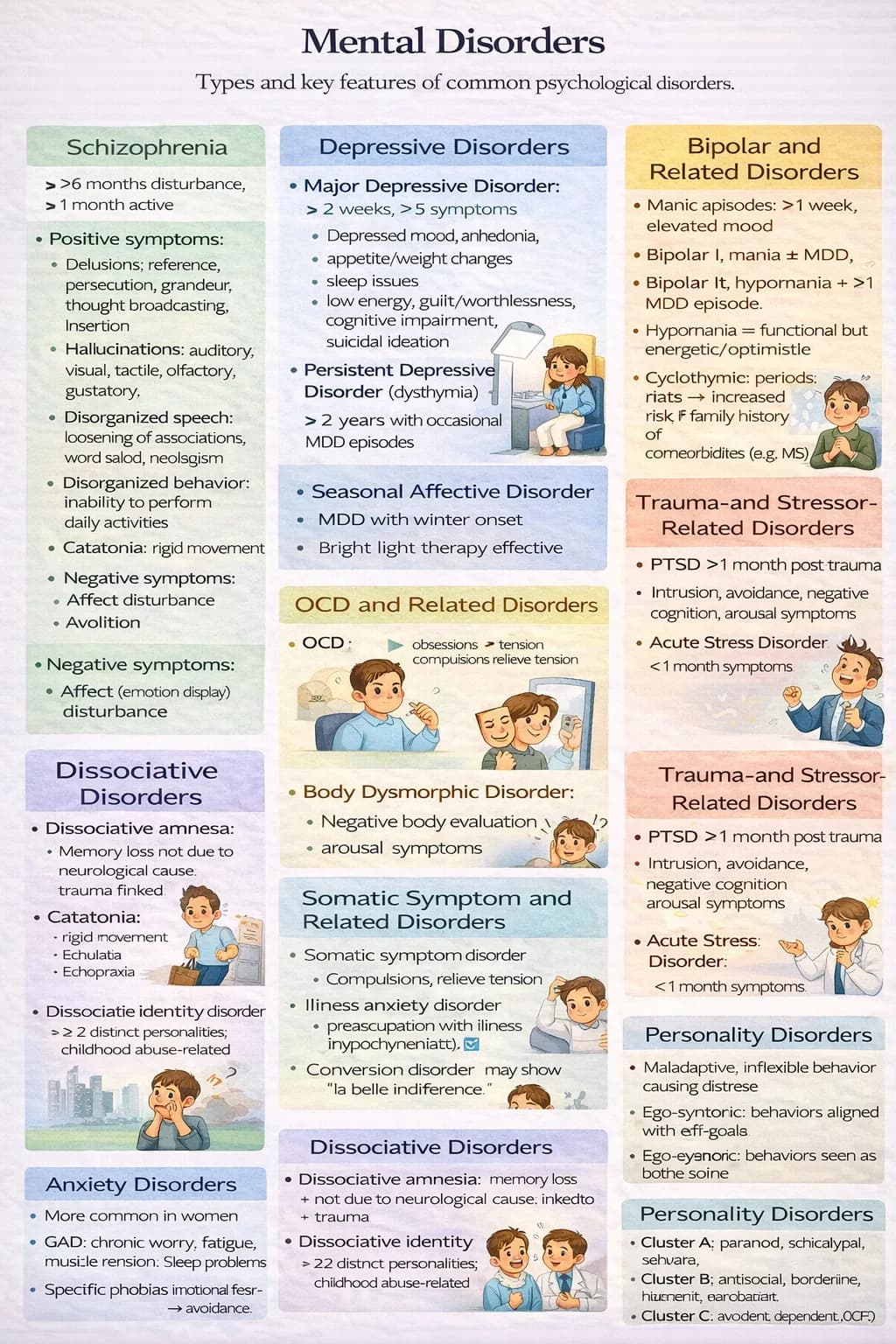
Disorders span schizophrenia, mood, anxiety, OCD, trauma, dissociative, somatic, and personality types. Diagnosis relies on symptom patterns, duration, and functional impairment.
Schizophrenia
- ≥6 months disturbance, ≥1 month active symptoms
- Positive symptoms: additions to normal
- Delusions: reference, persecution, grandeur, thought broadcasting, insertion
- Hallucinations: auditory, visual, tactile, olfactory, gustatory
- Disorganized speech: loosening of associations, word salad, neologism
- Disorganized behavior: inability to perform daily activities
- Catatonia: rigid movement
- Echolia: repeat words
- Echopraxia: repeat actions
- Negative symptoms: deficits
- Affect (emotion display) disturbance
- Avolition (goal-directed action decrease)
- Prodromal phase: poor adjustment → active phase
- Slow onset → worse prognosis
Depressive Disorders
- Major Depressive Disorder: ≥2 weeks, ≥5 symptoms
- Depressed mood, anhedonia, appetite/weight changes, sleep issues, low energy, guilt/worthlessness, cognitive impairment, suicidal ideation
- 15% suicide risk
- Persistent Depressive Disorder: dysthymia ≥2 years
- Occasional MDD episodes
- Seasonal Affective Disorder: MDD with winter onset
- Bright light therapy effective
Bipolar and Related Disorders
- Manic episodes: ≥1 week, elevated mood
- Bipolar I: mania ± MDD
- Bipolar II: hypomania + ≥1 MDD episode
- Hypomania = functional but energetic/optimistic
- Cyclothymic: hypomania + dysthymia periods
- Neurotransmitter theory: ↑NE/5HT → mania, ↓NE/5HT → depression
Anxiety Disorders
- More common in women
- GAD: chronic worry, fatigue, muscle tension, sleep problems
- Rule out hyperthyroidism
- Specific phobias: irrational fear → avoidance
- Social anxiety: fear in social situations
- Agoraphobia: fear in inescapable situations
- Panic disorder: recurrent panic attacks; may co-occur with agoraphobia
OCD and Related Disorders
- OCD: obsessions → tension, compulsions relieve tension
- Body Dysmorphic Disorder: negative body evaluation, seeks corrective surgeries
Trauma- and Stressor-Related Disorders
- PTSD: ≥1 month post-trauma
- Intrusion, avoidance, negative cognition, arousal symptoms
- Acute Stress Disorder: <1 month symptoms
Dissociative Disorders
- Dissociative amnesia: memory loss not due to neurological cause; trauma-linked
- Dissociative fugue: sudden relocation, new identity
- Dissociative identity disorder: ≥2 distinct personalities; childhood abuse-related
- Depersonalization disorder: detachment from mind/body; out-of-body experiences
Somatic Symptom and Related Disorders
- Somatic symptom disorder: somatic symptom, excessive concern
- Illness anxiety disorder: preoccupation with illness, hypochondriasis
- Conversion disorder: unexplained symptoms (paralysis/blindness) without neuro damage; may show la belle indifference
Personality Disorders
- Maladaptive, inflexible behavior causing distress
- Ego-syntonic: behaviors aligned with self-goals
- Ego-dystonic: behaviors seen as bothersome
- Cluster A: paranoid, schizotypal, schizoid
- Cluster B: antisocial, borderline, histrionic, narcissistic
- Cluster C: avoidant, dependent, OCPD
7.3 Biological Basis or Nervous System Disorders
Many psychological disorders have identifiable neurobiological correlates, including neurotransmitter imbalances, structural brain changes, and genetic influences.
Schizophrenia
- Risk factors: birth trauma, hypoxemia, genetic predisposition
- Excess dopamine
- Neuroleptics block DA
Depressive and Bipolar Disorders
- Depression: ↑amygdala glucose metabolism, hippocampal atrophy, ↑cortisol, ↓NE/5HT/DA
- Bipolar: ↑NE/5HT, increased risk if family history or comorbidities (e.g., MS)
Alzheimer's Disease
- Dementia: memory loss, disorientation, cognitive deficits
- 65 yrs, more common in women
- Genetic component: beta-amyloid precursor protein (chromosome 21)
- Higher risk in Down syndrome
- Markers: cortical atrophy, flattened sulci, enlarged ventricles, ↓Ach/ChaT, plaques/tangles
Parkinson's Disease
- Symptoms: bradykinesia, resting tremor, pill-rolling, masklike facies, cogwheel rigidity, shuffling gait
- Cause: ↓DA in substantia nigra → basal ganglia dysfunction
- Treatment: L-DOPA → converted to DA
Spotted something wrong or unclear? Tell us — these notes are revised continuously.