
MCAT Psychology & Sociology · Lesson 8
Social Processes, Attitudes, and Behavior
2 min read3 sectionsUpdated
Jump to a section3
3 sections
8.1 Group Psychology
Group dynamics influence individual behavior, decision-making, and social norms. Social psychology explores how groups affect performance, conformity, and cultural behaviors.
Key Concepts
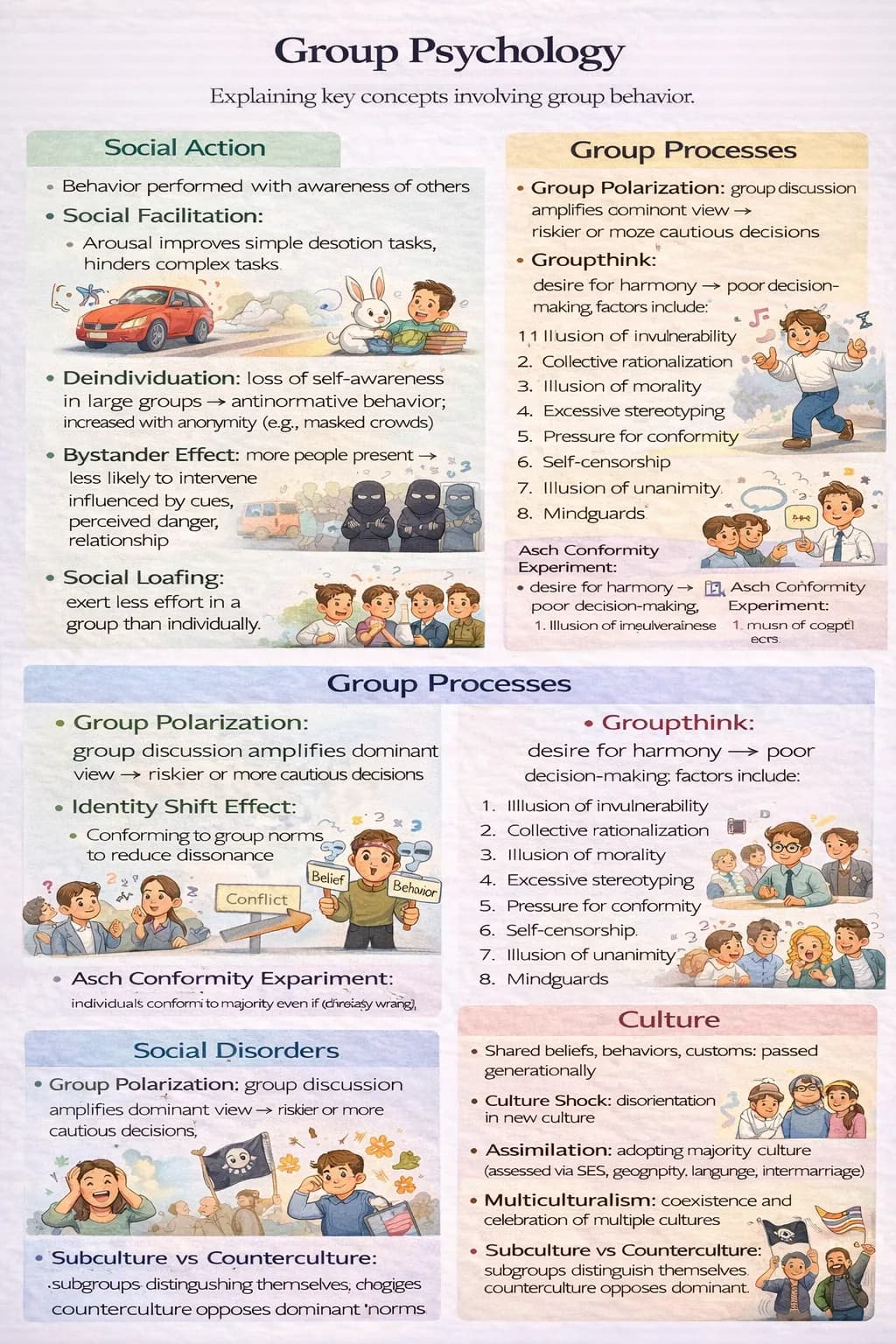
- Social Action: behavior performed with awareness of others
- Social Facilitation: arousal improves simple tasks, hinders complex tasks (Yerkes-Dodson law)
- Deindividuation: loss of self-awareness in large groups → antinormative behavior; increased with anonymity (e.g., masked crowds)
- Bystander Effect: more people present → less likely to intervene; influenced by cues, perceived danger, relationship
- Social Loafing: exert less effort in a group than individually
- Peer Pressure: changes behavior/attitudes to align with group; can be positive or negative
- Identity Shift Effect: conforming to group norms to reduce dissonance
- Cognitive Dissonance: discomfort from conflicting beliefs → motivate attitude/behavior change
- Asch Conformity Experiment: individuals conform to majority even if obviously wrong
Group Processes
- Group Polarization: group discussion amplifies dominant view → riskier or more cautious decisions
- Groupthink: desire for harmony → poor decision-making; factors include:
- Illusion of invulnerability
- Collective rationalization
- Illusion of morality
- Excessive stereotyping
- Pressure for conformity
- Self-censorship
- Illusion of unanimity
- Mindguards
- Fads: transient popularity
- Mass Hysteria: widespread societal panic (e.g., Salem witch trials)
Culture
- Shared beliefs, behaviors, customs; passed generationally
- Culture Shock: disorientation in new culture
- Assimilation: adopting majority culture (assessed via SES, geography, language, intermarriage)
- Multiculturalism: coexistence and celebration of multiple cultures
- Subculture vs Counterculture: subgroups distinguishing themselves; counterculture opposes dominant norms
8.3 Attitudes and Behavior
Attitudes influence behavior; shaped by cognitive, affective, and behavioral components, and modified by social context.
Components of Attitude
- Affect: emotional response
- Behavioral: actions toward object
- Cognitive: beliefs/knowledge supporting attitude
Theories
- Functional Attitude Theory:
- Knowledge: provides consistency
- Ego-expressive: communicates identity
- Adaptive: socially acceptable attitudes
- Ego-defensive: protects self-esteem
- Learning Theory: attitudes shaped by reinforcement, punishment, observation
- Elaboration Likelihood Model:
- Central route: deep processing
- Peripheral route: superficial cues
- Social Cognitive Theory: attitudes learned via observation and modeling; behavior influenced by environmental feedback
Spotted something wrong or unclear? Tell us — these notes are revised continuously.
8.2 Socialization
Socialization teaches norms, values, and behaviors, shaping individual identity within society.
Types
Norms
Agents of Socialization
Deviance and Stigma
Conformity, Compliance, Obedience