
MCAT Biochemistry · Lesson 5
Lipid Structure and Function
3 min read3 sectionsUpdated
Jump to a section3
3 sections
5.1 Structural Lipids
This section describes structural lipids, including phospholipids, glycerophospholipids, sphingolipids, and waxes, focusing on their structure, saturation, and functional roles in membranes and protection.
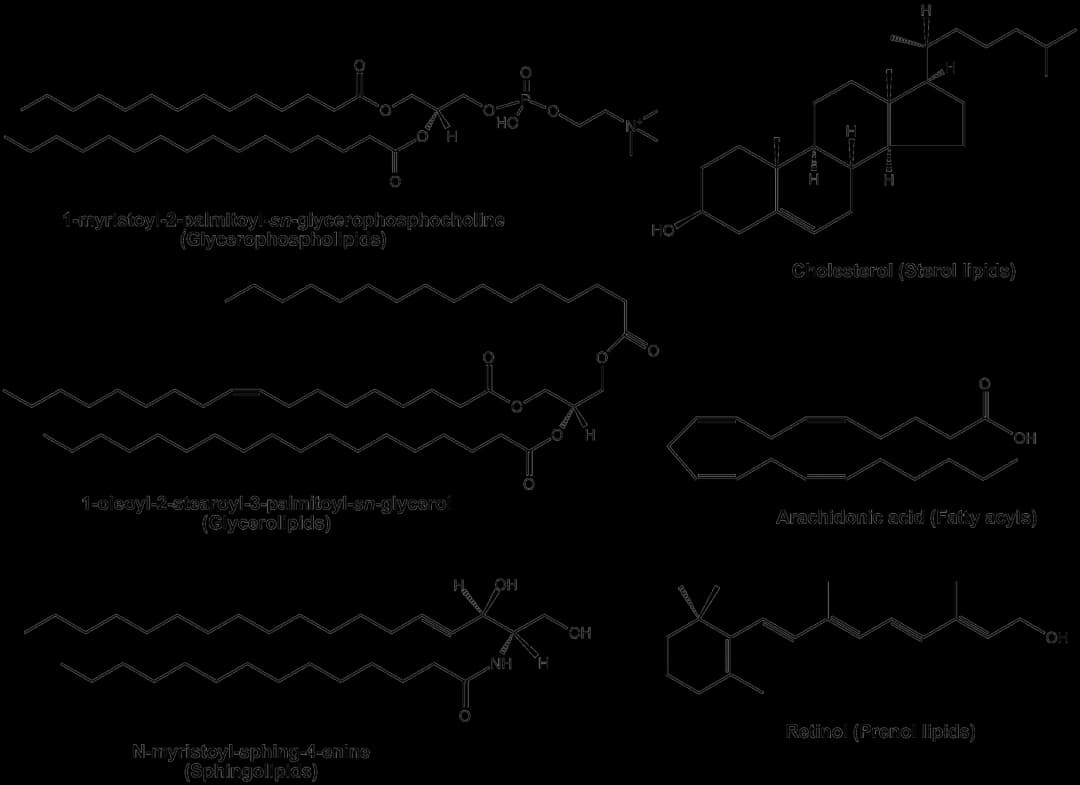
- Lipids: insoluble in water.
- Phospholipid bilayer = amphipathic: polar head, hydrophobic tail.
- Head group: phosphate + alcohol, phosphodiester linked to fatty acid tail.
- Glycerol: 3C alcohol → phosphoglycerides/glycerophospholipids.
- Sphingolipids: sphingosine backbone.
- Tail varies by saturation and length:
- Saturated: single bonds → more stable.
- Unsaturated: double bonds → liquid at room temp.
- Glycerophospholipids
- All glycerophospholipids are phospholipids; not all phospholipids are glycerophospholipids.
- Glycerol backbone + 2 fatty acids.
- Named for head group:
- Phosphatidylcholine → choline
- Phosphatidylethanolamine → ethanolamine
- Head group charges vary; chains vary in length/saturation.
- Sphingolipids
- Surface cell antigens (ABO blood typing).
- Sphingosine/sphingoid backbone.
- Some are phospholipids (phosphodiester linkage); some glycolipids (glycosidic linkage).
- Four main subclasses:
- Ceramide: single H as head group.
- Sphingomyelins: phosphatidylcholine/ethanolamine head; only phospholipid sphingolipid; no net charge; plasma/myelin component.
- Glycosphingolipids: sugar head groups; no phosphate; outer membrane surface.
- Cerebrosides = single sugar
- Globosides = 2+ sugars
- Neutral glycolipids: no net charge at pH 7.4
- Gangliosides: oligosaccharide + N-acetylneuraminic acid (NANA); negative charge; cell interaction, recognition, signal transduction.
- Sphingolipid Accumulation
- Niemann-Pick disease: intellectual disability, seizures.
- Sulfatides: sulfated cerebrosides; associated with Alzheimer’s.
- Waxes
- Esters of long fatty acids + long chain alcohols.
- Pliable solids at room temp.
- Functions: protection, prevent evaporation, shield against parasites.
- Examples: carnauba wax (candies, cars), beeswax (shelter).
5.2 Signaling Lipids
Signaling lipids include terpenes, terpenoids, steroids, prostaglandins, and fat-soluble vitamins, which serve as precursors, hormones, and regulators in the body.
- Terpenes and Terpenoids
- Terpenes: odiferous metabolic precursors to steroids; built from isoprene (C5H8) units; produced by plants/insects; part of defense and scents.
- Classification by isoprene units:
- Monoterpenes: 2 units → essential oils, turpentine
- Sesquiterpenes: 3 units
- Diterpenes: 4 units → Vitamin A (retinal)
- Triterpenes: 6 units → cholesterol, steroids
- Tetraterpenes: 8 units → carotenoids
- Polyterpenes: natural rubber (1000–5000 units)
- Terpenoids: oxygenated derivatives; contribute to steroid biosynthesis, aromas.
- Steroids
- Metabolic derivatives of terpenes; 4 fused cycloalkane rings (3 cyclohexanes + 1 cyclopentane).
- Steroid hormones: endocrine secretion, protein carriers (testosterone, estrogen, cortisol, aldosterone).
- Cholesterol: membrane fluidity, steroid/bile acid/vitamin D precursor.

- Prostaglandins
- 20 C unsaturated carboxylic acids from arachidonic acid; 1 5C ring.
- Paracrine/autocrine signaling; regulates cAMP, smooth muscle, sleep-wake, body temp.
- NSAIDs inhibit COX → reduce prostaglandin synthesis.
- Fat-Soluble Vitamins
- Vitamin A: carotene → retinal (vision); retinol storage; retinoic acid regulates gene expression.
- Vitamin D: cholecalciferol → calcitriol; ↑ Ca²⁺ & PO₄³⁻ absorption; deficiency → rickets.
- Vitamin E: tocopherols/tocotrienols; aromatic ring + isoprenoid chain; antioxidant.
- Vitamin K: phylloquinone (K1), menaquinones (K2); posttranslational modification of prothrombin; Ca²⁺ binding; clotting.
5.3 Energy Storage
Triacylglycerols are hydrophobic energy storage molecules, with properties determined by fatty acid saturation, and participate in processes like saponification and micelle formation.
- Triacylglycerols
- 3 fatty acids esterified to glycerol; rare for all 3 to be identical.
- High energy density (more reduced carbons than glycogen); hydrophobic → no water weight.
- Stored as oily droplets in cytosol (adipocytes under skin; seeds in plants).
- Travel bidirectionally in blood between liver and adipose tissue.
- Properties depend on fatty acid saturation.

- Free Fatty Acids & Saponification
- Free fatty acids: unesterified, circulate bound to serum albumin.
- Saponification: ester hydrolysis of triacylglycerols using strong base (NaOH/KOH).
- Produces soap (Na salt of fatty acid + glycerol).
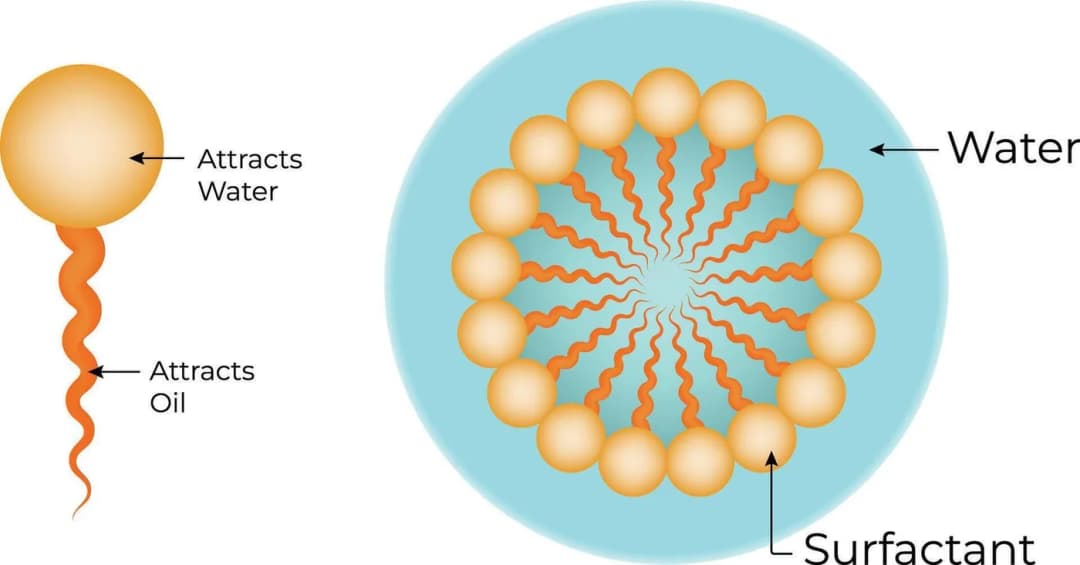
- Soaps act as surfactants: reduce surface tension, emulsify polar/nonpolar mixtures.
- Micelles
- Nonpolar compounds dissolve in micelle core.
- Important for fat-soluble vitamin absorption.
- Formation facilitated by fatty acids + bile salts → increase surface area.
Spotted something wrong or unclear? Tell us — these notes are revised continuously.