
MCAT Biology · Lesson 5
Endocrine System
3 min read2 sectionsUpdated
Jump to a section2
2 sections
5.1 Mechanisms of Hormone Action
Explains hormone types, mechanisms of action, second messenger systems, and classification by target tissues.
- Endocrine system
- Glands secrete hormones into bloodstream
- Hormones bind to receptors on target tissues
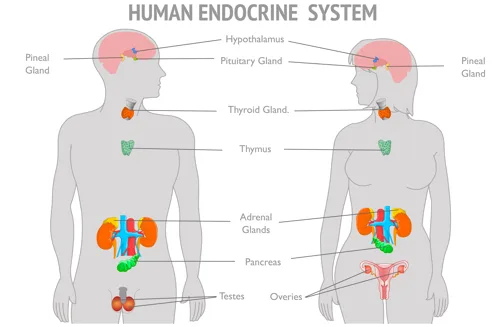
- Peptide Hormones
- Made of amino acids, derived from larger precursors
- Packaged in Golgi, released via exocytosis
- Act as first messengers, triggering second messengers (e.g., cAMP, IP3)
- GPCRs activate/inhibit adenylate cyclase → changes cAMP → activates PKA → phosphorylates CREB
- Rapid, short-lived effects
- Travel freely in blood, no carrier needed
- Steroid Hormones
- Derived from cholesterol, produced by gonads & adrenal cortex
- Nonpolar, cross membranes
- Receptor-hormone complexes bind DNA → transcriptional changes
- Dimerization: 2 complexes pair
- Slower onset, longer duration
- Require protein carriers (specific or nonspecific)
- Most end in -one, -ol, -oid (e.g., testosterone, cortisol)
- Amino Acid Derivative Hormones
- Examples: E, NE, T3, T4
- Derived from 1–2 amino acids
- Catecholamines (E, NE): fast acting, short-lived, GPCRs
- Thyroid hormones: slow onset, longer duration, intracellular receptors
- Classification by target tissue
- Direct hormones: act directly on target (e.g., insulin)
- Tropic hormones: require intermediary (e.g., GnRH → LH/FSH → gonads)
- Tropics often originate in brain/anterior pituitary
5.2 Endocrine Organs and Hormones
Details major endocrine organs, their hormones, mechanisms, feedback loops, and physiological effects.
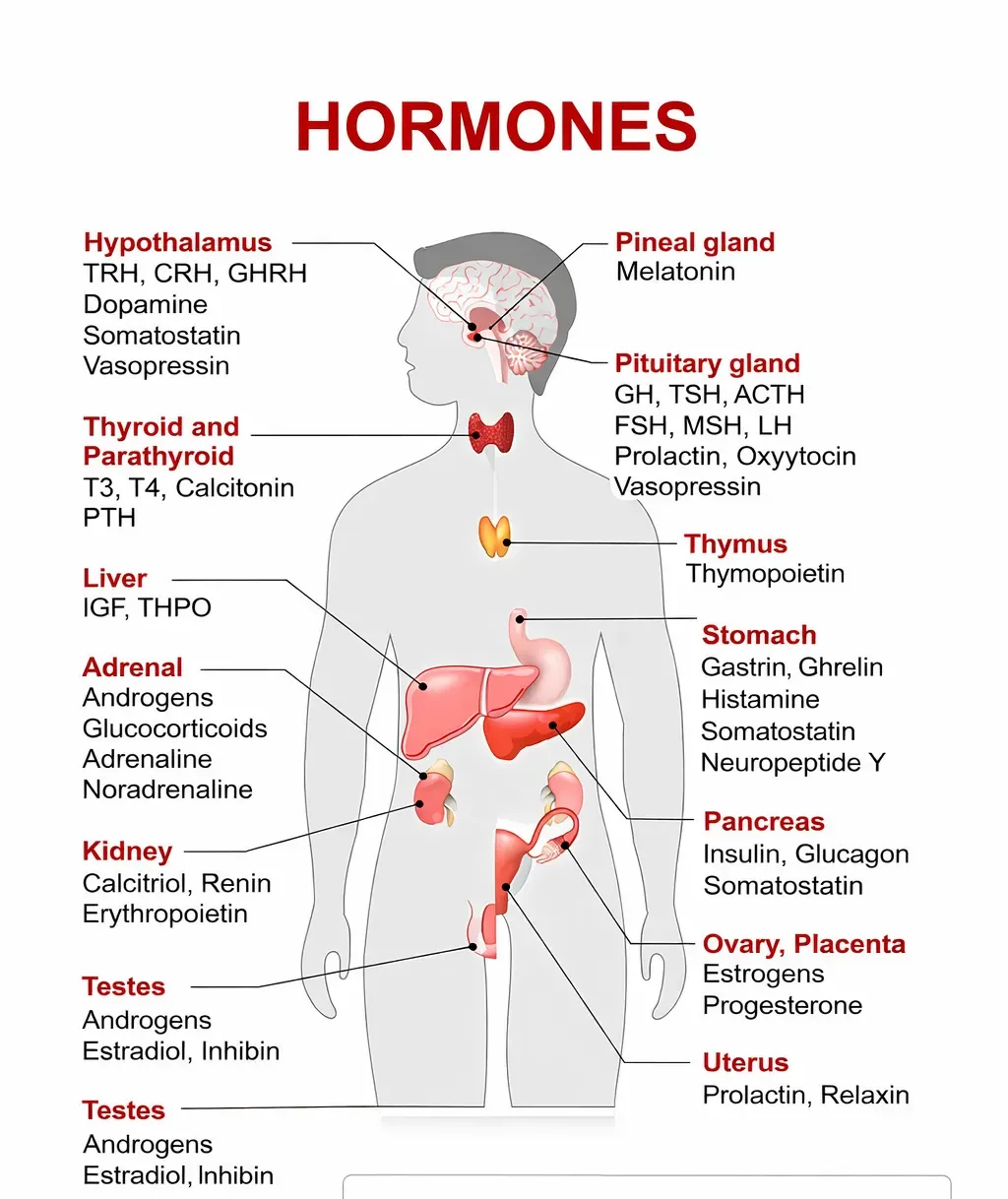
- Hypothalamus
- Bridge between nervous & endocrine systems
- Regulates anterior pituitary via tropic hormones (via hypophyseal portal system)
- Responds to light, osmolarity, appetite, satiety
- Negative feedback maintains homeostasis
- Tropic hormones:
- GnRH → FSH/LH
- GHRH → GH
- TRH → TSH
- CRF → ACTH
- PIF (dopamine) → decreases prolactin
- Axes example: HPA axis (CRF → ACTH → cortisol; cortisol inhibits hypothalamus & anterior pituitary)
- Posterior Pituitary
- Hormones synthesized in hypothalamus, released via axons
- Oxytocin: uterine contractions, milk letdown, bonding (positive feedback)
- ADH (vasopressin): increases water reabsorption in kidneys
- Anterior Pituitary
- Tropic: FSH, LH, ACTH, TSH
- Direct: prolactin, endorphins, GH
- GH promotes growth, requires glucose
- Excess in children: gigantism
- Excess in adults: acromegaly
- Mnemonic: FLAT PEG (FSH, LH, ACTH, TSH - Prolactin, Endorphins, GH)
- Thyroid
- Controlled by TSH
- Produces T3/T4 (iodinated tyrosine): ↑ metabolism, protein & fat turnover
- Calcitonin from C cells: ↓ plasma Ca²⁺ via kidney, gut, bone
- Disorders:
- Iodine deficiency → hypothyroidism (cretinism in children)
- Excess hormone → hyperthyroidism
- Parathyroid
- 4 glands, posterior thyroid
- PTH: ↑ blood Ca²⁺, ↑ kidney reabsorption, ↑ bone resorption, ↑ gut absorption via Vitamin D
- Antagonistic to calcitonin
- Adrenal Cortex
- Corticosteroids (3 S's):
- Salt → mineralocorticoids (aldosterone): ↑ Na⁺ reabsorption, ↑ water retention, RAAS regulated
- Sugar → glucocorticoids (cortisol, cortisone): ↑ gluconeogenesis, ↓ protein synthesis, stress response, ACTH regulated
- Sex → cortical sex hormones (androgens): minor in females, masculinization if excess
- Corticosteroids (3 S's):
- Adrenal Medulla
- NS-derived, secretes E & NE (catecholamines)
- Rapid sympathetic effects
- Pancreas
- Exocrine: digestive enzymes
- Endocrine: islets of Langerhans
- Alpha: glucagon → fasting, glycogenolysis, gluconeogenesis
- Beta: insulin → fed state, glucose uptake/storage
- Delta: somatostatin → inhibits insulin & glucagon, ↑ by high glucose/AA
- Gonads
- Testes → testosterone (sexual differentiation)
- Ovaries → estrogen, progesterone (secondary sex characteristics)
- Pineal Gland
- Melatonin → circadian rhythm regulation
- Other organs
- GI tract: endocrine peptides
- Kidneys: ADH, erythropoietin
- Heart: ANP → Na⁺ excretion, volume regulation
- Thymus: thymosin → T cell development, atrophies in adulthood
Spotted something wrong or unclear? Tell us — these notes are revised continuously.