
MCAT Biology · Lesson 4
Nervous System
2 min read3 sectionsUpdated
3 sections
4.1 Cells of Nervous System
Introduces neurons and glial cells, their structures, functions, and how they form the basic units of the nervous system.
- Neurons
- Soma: contains nucleus, ER, ribosomes
- Dendrites: receive information from other cells
- Axon hillock: integrates signals, initiates action potentials
- Axon: conducts AP; myelinated by:
- Oligodendrocytes (CNS)
- Schwann cells (PNS)
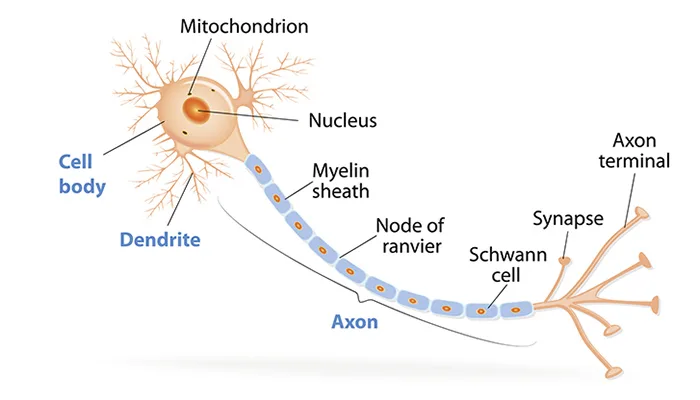
- Axon terminal/synaptic bouton: transmits signals to next cell
- Bundled axons:
- Nerves (PNS): can be sensory, motor, or mixed
- Tracts (CNS): only one type of info
- Cell body groupings:
- Ganglia (PNS)
- Nuclei (CNS)
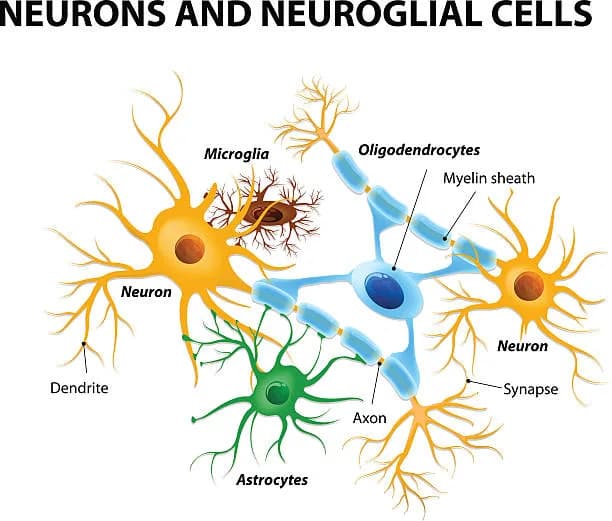
- Glial cells (neuroglia)
- Astrocytes: nourish neurons, form blood-brain barrier
- Ependymal cells: line ventricles, produce CSF
- Microglia: phagocytic, remove waste
- Oligodendrocytes/Schwann cells: myelin production
4.2 Transmission of Neural Impulses
Covers resting potential, action potential initiation and propagation, ion channels, synaptic transmission, and factors affecting conduction.
- Resting potential
- K⁺ leak channels contribute
- Axon hillock
- AP triggered if threshold reached
- Summation:
- Temporal: multiple signals at same time
- Spatial: multiple signals close in space
- Ion channels & membrane potential
- Na⁺ influx depolarizes cell (Vm = +35)
- Relative refractory period prevents immediate reactivation
- Impulse propagation
- AP depolarizes neighboring regions → Na⁺ influx triggers next AP
- Inactivation prevents backward conduction
- Clinical relevance:
- Local anesthetics block VGNa⁺ channels (pain neurons preferentially affected)
- Tetrodotoxin (TTX) blocks VGNa⁺ → paralysis (e.g., diaphragm)
- Synaptic transmission
- Ca²⁺ influx triggers neurotransmitter vesicle fusion with terminal membrane
4.3 Organization of Human Nervous System
Outlines CNS and PNS divisions, reflex circuits, and functional organization of somatic and autonomic systems.
- CNS & PNS
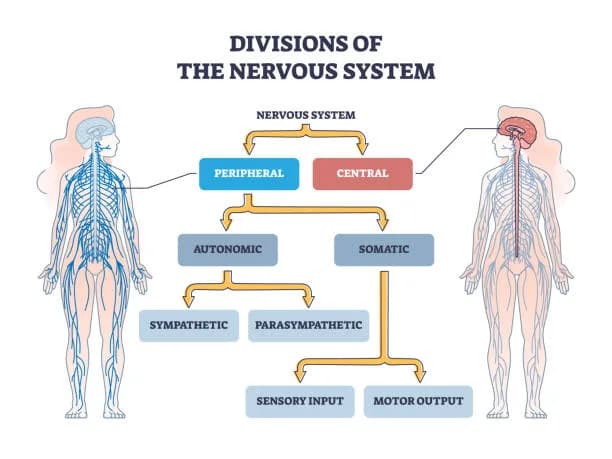
- CNS: brain and spinal cord
- PNS: nerve tissue outside CNS
- 31 spinal nerve pairs, 10–12 cranial nerves
- Olfactory & optic are CNS outgrowths
- Spinal cord:
- White matter deeper than gray matter
- Protected by vertebral column
- Dorsal: sensory input
- Cervical, thoracic, lumbar, sacral regions
- Somatic nervous system
- Innervates skeletal muscle
- Autonomic nervous system (ANS)
- Sympathetic: fight or flight
- Parasympathetic: rest and digest
- Reflexes
- Reflex arcs control immediate responses
- Monosynaptic: single synapse (e.g., knee-jerk)
- Sensory afferent → motor efferent
- Protects muscles from overstretch
- Polysynaptic: at least one interneuron
- Withdrawal reflex requires contralateral limb extension
Spotted something wrong or unclear? Tell us — these notes are revised continuously.