
MCAT Biology · Lesson 12
Genetics and Evolution
7 min read4 sectionsUpdated
4 sections
12.1 Fundamental Concepts of Genetics
Genes are organized into chromosomes and expressed as genotypes and phenotypes. This section covers dominance patterns plus penetrance/expressivity and core Mendelian laws. It also summarizes classic experiments showing DNA is genetic material.
- Genes organized into chromosomes
- Has multiple alleles
- Genetic combination is genotype, manifestation is phenotype
- Each person has homologues, copies of chromosomes
- Dominant if one copy, recessive if 2 copies
- Homo vs heterozygous
- Patterns of dominance
- Complete is only one dominant and recessive
- Codominance is more than one dominant allele
- A/B blood type
- Incomplete dominance when intermediate
- Red, white, pink flowers
- Penetrance and expressivity
- Penetrance is proportion of individuals carrying allele that express phenotype
- In Huntingtins, more than sequence repeats have full penetrance
- of individuals show disease
- Lower repeats = lower penetrance = only some symptoms
- Looks at population
- Expressivity is varying phenotypes despite identical genotypes
- Is constant, all in genotype express phenotype
- If variable, same genotype can have different phenotypes
- If genetic disease, can have different symptoms = variable expressivity
- Looks at individual
- Penetrance is proportion of individuals carrying allele that express phenotype
- Mendelian concepts
- First law of segregation
- Genes exist in alleles, each has alleles (one from each parent)
- If alleles segregate in meiosis, gametes only have allele
- If alleles, one fully expressed and one dominant
- Like anaphase I of meiosis
- Second law of independent assortment
- Inheritance of one gene does not affect inheritance of another
- DNA strand held at centromere, makes sister chromatids
- Homo chromosomes make tetrads
- Recombination results in novel combinations of alleles not originally present
- Linked genes mess with this law
- Like prophase I of meiosis
- First law of segregation
- DNA as genetic material
- Used to think protein was material
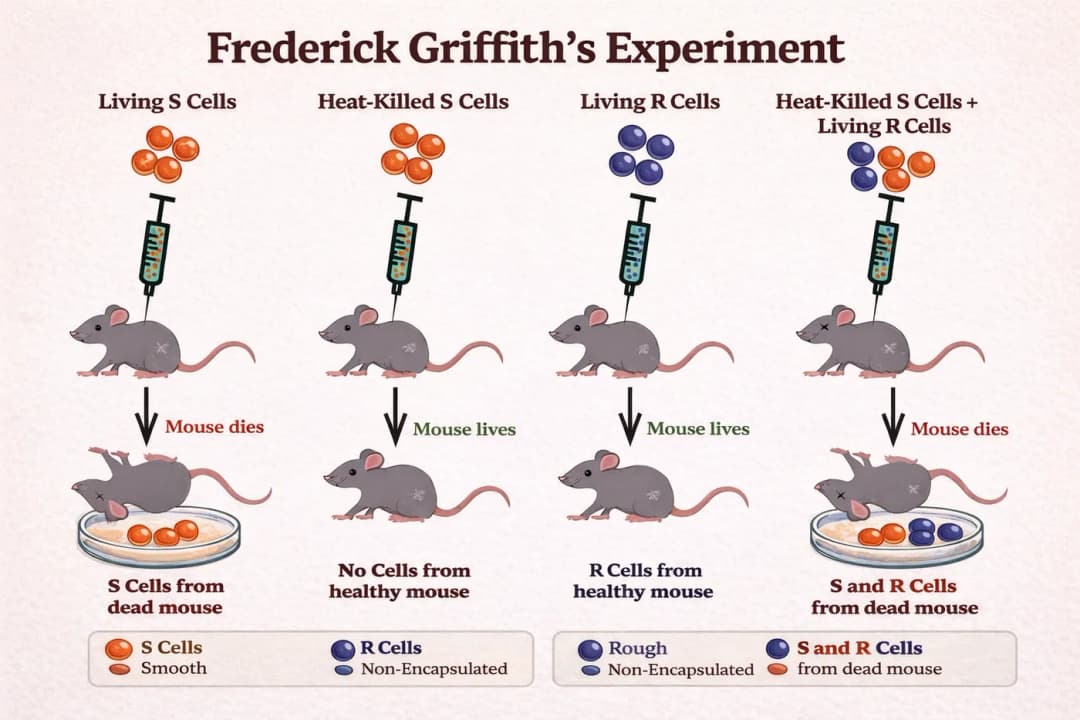
- Frederick Griffith
- different strains of pneumonia, virulent and non virulent
- Transforming principle, live nonvirulent gets ability to make smooth capsules, making them virulent
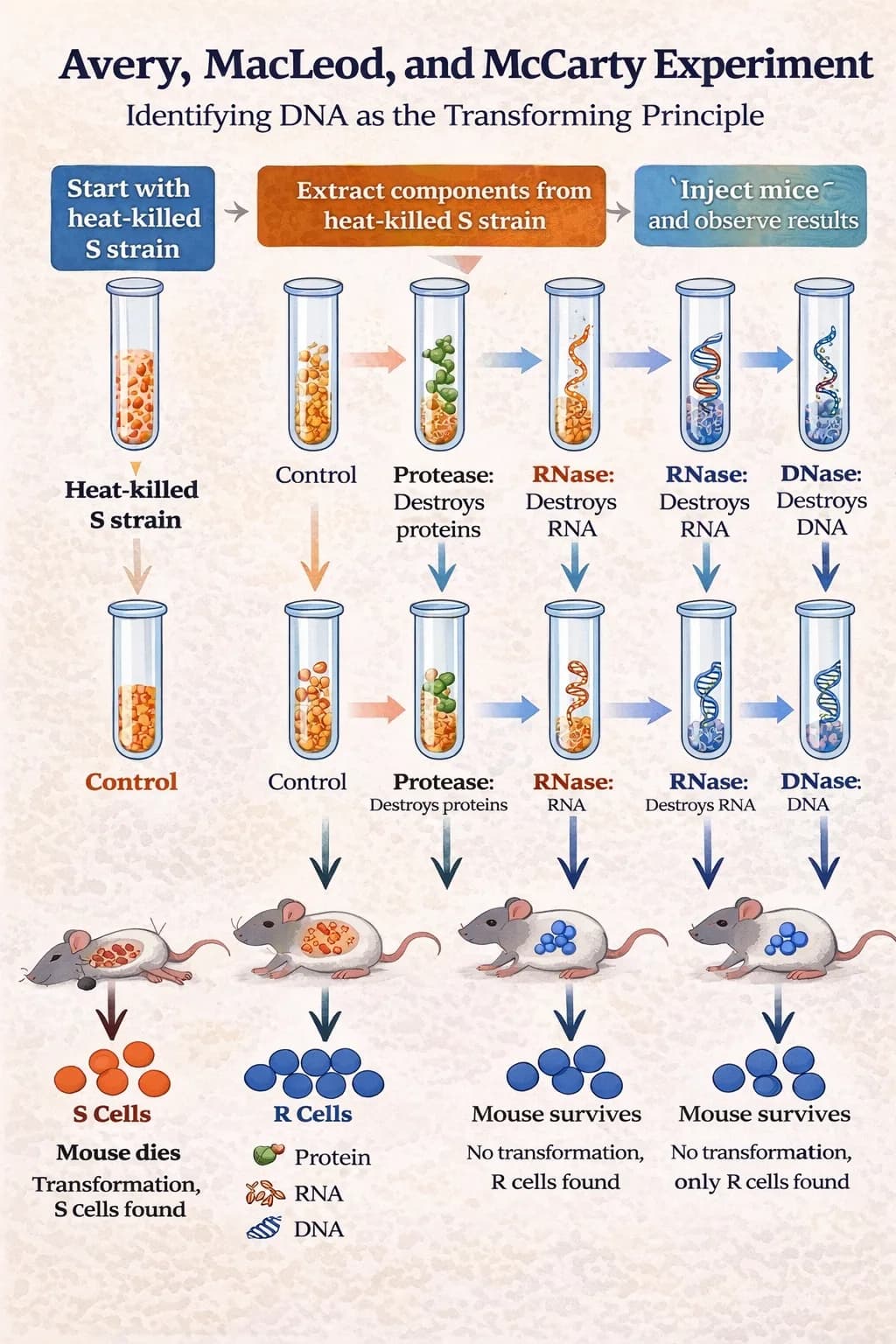
- Avery, MacLeod, McCarty
- Used lots of heat killed virulent bacteria
- If enzyme used to degrade DNA used, bacteria not transformed
- So transforming substance must be DNA
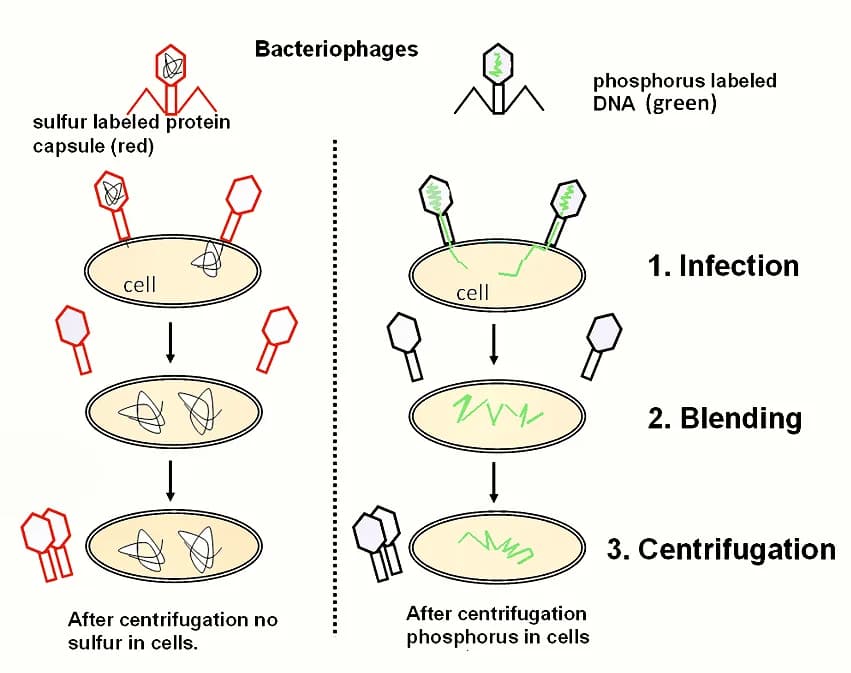
- Hershey and Chase
- Made bacteriophages with radiolabeled DNA and protein
- One had radioactive sulfur, in proteins but not DNA
- Other had radioactive phosphorus, DNA not in protein
- Radiolabeled DNA had entered cells
12.2 Changes in the Gene Pool
This section defines the gene pool and how mutations, gene flow, and genetic drift change allele frequencies. It covers mutation types at nucleotide and chromosomal levels and how population size effects (founder/bottleneck/inbreeding) reduce diversity.
- All alleles that exist is the gene pool
- Mutations
- Change DNA sequence, results in different allel
- Substances that cause mutations are mutagens
- Transposons can insert and remove themselves from genome
- If insertion into middle of coding sequence, disrupt gene
- Nucleotide level
- Silent = no effect, due to wobble pairing
- Missense = change AA
- Nonsense = stop codon
- Frameshift = messes everything up
- Insertion/deletion
- Chromosomal mutations
- Deletion of part of chromosome
- Duplication of part, makes it longer
- Inversion, segment is reversed
- Insertion puts one part of one into another
- Translocation = DNA from one chromosome swapped with segment from another
- Can lead to genetic abnormalities, like trisomy
- Consequences of mutations
- Advantageous can help you, like sickle cell anemia
- Deleterious is bad, xeroderma pigmentosum (XP), can't repair UV damage = cancer
- Inborn errors of metabolism
- Require early intervention to fix, metabolism is incorrect
- Can supplement with diet
- Leakage
- Flow of genes between species
- Can make hybrid offspring if different but closely related species
- Hybrid can't reproduce because odd number of chromosomes
- Like mule
- Sometimes can reproduce with both parent types
- Beefalo can breed with cattle or bison
- Genetic drift
- Founder effect is extreme case where small population is isolated from rest
- Bottlenecks reduce size population available for breeding
- Inbreeding can occur, encourages homozygosity
- Cause reduction in genetic diversity
- Why small communities have inbreeding
- Inbreeding depression
12.3 Analytical Approaches in Genetics
This section focuses on tools for predicting and analyzing inheritance, including Punnett squares, monohybrid/dihybrid/test crosses, and sex-linked patterns. It also covers gene mapping by recombination frequency and Hardy–Weinberg equilibrium math.
- Biometric techniques (quantitative approaches to studying data, have been developed)
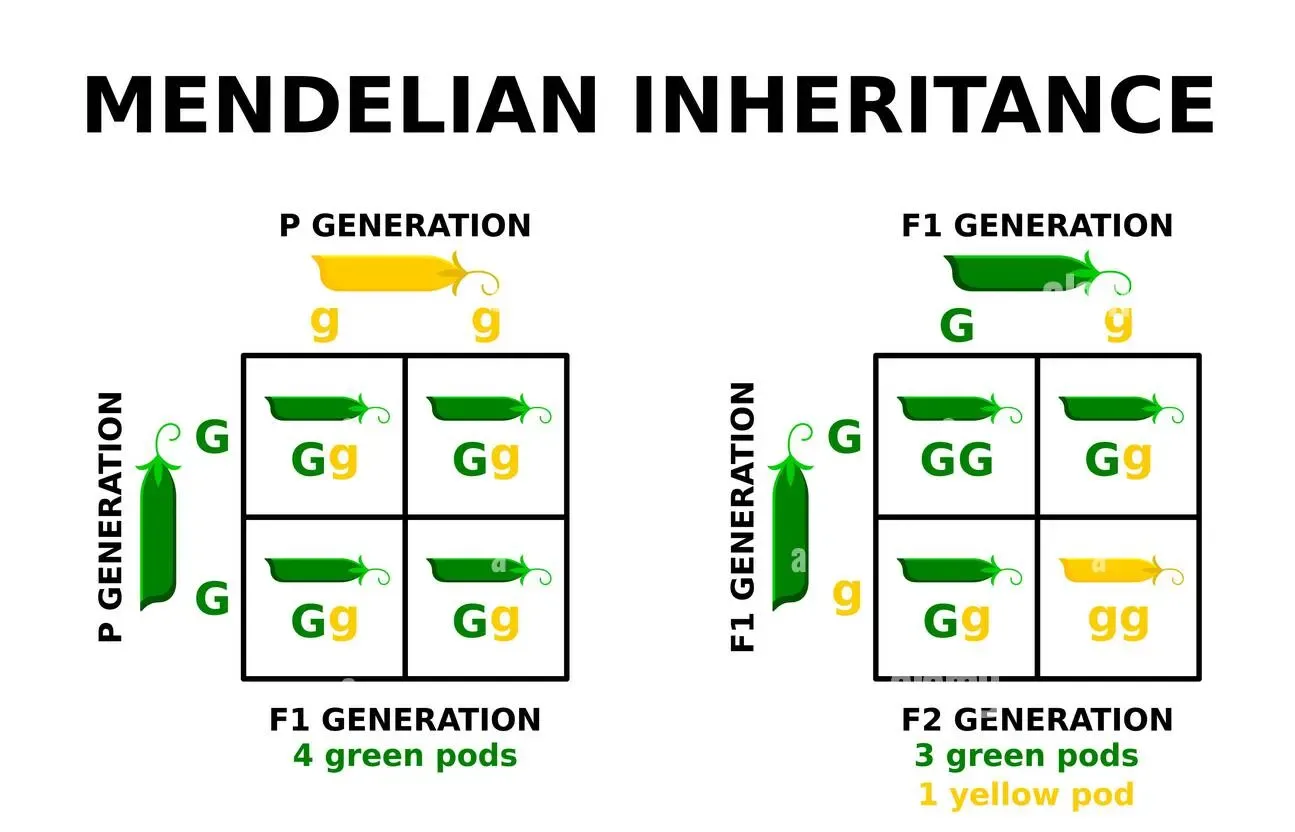
- Punnet squares
- Diagrams to predict alleles
- Monohybrid cross
- When only one trait is being studied
- P generation is crossed, filial or F generation is offspring
- Can go to F2
- Mendel's pea plants
- Can make , or ratios
- Only expected ratio, not always true
- More offspring will be closer to ratio
- Test cross
- If unknown genotype
- Crossed with homozygous recessive
- If all dominant, than XX
- If half dominant, than Xx
- Sometimes called back crosses, since moving backwards
- Dihybrid cross
- Punnet square for multiple unlinked traits
- Still ratio, but between traits
- Sex linked crosses
- Sex linked traits can be carried on X or Y chromosome
- Man with sex linked trait will pass down to daughters, never son
- Women with trait will pass down to son
- Gene mapping
- Further apart genes are, more likely point of crossing over between them (chiasma)
- Recombination frequency is likelihood that they are separated from each other
- Proportional to distance between genes
- Tightly linked genes have recombination frequencies close to
- Weakly linked genes approaching
- Genetic map shows relative distance
- Map unit or centimorgan represents chance of recombination
- So if mp apart, of total gametes have recombination
- Hardy Weinberg principle
- Allele frequency is how often it appears
- Doesn't tell us who has allele or homo/hetero, only allele type
- criteria
- Large population (no genetic drift)
- No mutations
- Random mating
- No migration of individuals
- Genes in population are equally successful at being reproduced
- Can do math
- Allele frequencies will be unchanged
12.4 Evolution
This section describes how natural selection and modern evolutionary theory explain changing allele frequencies over time. It covers selection modes, speciation barriers, and evolutionary patterns like divergent/convergent evolution plus molecular clocks.
- Natural selection
- Survival of the fittest, traits can help one survive and reproduce
- Tenets
- Organisms produce few offspring, not all survive to maturity
- Chance variations may be heritable, could be favorable
- Individuals with greater preponderance more likely to survive, more fitness
- Modern theories
- Modern synthesis model (Neo-Darwinism) = when mutation or recombination results in favorable change, change is more likely to pass on
- Opposite is also true
- Differential reproduction, overtime traits passed by more successful organisms become ubiquitous
- Inclusive fitness is organisms success in population
- Based on # of offspring, success in supporting offspring, ability of offspring to support others
- Supports existence of altruism, protect offspring of group at large
- Ensures can get passed down to future generations
- Punctuated equilibrium, changes occur in rapid bursts rather than over time
- Modes of natural selection
- Stabilizing = keeps phenotypes in certain range
- Human birth weight, can't be too low or too heavy
- Directional selection = extreme phenotype
- Bacteria is advantageous to be resistant to antibiotics
- Mosquito resistance to DDT
- Disruptive selection = extreme phenotypes over norm
- Galapagos finches, all had large or small beaks but not intermediate
- Facilitated by polymorphisms, naturally occurring differences
- Adaptive radiation, allows various species to occupy different niche
- Niche is specific environment
- Stabilizing = keeps phenotypes in certain range
- Speciation
- Species is largest group of organisms capable of breeding to form fertile offspring
- Formation of new species is speciation
- If enough time passed between separation of species, can lead to isolation
- Isolation is when progeny can't interbreed, so separate species
- Prezygotic mechanisms = can't form zygote completely
- Breeding at different times, living in different places, lack of attraction
- Postzygotic mechanisms = gamete fusion, non fertile or steril offspring
- Zygote doesn't form, like mule
- Patterns of evolution
- Divergent = development of different characteristics from common ancestor
- Seals and cats in same order, but different
- Parallel = species evolve in similar ways for a long tie
- Convergent = independent development of similar characteristics
- Fish and dolphins, even though they are different
- Divergent = development of different characteristics from common ancestor
- Measuring evolutionary time
- Slow process, change may not occur if well adapted
- If environment changes, evolution will be greater
- Compare DNA to quantify
- Chimps share % of DNA with humans, mice share %
- More taxonomically different = proportion of shared genome decreases
- Molecular clock model
Spotted something wrong or unclear? Tell us — these notes are revised continuously.