
MCAT Biology · Lesson 10
Homeostasis
6 min read2 sectionsUpdated
Jump to a section2
2 sections
10.1 Excretory System
This section covers kidney anatomy and nephron function (filtration, secretion, reabsorption), then connects nephron segments to osmoregulation, blood pressure control (RAAS/ADH), and acid-base balance.
- Regulation of blood pressure, blood osmolarity, acid base
- Anatomy
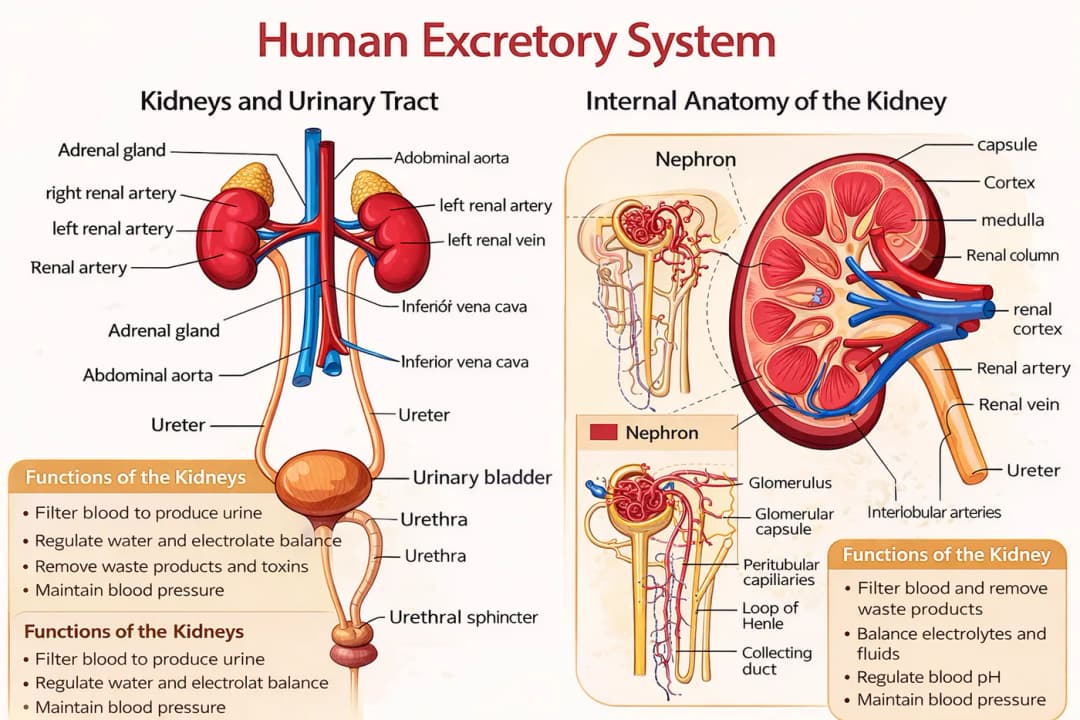
- Kidneys are at level of bottom rib, has nephrons
- Nephrons empty into renal pelvis, forms ureter
- Urine travels through ureter to bladder
- Urine transported through urethra to exit body
- Kidney structure
- Cortex outermost layer, medulla innermost
- Renal hilum is deep slit in center of medial surface
- Renal pelvis is widest part of ureter, spans enter width of hilum
- Renal artery, vein, ureter enter and exit through hilum
- Portal system
- Portal system has capillary beds where blood travels through
- Renal artery branches out, enters afferent arterioles
- Passes through glomerulus, goes to efferent arterioles
- Capillaries surround the loop of Henle, vasa recta
- Other portal systems are hypophyseal (anterior pituitary) and hepatic (gut tube and liver)
- Glomerulus + Bowman’s capsule
- Glomerulus has Bowman's capsule, with long tubule
- Ability to excrete waste linked to structure
- Bladder structure
- Bladder has muscular lining that is detrusor muscle
- Contracts with parasymp, urine passes through sphincters
- Contrast when full bladder activates stretch receptors
- Internal urethral sphincter has smooth muscle, normally contracted
- Involuntary because smooth muscle
- External sphincter has skeletal muscle, voluntary
- Micturition reflex: detrusor muscle contracts and internal sphincter relaxes
- Can usually urinate or stop if they want to
- Contraction of abdominals increase pressure, flow rate
- Bladder has muscular lining that is detrusor muscle
- Osmoregulation
- Kidney filters blood to make urine, type determined by state of body
- Filtration
- Nephrons first function, of blood gets filtered as fluid into Bowman's capsule
- Movement governed by Starling forces
- Positive filtrate due to glomerular hydrostatic pressure
- If ureter blocked (kidney stone), filtration might not occur due to excess hydrostatic pressure in Bowman's space
- Kidneys filter L/day, blood volume
- Secretion
- Nephrons secrete salt, acid, base, urea depending on intake
- Heavy meat = lots of N = ammonia = urea
- Also how you excrete waste that are too large to pass through
- Reabsorption
- Some compounds that are filtered or secreted may be taken back up
- Glucose, AA, vitamins always reabsorbed
- ADH affects water
- Proteins should not pass through glomerulus
- Nephron function
- Keep what body needs and lose what it doesn't, more concentrated urine to conserve water
- Proximal convoluted tubule (PCT)
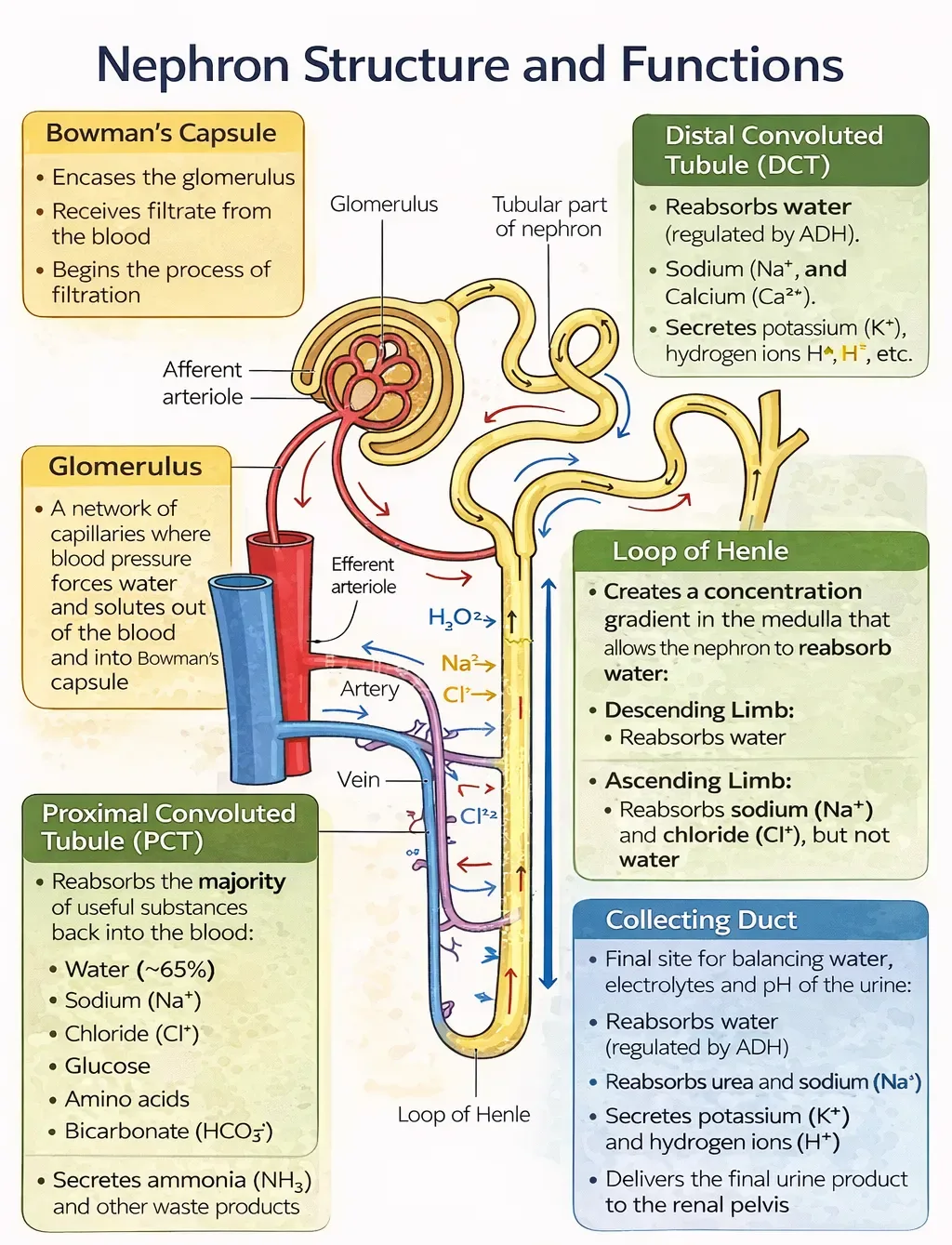
- Where AA, glucose, vitamins, and majority of salts are reabsorbed
- of filtered Na reabsorbed, filtrate is isotonic
- Interstitium = connective tissue that surrounds nephron
- Solutes that enter picked up by vasa recta to be returned to blood
- Secretion for waste products
- H⁺ ions, K⁺ ions, ammonia, urea
- Dump the HUNK
- Loop of Henle
- Filtrate enters DLoH, dives into medulla before ALoH
- Descending limb (DLoH)
- Only permeable to water
- Increasing osmolarity as going deeper into it
- Favors outflow of water from limb → reabsorbed into vasa recta
- Normally osmolarity of cortex is same as blood
- Deeper in medulla, osmolarity can be isotonic to []ed (trying to conserve)
- If more concentrated, water moves out
- Countercurrent multiplier system
- Flow of filtrate through LoH is opposite of blood flow from vasa recta
- If same direction, would reach equilibrium and kidney couldn't absorb as much
- So filtrate always exposed to hypertonic blood → maximal water reabsorption
- Ascending limb (ALoH)
- Permeable to salts, but not water
- Maximizes salt reabsorption by decreasing medullary osmolarity
- Diluting segment (thick ALoH)
- Cells lining tube are larger, more mitochondria → reabsorption of Na and Cl by active transport
- Filtrate is hypotonic compared to interstitium
- Urine is more dilute than blood in this portion
- In overhydration, can eliminate excess water
- In LoH large volume of filtrate reduced, so net reabsorption of water
- Distal convoluted tubule (DCT)
- Responds to aldosterone, promoting Na reabsorption
- Water follows solute → concentrating urine and decreasing volume
- Reabsorbs salts, secretes K, H, ammonia, urea (like PCT)
- Collecting duct (CD)
- Final [urine] depends on permeability of collecting duct, responsive to aldosterone and ADH
- Can vary permeability
- Permeability increases → more water reabsorption → more []ed
- Anything not reabsorbed by end of CD will be excreted
- Filtrate collects in renal pelvis → ureter → bladder
- Functions of excretory system
- Blood pressure
- Aldosterone secreted in response to decreased blood pressure
- First renin from juxtaglomerular cells
- Cleaves angiotensinogen → angiotensin I
- ACE = angiotensin II
- Angiotensin II promotes aldosterone release
- Alters ability of DCT and CD to reabsorb Na
- If reabsorb more Na, reabsorb more water too → ↑ blood volume
- Increases K⁺ and H⁺ excretion
- ADH released by posterior pituitary, alters permeability of CD
- Making it leaky → more reabsorption
- Alcohol and caffeine inhibit ADH → frequent excretion of dilute urine
- Also can constrict afferent or efferent arterioles
- Osmoregulation
- Sucking pressure that draws water into vasculature
- Oncotic pressure is osmotic pressure from dissolved proteins
- Kidneys control by modulating, filter/excrete particles
- Low osmolarity = excess water excreted (vice versa)
- Acid-Base Balance
- Bicarbonate buffer regulates blood pH
- Kidneys can increase or decrease secretion of H ions or bicarb
- Low pH → more H excretion, reabsorption of bicarb
- Vice versa
- Blood pressure
10.2 Skin
This section outlines skin layers (epidermis/dermis/hypodermis), major cell types and immune roles, sensory receptors, and thermoregulation mechanisms like sweating, vasodilation/constriction, and shivering/brown fat.
- Skin (integument) is largest organ in bodies, of weight
- Structure
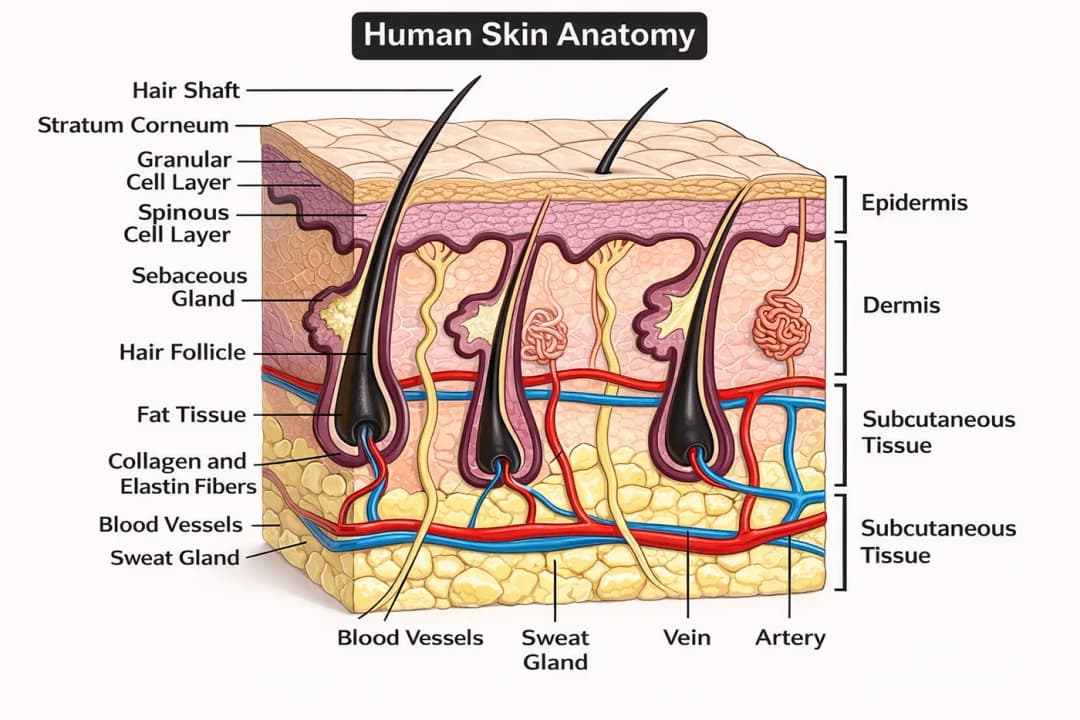
- Epidermis
- Divided into layers called strata
- Stratum basale
- Stem cells, proliferation of keratinocytes = keratin
- Predominant cells
- Stratum spinosa
- Where cells become connected
- Site of Langerhans cells
- Stratum granulosum
- Keratinocytes die, lose their nuclei
- Stratum lucidum
- Present in thick, hairless skin (sole or palms), transparent
- Stratum corneum
- Layers of keratinocytes
- Barrier from pathogens
- Other
- Main cells are keratinocytes, resistant to damage and protects against stuff
- Calluses from excessive keratin deposition in areas of strain
- Fingernails and hair also formed from keratin
- Melanocytes from neural crest cells, making melanin (pigment)
- Humans have same amount, color from varying activity
- Exposure to UV light increases activity = tan
- Albinism means can't make melanin
- Vitiligo = autoimmune disorder, attack melanocytes
- Langerhans cells = macrophages in stratum
- Make antigens to T cells to activate immune system
- Mnemonic (superficial to deep)
- Come Let's Get Sun Burned
- Dermis
- Multiple layers
- Papillary layer (upper)
- Loose connective tissue
- Reticular layer (below)
- Where sweat glands, blood vessels, hair follicles originate
- Sensory receptor cells like
- Merkel discs (deep pressure)
- Meissner's = light touch
- Ruffini endings = stretch
- Pacinian corpuscles = deep pressure and vibration
- Hypodermis
- Layer of connective tissue connecting skin to rest of body
- Contains fat and fibrous tissue
- Epidermis
- Thermoregulation
- Sweating is cooling mechanism
- Symp use ACh to innervate sweat glands
- Promote secretion of water with ions
- Evaporation of water absorbs body heat
- Arteriolar vasodilation to maximize heat loss
- Arrector pili muscles contract in cold
- Traps heated air near skin
- Arterioles constrict, limiting blood near skin
- Shivering requires ATP, but converts it into thermal energy
- Brown fat has less efficient ETC, so more energy released as heat
- Skin maintains osmolarity, impermeable to water
- Sweating is cooling mechanism
Spotted something wrong or unclear? Tell us — these notes are revised continuously.